



The Ethereum Foundation locked up $46 million worth of ETH for staking protocols. Despite the foundation staking this massive amount of Ethereum, the ETH prices are still consolidating. This news comes just a few days after the Ethereum Foundation sold 5,000 ETH to Tom Lee, the founder of Fundstrat.
Since February, Ethereum has been consolidating inside a tight range between $2,000 and $2,100. This consolidation phase comes after Ethereum continued to fall straight for more than 18 months. During a consolidation phase, the price of Ethereum moves sideways within a defined range as the market takes a pause after a strong move.
This period reflects a balance between buyers and sellers, where early investors may be taking profits while others are quietly accumulating positions. Volatility typically decreases, and clear support and resistance levels begin to form as liquidity builds on both sides of the market.
Rather than signaling weakness, consolidation often represents a reset phase where the market digests previous gains or losses and waits for a new catalyst. It is important because it frequently precedes a significant move, either continuing the previous trend if demand strengthens or reversing if selling pressure takes control.
However, this consolidation phase comes even as the Ethereum Foundation locked up about $46 million worth of Ethereum for staking. This treasury optimization strategy signals a clear evolution in how institutions approach digital asset management. Instead of leaving ETH reserves idle, the foundation is actively deploying them to generate yield, turning a passive holding into a productive asset.
By staking 22,500 ETH or $46 million worth of Ethereum, it can earn roughly 3.2% annually under current network conditions, translating to about $1.47 million in yearly income at prevailing prices. Beyond the immediate returns, this approach reflects a broader shift toward capital efficiency, where on-chain assets are managed more like traditional financial portfolios—balancing risk, yield, and liquidity.
It also aligns the foundation more closely with the Ethereum network itself, as staking contributes to network security while reinforcing long-term conviction. As more institutions adopt similar strategies, idle crypto treasuries are increasingly becoming yield-generating engines, adding a new layer of sustainability and financial discipline to the digital asset ecosystem.
But despite so much supply being locked up, the prices are consolidating, as the Ethereum Foundation is also selling some ETH. In recent time, the foundation sold about 5,000 ETH to Tom Lee.
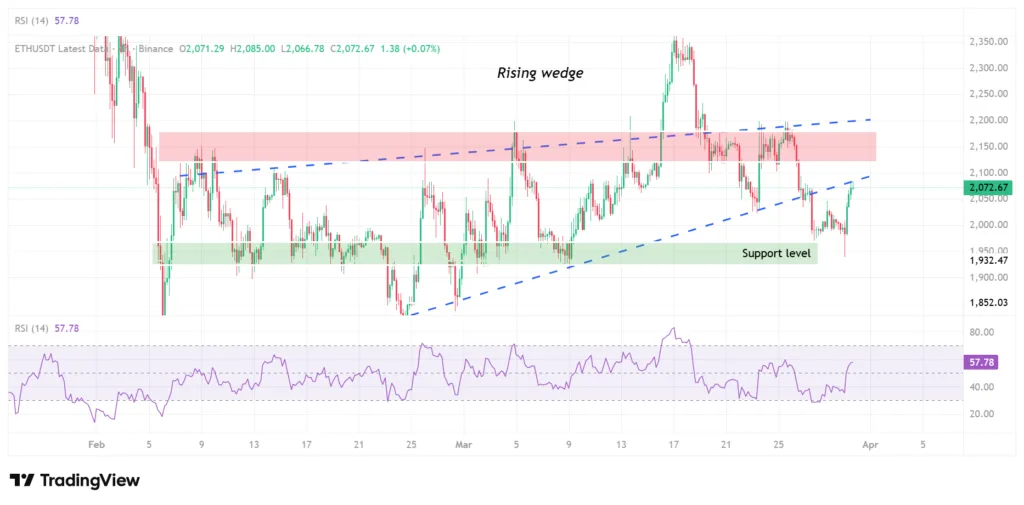
Meanwhile, the Ethereum prices are trading inside a rising wedge on the 4-hour chart. A rising wedge is a bearish chart pattern where price moves upward, but the momentum behind that move is steadily weakening. Inside the wedge, both higher highs and higher lows are still being formed, but the range between them keeps tightening—meaning each push up is weaker than the last.
This usually reflects a shift in control: buyers are still pushing price higher, but with less conviction, while sellers are gradually stepping in at lower and lower levels. Volume often declines during this phase, signaling fading demand.
As of the time of writing, ETH is once again trying to get back above the lower trendline of the rising wedge. Priced just above $2,000, ETH is building on bullish momentum as the RSI indicator is making higher lows.