


The number of whale wallets holding Chainlink (LINK) has grown from 100 to 125 within the past year. The current bearish market conditions do not reflect the correlation between price and whale activity. However, once the market conditions clear, this growth is a sign that retailers need to look for.
Despite the bearish market conditions, Chainlink (LINK) wallets that hold 1 million or more LINK tokens have increased from 100 to 125 wallets over the past year. Although the increase is minor and the prices have remained stable despite the whale’s buying frenzy, it is an important signal that the traders need to check before entering the market.
Usually when the whale activity increases in the market, especially when the wallets holding a million LINK go up, the prices react. However, the broader landscape of the market has been bearish, with the geopolitical conditions in the Middle East worsening. This broader bearish sentiment has dwarfed even whale activities like these.
Whales accumulate LINK through thick and thin
When observing the whales’ activity with respect to the LINK prices, there is a clear sign of constant accumulation. The fact that whales have been buying LINK through both the highs and the lows shows this isn’t reactive — it’s consistent accumulation.
It just goes on to show that they are not trying to time the market and not trying to catch perfect entries. They’re building positions over time, regardless of price, which usually signals conviction rather than short-term speculation.
While most of the market is reacting to price, getting shaken out or waiting for confirmation, whales are doing the opposite — accumulating through volatility and weak sentiment.
Structurally, this is where the markets start to recover. As more supply is absorbed into whale wallets, exchange balances slowly start to tank and the selling pressure eases, while the liquidity starts getting controlled by a smaller group of large players.
This is where it becomes interesting for traders. When the market flips and sentiment turns, these are the assets that tend to move first. There’s simply less supply available, whales are already positioned, and any new demand coming in has no choice but to chase price higher.
It’s not just the whales who are accumulating LINK, but even the midsized buyers are also accumulating LINK. Just about a week ago, Santiment tweeted that wallets holding at least 1000 Chainlink tokens have increased to 25. 4K, the highest amount since December.
LINK could go past $10 when it breaks out
Despite all these activities, LINK prices have been moving very lethargically within a tight range. Technically speaking, LINK prices have been trading inside the symmetrical triangle.
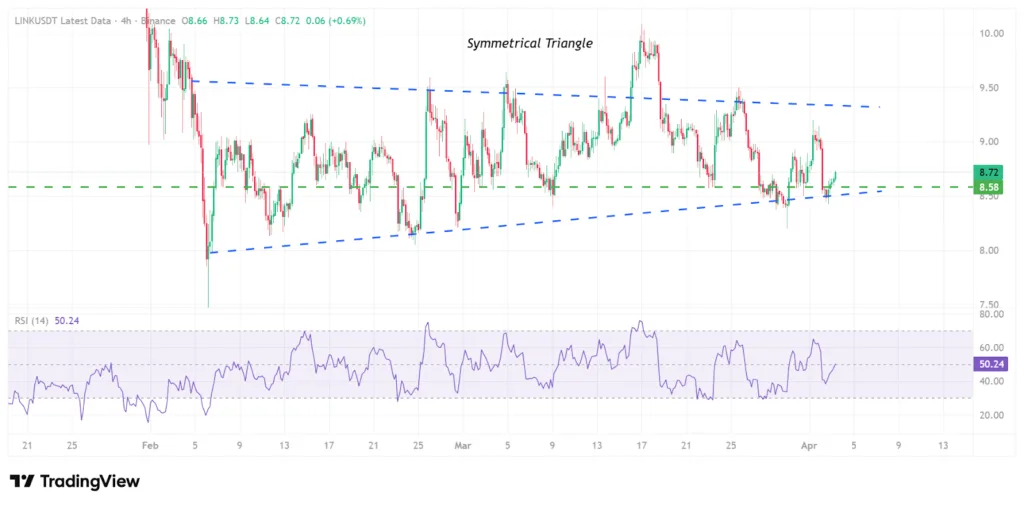
Inside a symmetrical triangle, traders get more cautious with price compressing between lower highs and higher lows and volatility drains. During the early days of formation, some traders try to play the range where they sell near resistance and buy near support.
However, as the structure tightens and the prices constrict, moves get weaker and less reliable. Volatility crashes, volume fades, and conviction on both sides starts to disappear.
At the same time, traders who wait for breakout begin to step back and wait. Instead of guessing the direction, they keep watching for confirmation, as most of the move happens after price escapes the triangle. Shorts become less aggressive, and buyers stop chasing because the risk-to-reward inside the range isn’t lucrative anymore.
So behavior shifts from active trading to patience. The market moves from trend to compression, where liquidity builds on both sides. By the time the price gets close to the apex, most traders are just waiting for the breakout—because that’s where the real move usually starts.
Usually a breakout from a symmetrical triangle produces a spike that is equivalent to the height of the triangle at its widest part. Given that LINK produces this spike and breaks out accordingly, there is a high chance that it could go well past the $10 level.