


The crypto market is starting to show signs of life again – but it’s not a full comeback just yet. Latest market data confirms this thesis.
Traders are stepping back in, but with caution
Over the past couple of days, traders have clearly begun re-entering the market. Bitcoin exchange flows have flipped positive, with netflows moving from a -1,275 BTC outflow to consecutive inflows of +682 BTC and +428 BTC.
On the surface, that suggests more coins are being moved onto exchanges, often a sign that short-term selling pressure could be building.
At the same time, activity in the derivatives market is picking up. Open interest has climbed steadily from $21.22 billion to $22.60 billion over three days, indicating that traders are rebuilding positions after a period of caution. Normally, a rise like this might hint at growing confidence – but the rest of the data tells a more complicated story.
Funding rates, for instance, have turned negative and stayed there for two straight days. That shift suggests the market isn’t leaning heavily bullish.
Instead, it points to a much more cautious environment, where traders are either hedging or positioning slightly short. It’s not the form of high leverage that the market typically sees during times of strong uptrends.
Liquidity is still missing in action
And then there’s liquidity—or the lack of it. Despite the rise in positioning, the broader flow of capital into the market hasn’t recovered in a significant manner.
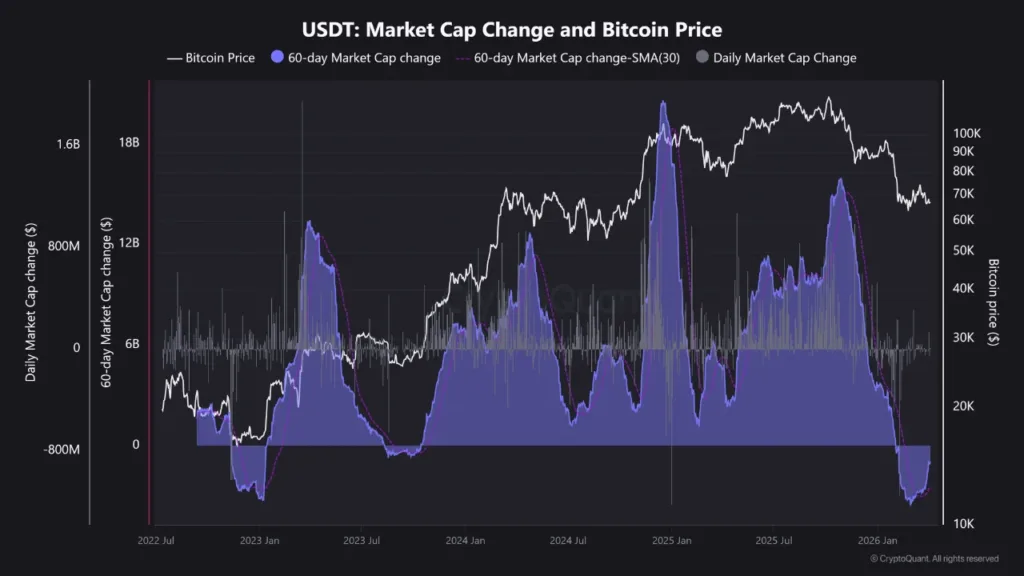
The 60-day change in USDT market cap is still in the red territory, which is a key signal that fresh money isn’t really coming in. Without that, any change in price tends to feel less certain and more fragile.
When all this is put together, it creates a market that feels active, but not fully supported. While the traders are returning and leverage is rebuilding, the fuel needed to sustain a strong move just isn’t there yet.
That’s why the current environment looks more balanced than directional. There’s a case for a short-term bounce, especially with positioning increasing, but there’s also a clear risk that any upside could stall without stronger liquidity behind it. On the flip side, rising exchange inflows mean downside pressure hasn’t gone away either.
Right now, the market sits somewhere in the middle. It’s not clearly bullish, not outright bearish—just in a holding pattern.
The coming move will heavily depend on what happens next with liquidity. If capital starts flowing back in and funding stabilizes, the upside case strengthens. But if inflows to exchanges continue rising while leverage builds, the risk of a sharper move down becomes harder to ignore.
For now, this looks less like a breakout phase – and more like a market waiting to decide.