



Ether’s (ETH) recent price action is showing only part of the story. Underneath the surface, derivatives data suggests that traders are still sitting with cash, as they are not completely sure about what comes next for the top smart contract coin.
ETH open interest and price fall
A major signal is the steep drop in open interest (OI) during the latest market dip. When both price and OI fall one after another, it points to a wave of liquidations, which means that leveraged traders are being forced out as positions continue to get wiped.
This kind of reset isn’t necessarily a bad thing. In fact, it often leaves the market in a cleaner, less overheated state. But it also tends to drain momentum, at least in the short term.
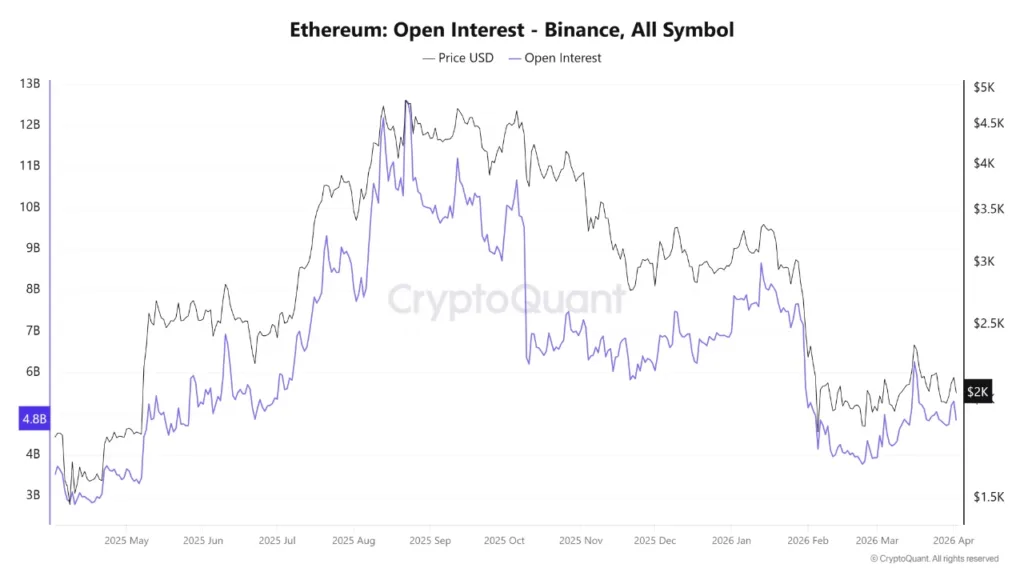
What’s more interesting is what’s happened since. Ethereum’s price has been trying to recover, but open interest hasn’t followed with the same strength. That gap matters. In a strong, confident market, rising prices are typically backed by new positions being opened. Here, that’s not really happening.
Instead, traders – especially those in the futures market – seem hesitant to jump back in. And it’s not hard to see why. Ethereum has been stuck in a tight range for a while now, with price swings that lack follow-through.
Whether you go long or short, there’s a good chance you’ll get caught on the wrong side of a sudden move and stopped out. That kind of environment tends to discourage risk-taking.
There has been a small uptick in open interest after the recent bottom, but it’s modest compared to the earlier drop. In other words, some traders are testing the waters again, but conviction is still low. Fresh capital isn’t flowing in with any real force.
Underlying weakness in ETH market
All of these point to a market that’s stable on the surface but fragile underneath. The leverage flush has reduced risk, but it has also left behind a lack of participation. Price moves, for now, don’t carry the same weight because they aren’t backed by strong positioning.
The bigger question is what happens next. Historically, when Ethereum trades in a prolonged tight range like this, it doesn’t last forever. Eventually, the market picks a direction—and more often than not, that breakout has leaned to the downside.
For now, the key signal to watch isn’t just price, but whether open interest starts to climb alongside it. Until that happens, any recovery may lack staying power, and the market could remain stuck in this cautious, wait-and-see phase.