


Ethereum activity on the Binance crypto exchange has started to feel a bit quiet lately, and the data backs that up. The exchange’s Ethereum liquidity ratio has slipped to around 5.01, its lowest level since early 2026.
A noticeable slowdown in ETH activity
That number might not mean much at first glance, but it essentially reflects how actively ETH is being traded compared to how much is sitting on the exchange. When it drops this low, it usually signals one thing: people just aren’t trading as much.
One of the clearest signs of this slowdown is Ethereum’s 30-day turnover. Over the past month, about 16.65 million ETH has moved through Binance. That’s still a big number—but it’s a step down from the kind of activity seen in 2025, when volumes regularly crossed the 20 to 25 million ETH range.
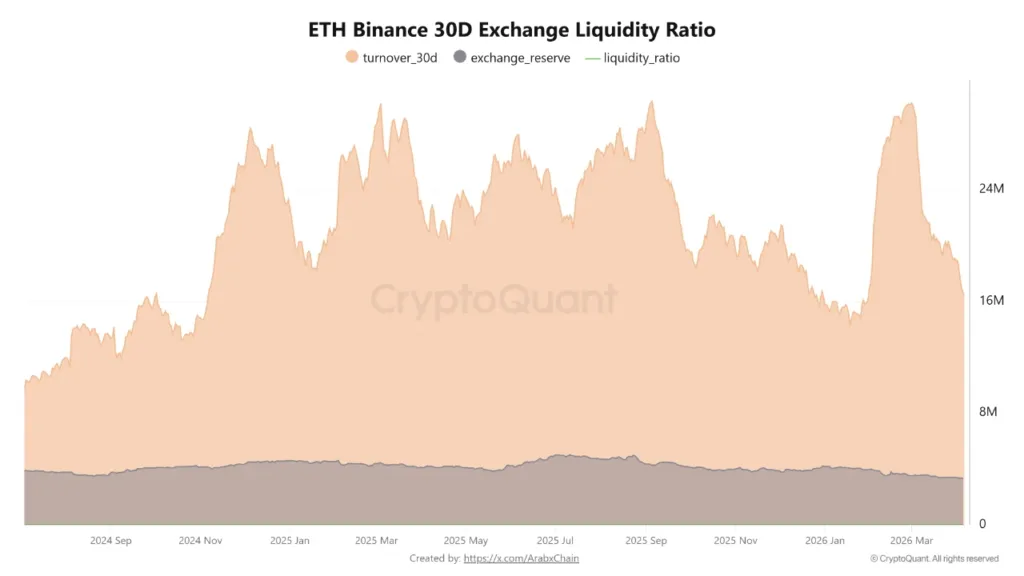
What this really shows is a clear change in behavior. Traders do not appear to be in any rush to be in and out of positions like before.
Instead, many traders seem to be sitting on the sidelines, just waiting for a clearer direction. This behavior isn’t out of the ordinary—especially in a market where momentum feels uncertain.
Further, what really makes this more interesting is that Ethereum reserves on Binance haven’t dropped by a lot.
The crypto exchange still holds around 3.32 million ETH, which has stayed fairly stable. This proves that it’s not like there’s less ETH available—it’s just not being traded as actively.
In simple words, while the supply is there, the action is missing.
Quiet markets don’t stay quiet forever
When liquidity drops but reserves stay steady, it often means the market is in a kind of pause mode. People are holding, watching, and waiting. It can feel uneventful, even a bit dull—but these phases don’t usually last forever.
In fact, low liquidity periods often come right before bigger moves. With fewer trades happening, it takes less pressure to move prices.
So when something finally moves with regard to ETH—whether it’s sentiment, news, or a technical breakout—the reaction can be quick and sharp.
That being said, it can be interpreted in both ways. Lower liquidity can also make the market more fragile. Price swings can become more sudden and less predictable—especially if large trades start hitting thinner order books.
For the time being, Ether’s setup isn’t entirely bullish or bearish – it’s showing more of a “wait and see” situation. The lack of activity shows a little bit of uncertainty, not necessarily weakness.
That being said, one thing is quite clear—markets rarely stay this quiet for long.
As Ethereum’s liquidity on Binance falls near its lowest point this year, the current calm could just be the buildup before the next big move. The only question is which direction it’ll take.