



Ethereum is starting to show one of those on-chain shifts that doesn’t always look exciting at first – but has mattered in past cycles.
After a rough stretch that pushed even large holders into unrealized losses, the picture now looks a bit different, with whale profitability quietly flipping back into positive territory for the first time in months.
Even the biggest Ethereum whales felt the downturn
At the worst point of the correction, whales holding more than 100,000 Ethereum briefly moved into unrealized losses. That’s not something you usually see in strong markets – it’s more typical of deep drawdowns where confidence has already been shaken across the board.
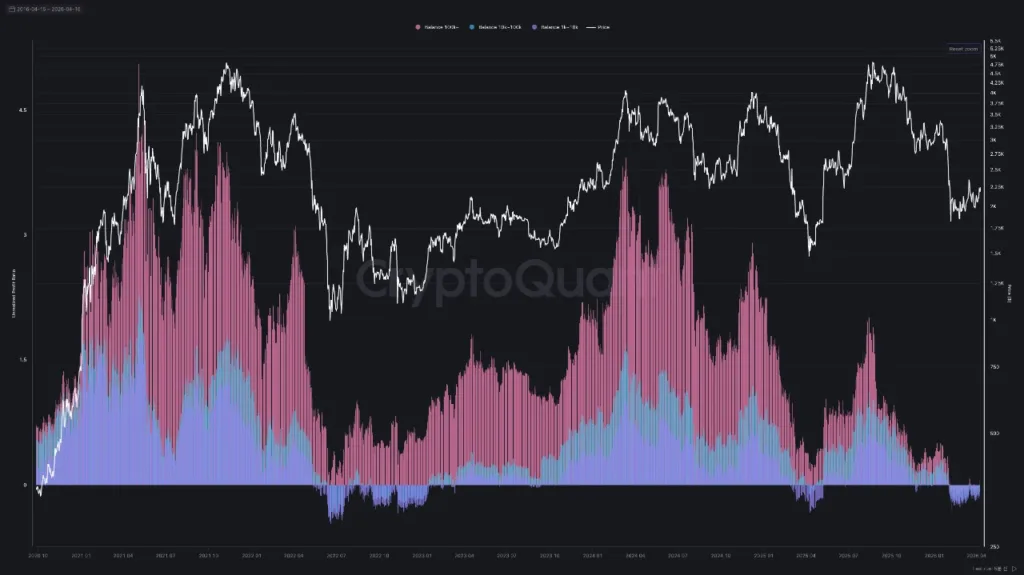
And that’s exactly what the market felt like. Participation faded, momentum dried up, and interest in Ethereum cooled off significantly compared to earlier phases of the cycle.
Now, that pressure has started to ease. Those same whale cohorts are no longer sitting in the red. On paper at least, they’ve moved back into profitability.
A signal that has appeared before
What makes this interesting is not just the shift itself, but where it has shown up historically. In past Ethereum cycles, moments where large holders move from loss back into profit have often lined up with early stages of broader recoveries.
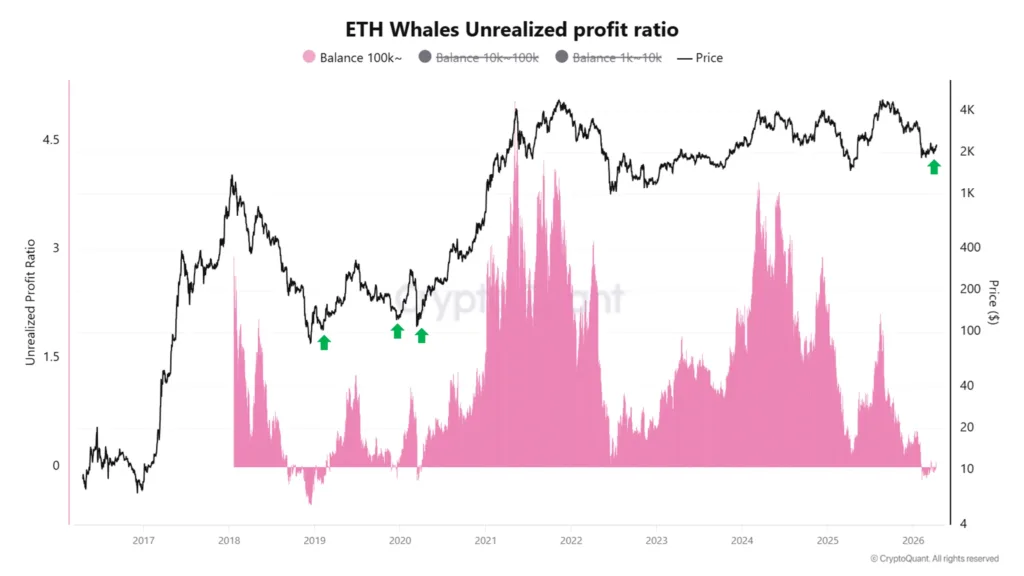
It’s not a perfect timing tool, and it doesn’t mean price immediately takes off. But it does tend to show up when the worst of the forced selling is already behind the market.
The logic is pretty simple. Whales tend to influence structure more than most participants. When they’re underwater, markets usually feel heavy – every rally gets sold into, and upside struggles to stick. When that pressure fades, conditions often start to stabilize.
What changes when whales stop bleeding
The shift from loss to profit doesn’t just matter on paper – it changes behavior. When large holders are deep in the red, there’s often a natural incentive to de-risk on strength. Once they’re back in profit, that pressure eases.
That doesn’t automatically mean aggressive buying kicks in. But it does reduce one layer of overhead supply that tends to weigh on price during corrections.
It also lines up with a broader pattern: when sentiment is still muted, but large holders are no longer under stress, markets often begin transitioning from defensive to more neutral positioning.
It’s worth saying that nothing here suggests a euphoric phase. Participation is still relatively thin compared to stronger cycles, and liquidity conditions can shift quickly in either direction.
But Ethereum rarely turns in loud environments. More often, those shifts begin when things still feel a bit tired – just less fragile than before.