


Ethereum’s market right now feels a bit hard to read, and that’s usually not a great sign. At press time, ETH trades at $2,168.
ETH market caught between caution and activity
There’s a clear sense of caution in the broader market. As geopolitical tensions, and economic uncertainty continue to brew, the majority of investors are still choosing to stay on the sidelines instead of making big moves.
Such kind of hesitation tends to lead to quieter, more uncertain price action. But interestingly, that caution doesn’t seem to apply everywhere.
Speculative traders are still very much active. In fact, activity in Ethereum’s derivatives market remains strong. Open interest has climbed to around 6.4 million ETH – getting close to the previous peak of 7.8 million ETH seen in mid-2025.
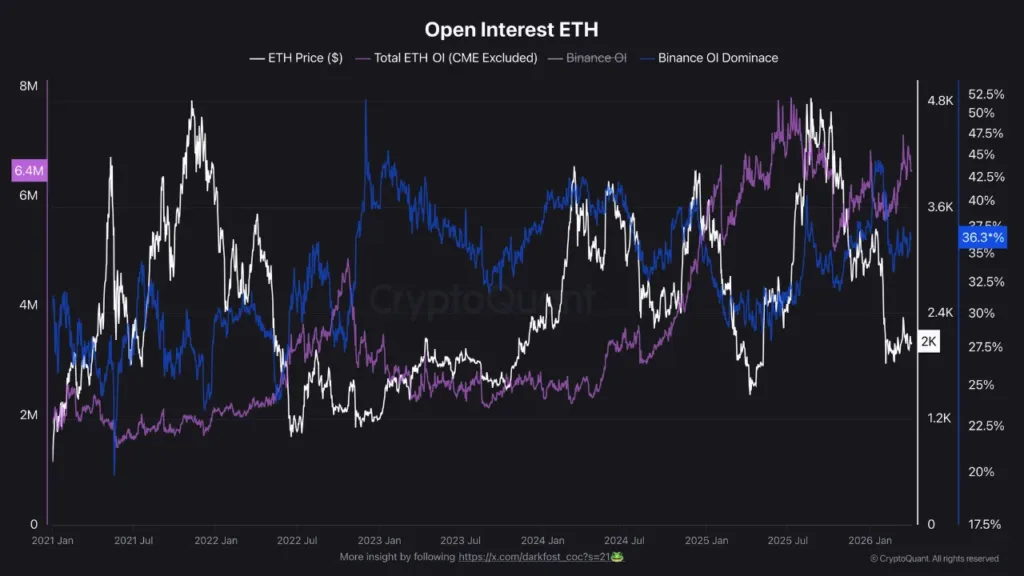
That’s quite a rebound. After dropping to about 5 million ETH in October, open interest has been steadily recovering. It suggests that traders are at least trying to come back, even if they’re not fully confident yet.
A big chunk of that activity is happening on Binance, which alone accounts for about 2.3 million ETH in open interest. That’s roughly 36% of the entire Ethereum derivatives market – showing just how concentrated this activity has become.
ETH futures are taking the lead
One of the most important things to understand right now is how much futures trading is dominating compared to spot. On Binance, the spot-to-futures volume ratio has fallen to just 0.13 – the lowest it’s been this year.
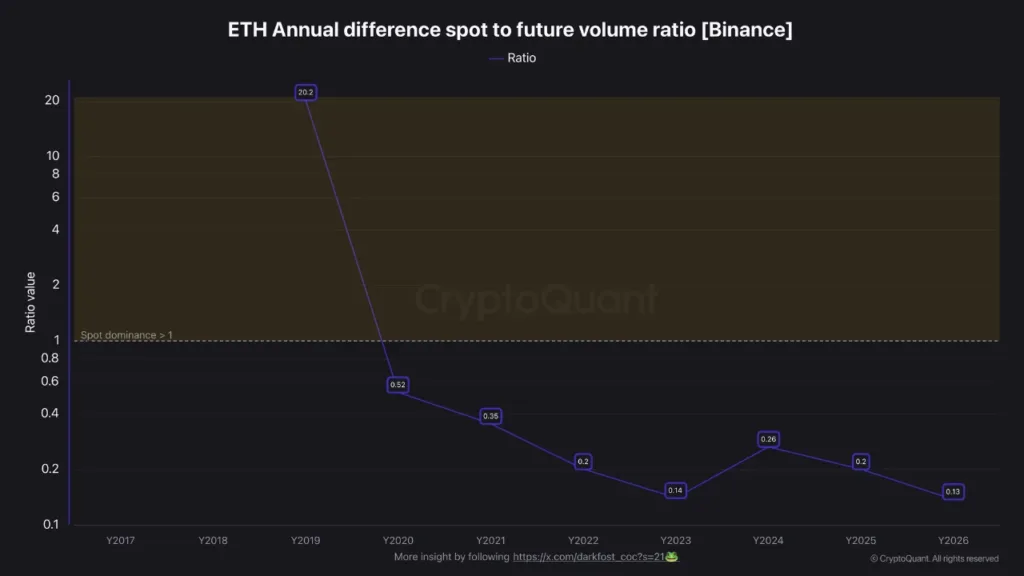
In simple terms, that means futures trading is about seven times larger than spot trading. For every dollar going through the spot market, roughly seven dollars are flowing through futures.
That tells something pretty significant about the market, the fact that the market is being driven more by speculation than by actual buying or selling of ETH.
When futures activity takes over like this, it usually means traders are using leverage to make directional bets rather than investing for the long term. While this can push prices around in a short period of time, it does not always necessarily result in stable or sustained trends.
Further, leverage also tends to bring risk. If prices move in the wrong direction, positions can get liquidated in an instance. These events can trigger a chain reaction and make price swings more extreme.
So while activity is high, the structure underneath isn’t necessarily strong.
For now, Ethereum is sitting in a kind of in-between state. Traders are active, open interest is rising, but the lack of strong spot demand means there’s no clear direction guiding the market.
It feels less like a trend – and more like a buildup. And until spot buyers step in or liquidity improves, price action will likely continue to be driven by speculation rather than conviction.