


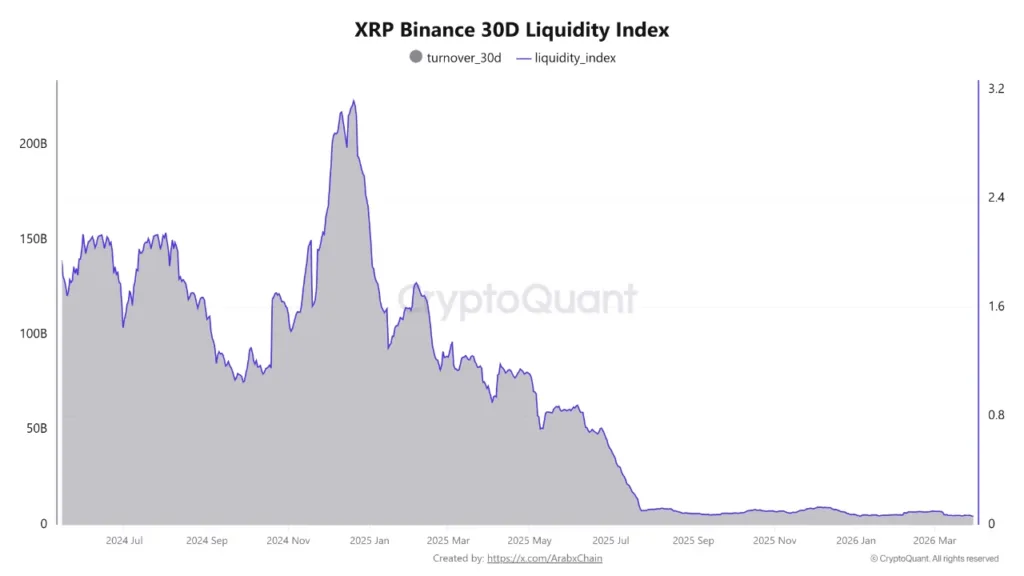
XRP’s market is currently showing signs of a major contraction in liquidity, with the 30-day liquidity index on Binance falling to around 0.062. This comes in the wake of the digital asset being down 2.8% in the past 24 hours.
XRP liquidity gets weak as market depth falls
The decline in XRP’s 30-day liquidity is one of the lowest levels seen in recent periods and highlights a significant reduction in market depth.
For the uninitiated, a lower liquidity index tells them that there are fewer buy and sell orders available at various price levels. This makes the wider market thinner and more sensitive to trading activity.
In cases where liquidity declines, even small trades can have an outsized impact on price. Consequently, there can be higher volatility, as the market does not currently have the depth required to absorb large orders without major price changes.
For XRP, this shows that the cryptocurrency’s price may be more susceptible to weakness. At the same time, the fall in liquidity points to reduced confidence from not only institutional but also retail investors.
Crypto markets usually depend on constant participation to maintain balance, and when that participation weakens, it signals a period of uncertainty among traders.
The current conditions point to XRP being in such a phase, where the market is becoming shallow and responsiveness to trades is already rising.
XRP trading activity drops, hinting at possible accumulation phase
In addition to the drop in liquidity, XRP’s 30-day turnover index has fallen to approximately $4.46 billion—confirming slowing trading activity.
To further explain this phenomenon, the turnover index measures the total value of assets traded over a set period. A decrease in this parameter suggests that fewer traders are in the market.
This combination of low liquidity and reduced turnover points to weaker market participation. As both buy and sell pressure continue to fall, XRP looks to be in a phase of stagnation. In such cases, price movements may remain very limited due to a lack of strong directional factors.
That being said, such conditions are quite common in the broader market cycle. Periods of low activity can sometimes hint toward accumulation. This is where larger market participants continue to build their positions without initiating big price changes.
Such phases also tend to be before more drastic moves once liquidity and trading volume return.
The current phase shown by XRP is a quiet period before volatility. If trading activity rises and liquidity sees even minor improvement, XRP could exhibit sharper price movements as capital flows back into the market.
On the other hand, if low participation persists, the asset may continue to trade within a narrow range or exhibit subdued momentum.
With the digital asset’s liquidity index currently around 0.062 and turnover close to $4.46 billion, the market is obviously in a low-activity phase.
While this suggests a little degree of caution in the short term, it also leaves room for a strong reaction once market conditions slightly improve.