


XRP continues to trade inside a tight range for more than a month, creating a compression phase. Historic data shows that when XRP breaks the resistance of the support level, the prices spike or drop drastically.
Ripple’s XRP has been trading inside a tight range since the first week of February. As the geopolitical conditions in the Middle East turned out to be worse, traders were scrambling to take what profits the market was offering.
Sellers were heavily defending the resistance level at $1.50 while the buyers made sure that the price did not crash below the $1.38 or $1.40 levels. Sellers and buyers virtually even out, so prices move sideways.
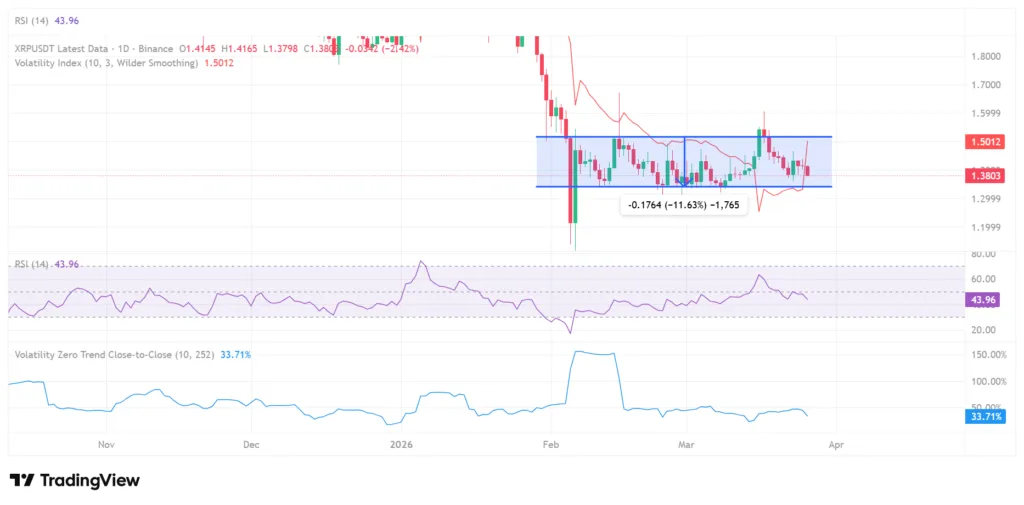
The price fluctuating within a tight range is not a sign of weakness or strength in the market—it’s a pause where traders are evaluating risk and calculating their chances. They are waiting for a clear directional signal from the market before setting a position. The main thing about a consolidation phase is that the longer the range, the more explosive the eventual breakout can be.
RSI shows neutral conditions
Even the relative strength index indicator, which signals if the coin is overvalued or undervalued, shows a neutral condition, with a value of 43 on its scale. The volatility index on the chart shows that the price action has been minimal since February.
The market is eagerly waiting on what is going to happen next after this long period of consolidation. As stated above, the longer the period of consolidation, the higher the range of price fluctuation.
Going by historic data, XRP, which is now at 2024 December levels, had a massive spike, from $1.5 to $3 back in 2024. And a reciprocation of this pattern is not something out of the ordinary.
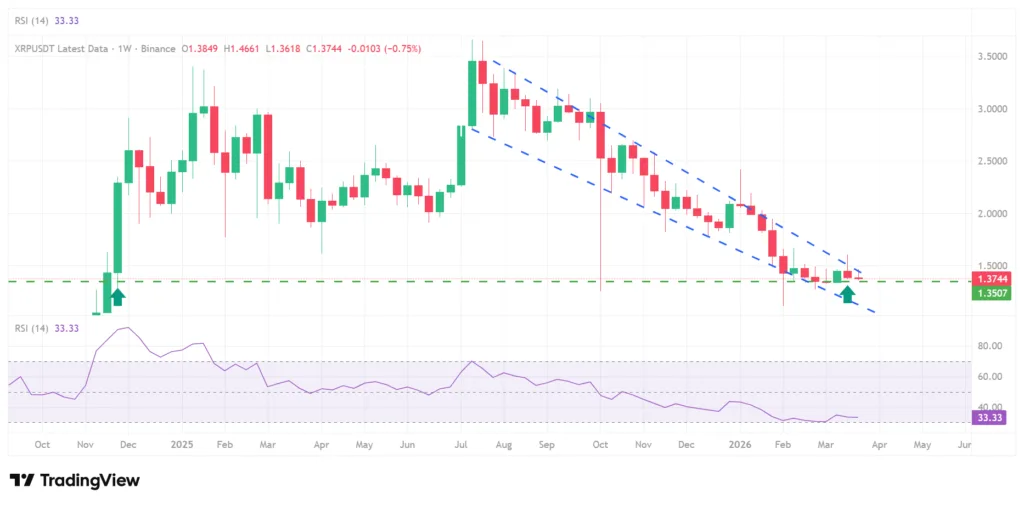
On the technical side of XRP is trading inside a bullish falling wedge.A bullish falling wedge is a technical pattern that is recognized in stock trading. It is a trend reversal pattern that can also be used to predict a continuation of the trend in the upward direction.
It is characterized by a price that is falling while the falling price is slowing down. This results in the formation of two downward-sloping trendlines. The upper resistance line slopes more than the lower support line.
Falling wedge mechanism
During the period in which the falling wedge is formed, the behavior of the traders can be characterized by caution and anticipation. At the beginning of the period, the short-term traders dominate the market and push the price down. However, as time progresses, the purchasing activity around the support line increases. This is due to the fact that smart traders are anticipating the price to rise in the future.
The trading volumes during the period in which the falling wedge is formed are low. This is due to the fact that the traders have already recognized the technical pattern and are waiting for the breakout. This means that the downward trend is losing momentum. The breakout is normally associated with a surge in trading volumes. This is due
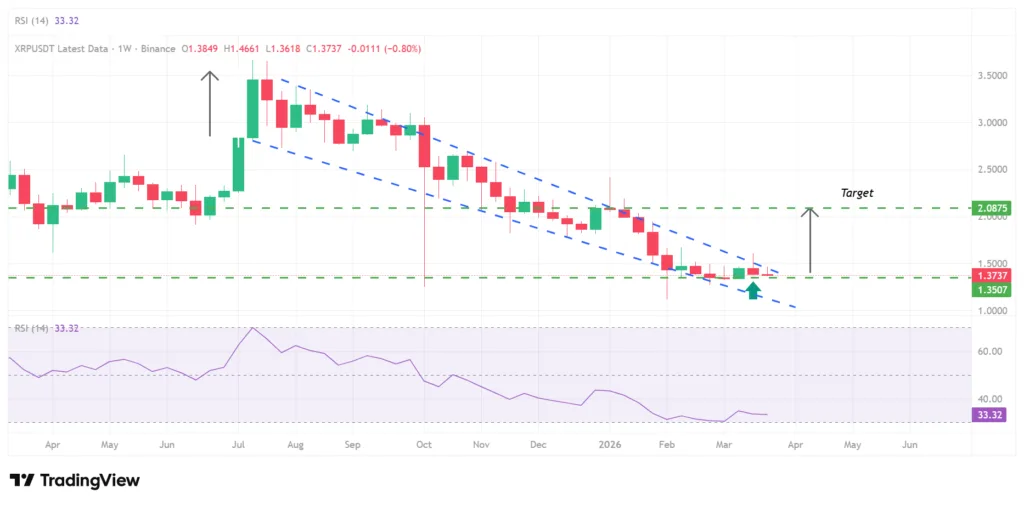
Now that XRP is forming the apex of the pattern, it is high time that it could break out from the wedge and move higher. As the falling wedge pattern breaks out, the price is expected to move by the height of the wedge, which is the widest part of the pattern.
How the falling wedge breaks out and produces a spike
The price is expected to make the measured move, which is the target. The falling wedge pattern works because the price has experienced some level of compression, where the selling pressure has gradually weakened, while the buying pressure has quietly accumulated. The price has the full range of movement, which is the widest part of the pattern.
As the price consolidates, the price movement becomes narrower, with the price building up energy. The price movement is due to the fact that the price has the full range of movement, which is the widest part of the pattern. Once XRP breaks out, it will rise above $2. However, that will just be the beginning of the breakout if XRP follows the December 2024 breakout style.