


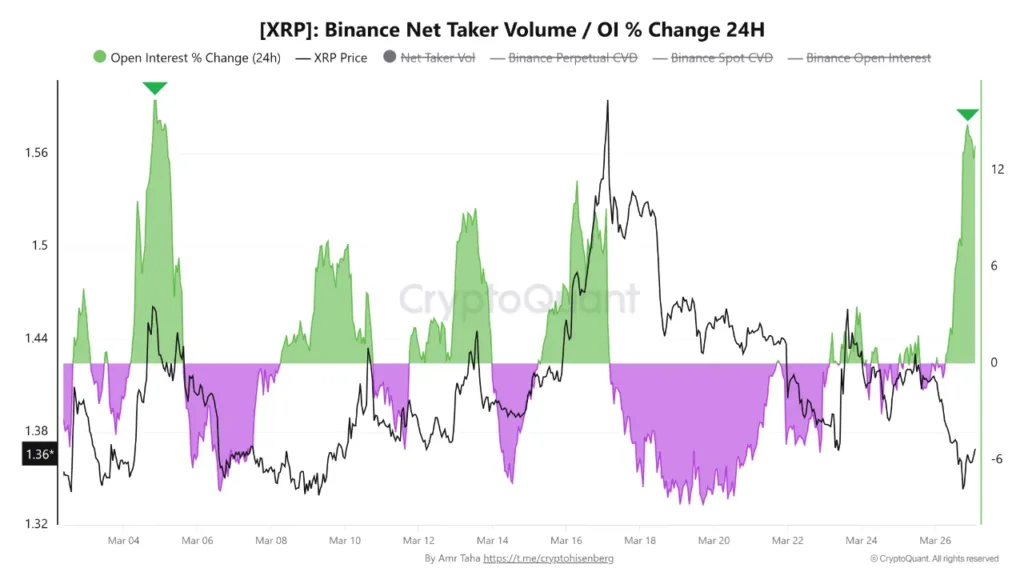
Data from Binance shows a sharp uptick in derivatives activity, with the 24-hour open interest change climbing to 14.8%. That’s the highest level since early March, when the metric briefly touched around 16%.
XRP liquidation data suggests cautious approach
Back then, the spike in positioning coincided with a wave of speculative enthusiasm. This time, the setup feels similar: traders are coming back in size, and they’re doing it with leverage.
Open interest, in simple terms, tracks the total number of outstanding derivative contracts. When it rises quickly, it usually means one thing—more traders are entering the market and putting on positions, often with borrowed capital.
It’s a sign of growing activity, but not necessarily stability. And that distinction matters right now. Because while leverage is clearly returning to XRP, the liquidation data tells a more cautious story.
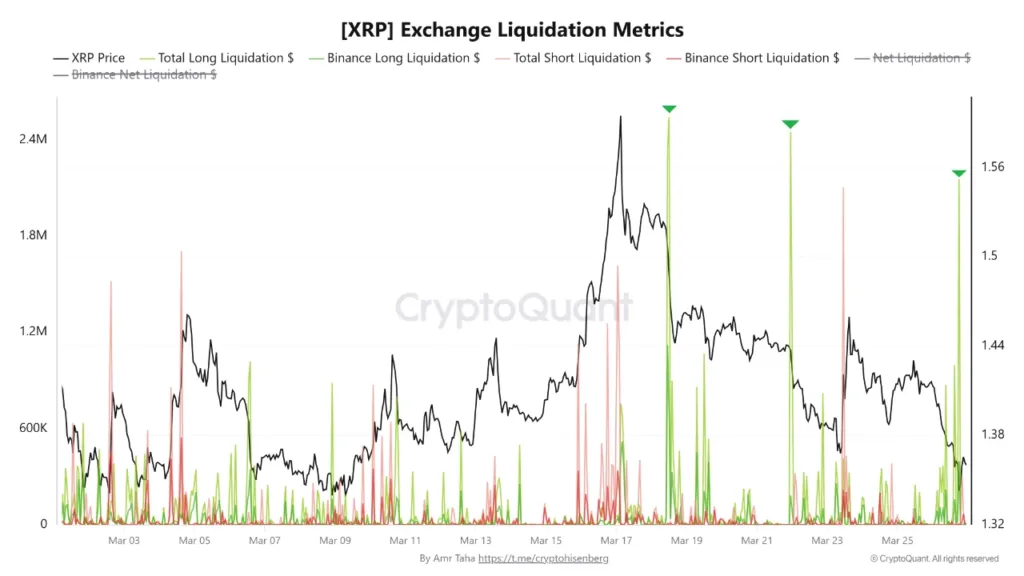
Over the past week, the market has seen a series of sharp long liquidations – moments where bullish traders, mostly overleveraged, are forced out of their positions as prices move against them.
On March 18, more than $2.5 million in long positions were wiped out. Just a few days later, on March 21, another $2.45 million followed. Then again, on March 26, approximately $2.15 million in long positions were liquidated. Three spikes, all within a relatively short window.
Individually, liquidation events aren’t unusual in crypto. But the pattern here is what stands out. Each time leverage builds and traders lean too heavily in one direction, the market pushes back—hard enough to trigger cascading liquidations.
It’s a dynamic that’s played out across crypto cycles before. Rising open interest brings liquidity and momentum, but it also shows rising fragility.
When too many traders get into the same trade, even a small price move can set off a chain reaction. Stops get hit, positions unwind, and what starts as a minor dip can quickly turn into a major flush.
That’s essentially what XRP is showing right now: a market where participation is increasing, but conviction isn’t quite there yet.
There’s a difference between traders entering positions and traders being comfortable holding them. The recent liquidation spikes suggest that many participants are still operating with tight margins and short-term horizons. They’re quick to enter, but just as quick to get forced out. This creates a kind of unstable equilibrium.
XRP currently in transitional phase
The increasing open interest points to renewed interest in XRP as a trading vehicle. That could be led by a range of factors such as broader market sentiment, short-term narratives, or simply the search for volatility.
XRP has always attracted a particular type of trader: one willing to play momentum, often with leverage, in pursuit of quick moves.
On the other hand, the repeated long liquidations show that bullish positioning is getting punished whenever it becomes too crowded. The market isn’t allowing an easy, sustained move higher. Instead, it is shaking out overextended positions before any real continuation can happen.
This push-and-pull dynamic shows up in transitional phases of the market.
After periods of lower activity, traders start to return, bringing leverage with them. At first, the market struggles to absorb that influx smoothly. Positioning becomes uneven, and volatility increases.
You get bursts of optimism followed by sharp corrections—enough to reset the board, but not enough to establish a clear trend. That’s where XRP appears to be sitting right now.
Open interest rising in the market
It’s not a lack of interest—if anything, interest is growing. But it’s not yet the kind of steady, confident positioning that supports a sustained move. In stark contrast, it is very reactive and highly sensitive to short-term price swings. For traders, this environment can be somewhat tricky.
Rapidly rising open interest in the market can be alluring for traders looking to make quick money. It hints at major opportunity for those looking to capitalize on volatility.
But when that rise is paired with frequent market liquidations, it means the margin for error is thin. Overleveraged positions become easy targets, and timing becomes pretty much everything.
In these conditions, the market rewards patience more than aggressive trading.
Waiting for positions to reset, or for a clearer directional bias to emerge, can be a much safer approach. Chasing crowded trades—especially on the long side, given the recent data—carries a higher risk of getting caught in the next flush.
At the same time, it’s worth noting that this kind of environment doesn’t last forever.
If open interest continues to develop while liquidation pressure keeps on reducing, it could signal that the market is finding stability.
That would suggest stronger hands are entering and willing to hold positions through volatility, instead of getting shaken out at the very first sign of weakness.
No clear directional bias yet
In other cases, if liquidation rise continues alongside rising leverage, it would reinforce the idea that the market remains overheated and prone to sudden drawdowns.
For now, the balance hasn’t tipped decisively in either direction.
What’s clear is that XRP is back on traders’ radar, and derivatives activity is picking up pace simultaneously. But beneath that surface-level strength, the structure still looks fragile. Leverage is returning, but it’s not yet being supported by conviction.
And until that changes, the risk of sharp, sudden moves – especially to the downside when longs get overcrowded – remains very much in play.