


The retail sentiment in the crypto market is turning bearish as the language they use on social media platforms reveals fear, uncertainty, and doubt (FUD). However, smart money does the opposite of what happens in the retail market – accumulate.
Santiment, a social metrics platform that gauges crypto market sentiment, revealed that retailers heavily used bearish words on social media. Words like “dip,” “pullback,” “rejection,” “crash,” or “bloodbath” have increased drastically.
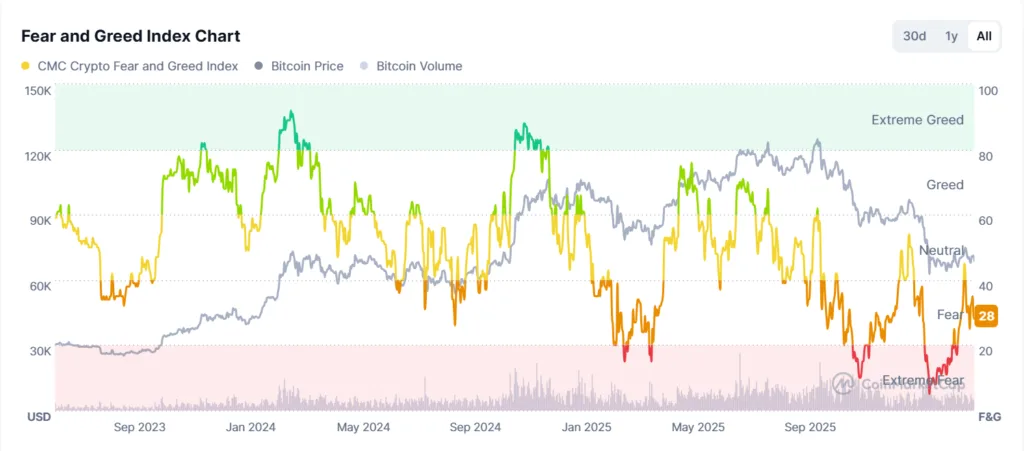
CMC Fear and Greed Index slips into fear
CoinMarketCap’s Fear and Greed Index indicator, which reveals the overall sentiment of the investors, shows that the market is still in a state of fear. From the neutral zone, the indicator has once again fallen into the fear zone as investors take precaution.
However, the markets usually work in the opposite direction of what the retailers think. When the retailers believe that the market is about to crash, that’s when smart money, or institutions and whales, gulp up the crypto in large quantities.
Why do markets always go against the retailers?
Markets drive crypto’s movement, not opinions, as liquidity, positioning, and incentives often dictate its direction contrary to retail traders’ expectations. Retail traders tend to cluster around obvious ideas (buying breakouts and selling panic), which creates predictable zones of stop-losses and leveraged positions.
However, larger players – often called “smart money” or whales—who know the market well take advantage by pushing the prices to those crowded areas to trigger liquidations.
This provides them with the liquidity needed to enter or exit big positions. For example, if most retail traders are long, price may dip sharply to liquidate those longs, then reverse upward once liquidity is absorbed.
There’s also a strong psychological component: retail traders are often driven by FOMO (fear of missing out) near tops and panic selling near bottoms, meaning they enter late and exit at the worst times. Meanwhile, experienced players tend to do the opposite – accumulate during fear and distribute during hype.
Retailers get liquidated as they use simple techniques
Additionally, retailers’ strategies are quite simple. They just rely on widely known indicators, and their behavior is highly predictable and exploitable.
In a nutshell, the market doesn’t intentionally “hunt retail,” but as most of the retail traders act similarly and emotionally, their positions become liquidity pools, and the market naturally moves in ways that maximize liquidity and efficiency, which often feels like it’s moving against them.
When the retail market is panicking, Chainlink whale wallets have been accumulating. For instance, the chart below shows that there is a surge in the number of wallets holding at least 1000 LINK tokens.
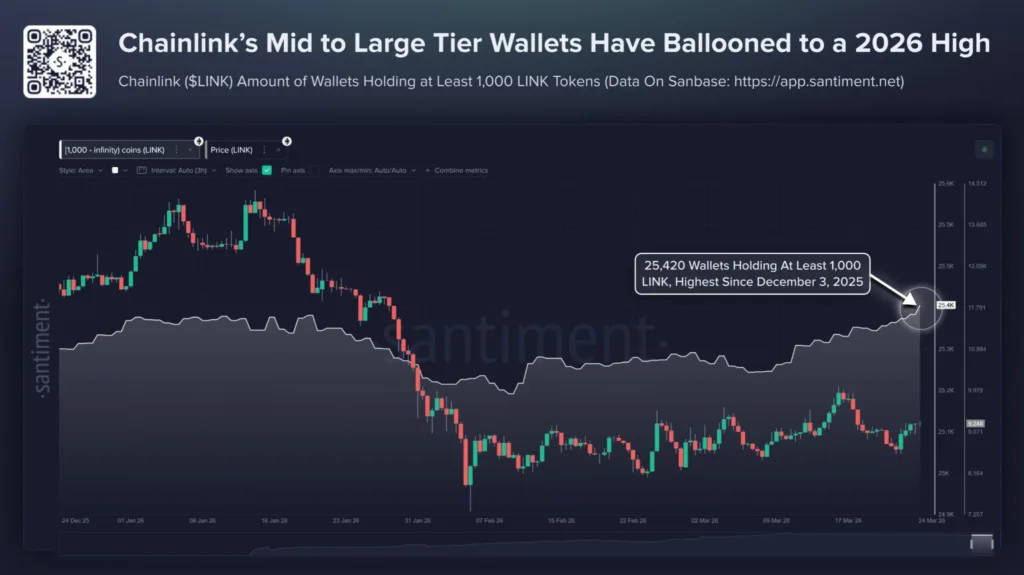
Since mid-March, the number of wallets with 1000 links or more has drastically gone up from 25.3K and is now almost touching 25.5K. Meanwhile, on another occasion, Fundstrat founder Tom Lee bought about 5000 ETH from the Ethereum Foundation.