

Free crypto sounds like a scam. In some cases it is, but not always. There are legitimate, low-risk crypto earning methods that don’t involve trading, risking savings, or needing any technical understanding to get started. Free crypto rewards are more accessible than most people realize, and the entry bar is genuinely low.
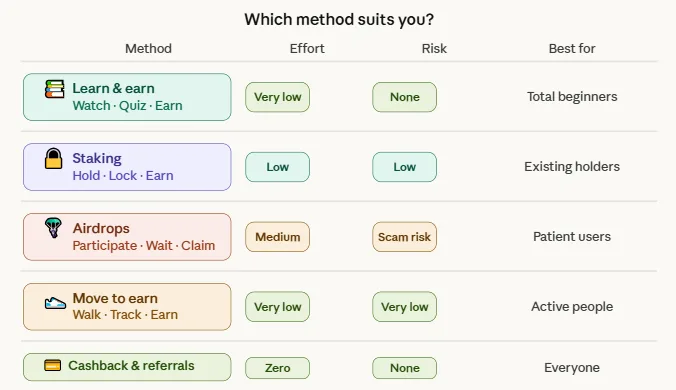
Below are five beginner-friendly methods to earn free crypto, the platforms that make them possible, and what to watch out for along the way.
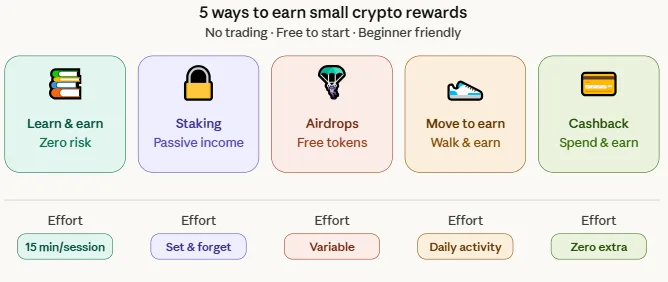
1. Learn and earn crypto: Get paid to study
Some platforms pay users to learn about crypto. Watch a short video about a cryptocurrency project, answer a few quiz questions based on what was covered, and get a small amount of that crypto deposited directly into an account. This is what learn and earn crypto programs are built around.
Binance, CoinMarketCap, Coinbase Wallet Quests, and CoinGecko all run active versions of this. Rewards per lesson are modest, usually a few dollars’ worth of tokens, but there’s zero financial risk. It’s time exchanged for crypto, not money.
Some platforms also offer microtasks for crypto alongside their educational modules. These are small actions like completing a short survey, testing a feature, or verifying information, each rewarding a tiny amount of tokens.
A few things worth knowing:
- Reward pools fill up fast and don’t always get topped up
- Identity verification is usually required before anything gets paid out
- Whatever’s earned is real crypto, not vouchers, meaning it can be held, swapped, or withdrawn
Out of all the methods out there, learn and earn crypto is one of the few where the worst-case scenario is walking away with nothing. No money goes in, so none can come out wrong.
2. Staking: Put existing crypto to work for passive crypto income
When someone stakes crypto, they’re agreeing to keep it parked in one place for a while. That locked balance helps a blockchain network stay operational and process transactions. The network pays back small rewards for that contribution. The closest everyday comparison is a high-yield savings account, but the mechanics work differently, and the returns can be noticeably better.
Ethereum, Cardano, and Solana are among the coins that support staking. On a platform like Coinbase, the whole setup takes a few taps and zero prior experience. Starting with a small amount is completely fine, and rewards build up steadily from there.
The one thing to know upfront is that staked funds aren’t immediately accessible. They stay locked until the unstaking process completes, and that waiting period varies by blockchain. It suits someone who already has crypto they weren’t planning to sell anytime soon.
Realistic annual returns for mainstream staking options sit in the single-digit percentages. For anyone looking to earn small crypto rewards passively, staking is one of the most straightforward low-risk crypto earning options out there, and one of the few that genuinely qualifies as passive crypto income.
3. Airdrops: Free tokens from new projects
Airdrops are free token distributions that crypto projects use to build a community and gain early traction. Some require holding a specific coin, others require testing a new app, or completing a small on-chain task.
When a legitimate airdrop pays out, the value can range from a few dollars to significantly more, depending on how the project performs after launch. Early participants in some well-known project launches received surprisingly large token distributions just for using a product during its testing phase.
That said, airdrops are also one of the most scam-heavy areas in crypto, and this is exactly where phishing becomes a serious concern.
What phishing actually means
Phishing means being tricked into handing over wallet access through a fake website or link. Unlike a fraudulent bank charge, there’s no department to call and nothing to reverse. The typical trap looks like a legitimate project site asking users to connect a wallet to claim an airdrop. That single action can hand a scammer full permission to drain everything in it.
These rules cover most of the risk:
- Never hand over a seed phrase to any website, under any circumstances
- Never act on airdrop links sent through DMs, emails, or group chats
- Always go straight to the official project website from a trusted source
- Don’t interact with unrecognized tokens that suddenly show up in a wallet
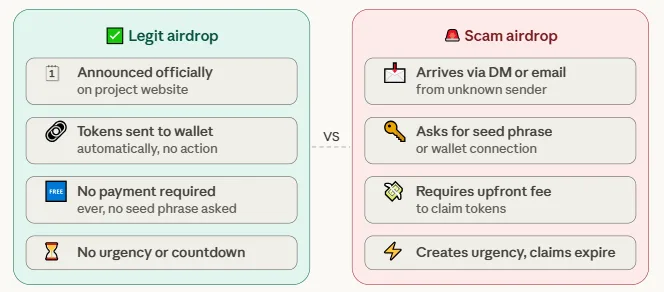
Legitimate airdrops never ask for upfront payment or private wallet keys.
4. Move-to-earn apps: Earn while staying active
Some apps reward users with crypto tokens for physical activity like walking, running, or hitting daily step goals. The phone tracks movement, and tokens accumulate in the background. STEPN is probably the best-known app for this, and it requires no trading, no technical setup, and no prior crypto knowledge.
Skip any app that demands big upfront purchases or promises suspiciously high daily earnings. Genuine move-to-earn apps are free or nearly free to start, and expensive in-app requirements before a single reward is earned is a reliable warning sign.
For anyone who already walks, commutes on foot, or exercises regularly, this is a simple way to earn small crypto rewards without changing a thing. A handful of apps throw in microtasks for crypto on top of step tracking, like short daily challenges for bonus tokens. For crypto rewards for beginners, it doesn’t get much lower-barrier than this.
5. Passive crypto income through cashback cards and browser rewards
Certain debit cards have quietly flipped the cashback model, paying out in crypto rather than airline miles or store points. For anyone spending money anyway, it’s probably the simplest way to earn free crypto without doing anything differently. The Coinbase debit card has no annual fee and skips the credit check entirely. The Crypto.com card works on a tiered system tied to token holdings. Brave browser handles it differently, dropping small amounts of BAT tokens into an account just for keeping ads on while browsing.
Coinbase, Binance, and Crypto.com all run crypto referral bonuses too. Bring someone new to the platform, and both accounts pick up a small reward. No investment goes in, nothing technical happens, and it quietly counts as passive crypto income that most beginners don’t think to use.
A few practical notes:
- Cashback rates vary by card tier and activity
- Some cards carry conversion fees that slightly reduce the net reward
- Crypto referral bonuses may require the referred user to complete a first trade
- Rewards are real crypto, not store points, and can be transferred or converted
Staying safe with every low-risk crypto earning method
These crypto rewards for beginners are low-risk by design, but across all the methods above, the biggest threat isn’t market volatility. It’s being deceived. Crypto transactions can’t be reversed, so losing wallet access via a phishing link or a fake platform is permanent.
Sticking to well-known platforms, never sharing a wallet recovery phrase, and treating every unsolicited free crypto offer with healthy skepticism covers the vast majority of that risk.
The smartest way to actually get started
Earning small crypto rewards doesn’t have to mean gambling on prices or understanding complex financial products. The five methods above are approachable and genuinely used by people just starting out in the space.
The best approach for anyone new is to combine a couple of these methods, start with zero or minimal financial exposure, and treat early earnings as a way to understand how crypto actually works. Done consistently, even modest passive crypto income adds up over time before any real money ever needs to go in.