


Crypto has been around for over a decade, and a surprising number of people still have not opened an exchange account. Not because it is complicated, but because nobody ever sat down and walked them through it properly. If that sounds familiar, this is exactly what this is for.
Setting up a crypto exchange account in 2026 takes about 20 minutes of actual effort. The hardest part is usually finding a utility bill for address verification. Everything else is straightforward once the steps are clear.
What is a crypto exchange?
A crypto exchange is where regular dollars get converted into cryptocurrency – Bitcoin, Ethereum, Solana, whatever the target is. It works the same way a brokerage account works for stocks, except the assets are digital.
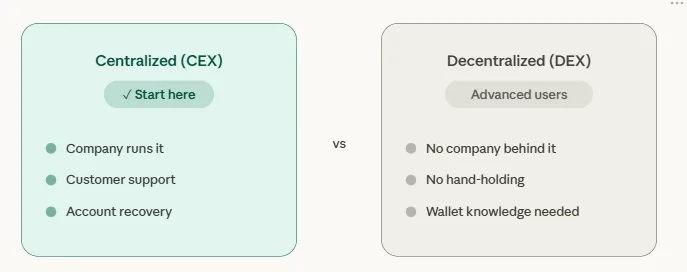
Two types exist: centralized and decentralized. Centralized exchanges like Coinbase or Kraken are run by a company, have customer support, and walk users through the whole process. Decentralized exchanges have no company behind them and zero hand-holding.
For anyone figuring out how to open a crypto exchange account for the first time, centralized is the only sensible choice.
Step 1: Choose the right crypto exchange for beginners
This decision matters more than most people realize going in. Picking the wrong platform early creates friction that worsens the whole experience. The best crypto exchange for beginners is not necessarily the one with the most coins or the lowest fees on paper. It is the one where the signup process does not feel like filing a tax return, and where funding an account works with a regular bank.
The four worth looking at seriously:
- Coinbase: Nasdaq-listed, beginner-friendly, and the easiest on-ramp into crypto. Fees are higher on the basic interface, but the simplicity makes up for it early on.
- Kraken: Publicly launched in 2013 with no major hacks on record. Better fees than Coinbase and a cleaner upgrade path when ready to go beyond basic buying.
- Robinhood: Good option for anyone already using it for stocks. No trading commissions, though spreads apply. Simple interface, limited advanced features, and external wallet transfers are available, but more limited compared to dedicated crypto platforms.
- Gemini: The most security-focused of the four. Worth considering for anyone who wants that to be the deciding factor.
One thing to check before signing up anywhere: not every exchange operates in every state. Confirming availability for your specific state takes two minutes on the exchange’s website and saves a headache later.
Step 2: Create the account
Once the exchange is picked, the actual signup is the easy part. Email address, password, confirmation link. Standard stuff.
The password deserves more thought than most people give it. An account holding real money with a recycled password from another site is a real security risk. A password manager like 1Password or Bitwarden generates something strong and stores it. Takes 30 seconds and is genuinely worth doing.
Step 3: Complete identity verification (KYC)
Here is where first-timers often get caught off guard. The account is created, there is excitement to get started, and then the platform asks for a government-issued ID, proof of address, and a selfie before anything can happen.
This process is called KYC (Know Your Customer) and is a federal legal requirement for every regulated crypto platform in the country. There is no legitimate exchange that skips it. Any platform advertising itself as “no KYC” is not properly licensed and carries serious risks.
What to have ready:
- A driver’s license or passport
- A recent utility bill or bank statement for address verification
- A live selfie or photo for identity confirmation
Coinbase typically clears this within 24 hours. Kraken may take slightly longer depending on the tier. Having the documents already scanned or photographed beforehand speeds things up considerably.
Step 4: Lock down account security before anything else
This is the step that gets skipped most often, and it is the one that causes the most damage when something goes wrong.
Two-factor authentication (2FA) needs to be enabled. But there is a catch that most beginner walkthroughs do not mention. SMS-based 2FA, the kind where a code gets texted to a phone number, has a known vulnerability. It is called a SIM-swap attack. Someone calls a phone carrier, convinces them to transfer the phone number to a new SIM card, and suddenly receives every verification code sent to that number. It has happened to real people with real accounts.
The fix is simple. Use an authenticator app instead. Google Authenticator and Microsoft Authenticator both generate codes directly on the device, completely separate from the phone carrier. No amount of social engineering at the carrier level touches those codes.
Two more things worth doing at this stage: enable withdrawal address allowlisting if the exchange offers it, meaning funds can only be sent to pre-approved wallet addresses. Turn on login and transaction alerts too, so any account activity triggers an immediate notification.
Step 5: Deposit funds
With verification done and security properly set up, money can go in. The main options:
- ACH bank transfer: Free on Coinbase and Kraken. Slow to fully clear, typically a few business days, but costs nothing and works fine for anyone not in a rush.
- Wire transfer: Arrives faster but carries fees. Coinbase charges for both incoming and outgoing wire transfers.
- Debit card or Apple Pay/Google Pay: Instant, but fees can reach around 2.5% per deposit. That is a significant cost on any meaningful amount.
ACH is the right call for a first deposit. And on the question of minimums: there are none worth worrying about. Crypto is fractional. Someone can buy $25 worth of Bitcoin and own a slice of it. There is no requirement to buy a whole coin, and waiting until a large lump sum is available is one of the most common mistakes new buyers make.
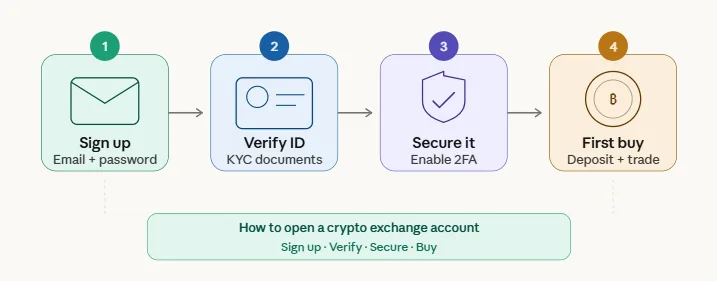
Step 6: Place the first order
Once the deposit clears, buying is straightforward. For a first purchase, a market order is the typical move. It buys at the current price, no extra configuration needed.
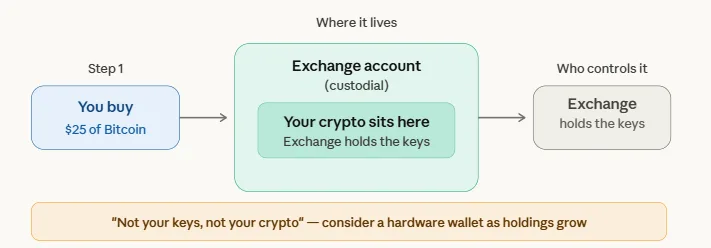
What actually happens after that purchase is something worth understanding properly. The crypto does not move to a private wallet. It stays on the exchange, in what is called a custodial account. The exchange holds it on the buyer’s behalf, much like a bank holds cash deposits. Ownership is real, but control of the underlying keys belongs to the platform.
The crypto community has a phrase for this: “not your keys, not your crypto.” It means that funds held on an exchange carry counterparty risk. If the platform gets hacked or collapses, recovery is not guaranteed. The history of crypto has enough examples of this exact thing happening.
For anyone working through how to open a crypto exchange account with a small starting balance, keeping funds on a regulated exchange is a reasonable approach. But as holdings grow, moving a meaningful portion into a personal hardware wallet, something like a Ledger or Trezor, is the responsible next step. Not urgent on day one, but it becomes more important over time.
The fee trap and the tax reality
One thing that catches almost every crypto exchange beginner: the default interface on most platforms is not the cheapest way to trade. Coinbase’s standard “Simple Buy” can cost around 1.5% or more per transaction when fees and spreads are combined. Switching to Coinbase Advanced, which is the same account and same login, brings that cost down substantially. It takes five minutes to figure out and saves real money over time.
On taxes, crypto is not a loophole. Every buy, sell, and trade on a regulated exchange is a taxable event and is visible to the IRS through KYC records. Keeping a record of transactions from the start is far easier than trying to reconstruct everything later. Most major exchanges provide downloadable transaction histories, and dedicated crypto tax software handles the rest.
Start small, get the setup right first
The account itself is the easy part. The setup, including the right exchange, proper security, and understanding where the crypto actually lives after buying, is what separates people who have a smooth experience from those who learn things the hard way.
Any crypto exchange for beginners worth its salt makes this process clear. Get the foundation right and the coin decisions become the easy part. Almost every mistake new buyers make happens before they ever place a trade.