



Crypto trading looks simple from the outside. Sign up, deposit money, buy a coin, sell it for more. What the platform does not show upfront is that the hidden costs of crypto trading are running quietly in the background on every single transaction, and most beginners never notice them until the numbers stop adding up.
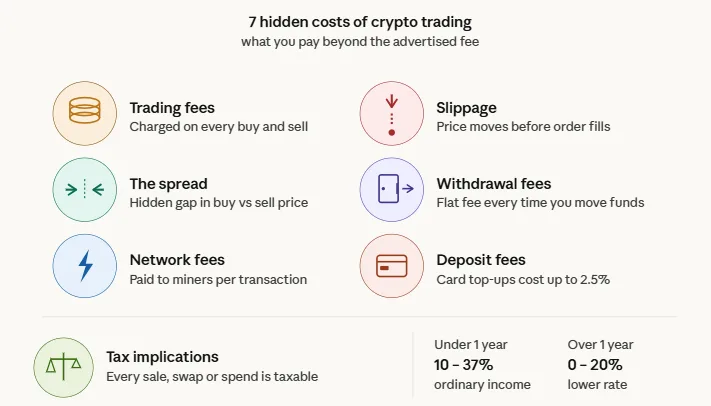
This guide breaks down all seven hidden costs in plain terms, with every piece of jargon explained along the way.
1. Trading fees: The cost everyone sees
Trading fees are the one expense exchanges actually advertise. Every time someone buys or sells crypto, the platform takes a small percentage of that transaction as payment for facilitating it.
Most platforms use a maker-taker model. A maker places an order and waits for someone else to fill it, similar to listing a product for sale and waiting for a buyer. A taker fills an existing order instantly, like clicking “buy now.” Takers usually pay a slightly higher fee because they are pulling available inventory out of the market rather than adding to it.
Most major US exchanges charge trading fees somewhere between 0.1% and 1.5% per trade. The fee hits on both the buy and the sell, so every completed round trip has a cost attached to both ends.
These fees are at least visible, which makes them the least dangerous item on this list.
2. The spread: Where hidden crypto trading fees actually live
The spread is the gap between the price someone pays to buy crypto and the price they would receive if they sold it immediately after. Exchanges quietly profit from this difference and rarely show it alongside their advertised rate.
Hidden crypto trading fees, like the spread, are most common on beginner-friendly apps that advertise zero commissions. Robinhood is the most well-known example in the US. There are no stated trading fees on the platform, but the spread baked into every trade still costs money. In volatile conditions, spreads on major platforms can quietly reach 1% to 3% of the trade amount.
A trader who buys $1,000 of Bitcoin and sells it the same day can end up losing more to the spread than to any visible line item. Those hidden crypto trading fees sitting inside the price gap add up fast.
3. Network fees and crypto trading costs: Nothing on the blockchain is free
The blockchain is the public record that logs every crypto transaction. To get a transaction added to that record, it has to be processed by validators or miners, the computers that keep the network running. They charge a small fee for doing that work. This is called a network fee, or “gas fee.”
This is one of the crypto trading costs that catches beginners off guard because the fee has nothing to do with the dollar amount being moved. It depends entirely on how busy the network is at that moment. During high-traffic periods, Ethereum network fees can spike significantly, regardless of trade size.
Some exchanges also mark up the actual network cost and pass it along as a service or processing charge. That markup is another layer of crypto trading costs that rarely gets flagged during sign-up.
4. Slippage: The exchange fees crypto traders never see coming
Slippage is the difference between the price shown when a trade is placed and the price it actually fills at. Crypto prices move in real time, and transactions take a few seconds to complete. Those seconds matter more than most beginners expect.
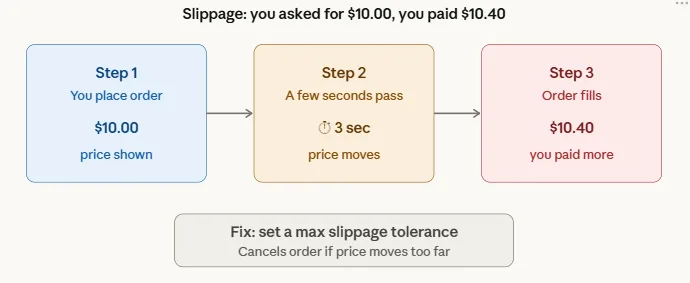
Exchange fees crypto traders usually track are the ones labeled on screen, but slippage can quietly exceed all of them on volatile tokens. Meme coins and low-liquidity assets, meaning coins with very few active buyers and sellers, are the most extreme examples. With thin trading activity, even a modest order can shift the price significantly before it fully executes.
Most platforms allow users to set a maximum slippage tolerance before placing a trade. Think of it as a personal boundary set before the trade goes through. If the price moves too far from what was shown, the order simply does not execute. It is a small step that takes seconds and can save a lot of frustration, especially on coins that swing wildly.
5. Crypto withdrawal fees: Paying just to leave
After all the trading is done, moving money out costs money too. Whether someone is sending crypto to their own wallet or cashing out to a bank account, the exchange charges a fee every time. It does not matter if the transfer is large or small; the fee is usually the same flat amount either way.
What makes it worse is that the number charged is often higher than what the blockchain actually costs to process the transaction. The exchange keeps the difference and calls it a service fee. Moving even a modest amount of Ethereum can quietly eat into what was supposed to be a clean transfer.
The workaround is simple. Withdraw less often and move larger amounts when doing so. Paying that flat fee less often is the easiest way to prevent it from becoming a recurring drain.
6. Deposit fees and exchange fees: Paying before the first trade
Most traders think carefully about what it costs to trade. Fewer stop to ask what it costs just to fund the account in the first place.
Depositing with a debit or credit card typically carries a fee of around 2.5%. On a $1,000 deposit, that is $25 gone before a single trade is placed. Bank transfers are usually cheaper and often free through major US exchanges, though they take a few business days to clear.
Exchange fees also show up during currency conversion. Swapping Bitcoin for Ethereum, for example, often requires two separate trades, each carrying its own exchange fees, plus a wider spread on the direct trading pair. Even converting US dollars at what a platform calls “market rates” can cost 2% to 3% more than the actual mid-market rate because the platform quietly adjusts the price in its own favor.
7. Crypto tax implications: The bill most traders forget to plan for
Most traders only think about this one when tax season is already here, which is usually too late to do much about it.
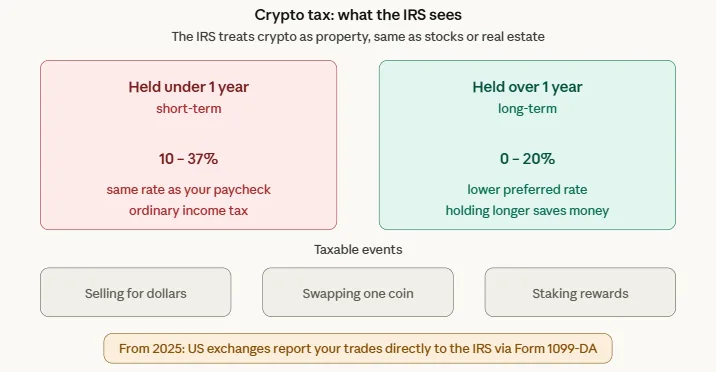
The IRS treats cryptocurrency as property, the same way it treats stocks or real estate. Every time crypto is sold, swapped for another coin, or used to buy something, it is a taxable event. Crypto held under a year is taxed at the same rate as regular income, between 10% and 37%. Hold it longer than a year, and that rate drops to 0%, 15%, or 20% depending on total annual income.
Staking rewards and mining income count as taxable income too, not just selling. Even trading one coin for another triggers a tax event under IRS rules.
Starting with the 2025 tax year, US exchanges report transaction activity directly to the IRS through Form 1099-DA. Keeping a personal record of every transaction, including the purchase date and dollar value at the time, is the only way to avoid surprises.
Final thoughts
Every hidden cost of crypto trading on this list is manageable once a trader knows it exists. None of them are devastating on their own, but together they can quietly turn a winning trade into a breakeven one. Knowing where the costs hide is the first and most useful step.