

Bitcoin gets most of the attention, but it’s not the whole story. A broad category of cryptocurrencies has been quietly building real products, landing serious institutional partnerships, and solving problems that traditional finance hasn’t cracked yet. These are altcoins, and the ones worth paying attention to have something concrete behind them beyond price movement and social media chatter.
Plenty of them are built on hype with nothing underneath. But a smaller group has years of real usage, active development, and backing from organizations like Amazon, BlackRock, and major financial institutions. Altcoins with the strongest fundamentals have real businesses and real users depending on them every single day, and those are the ones worth understanding.
What makes altcoins with strong fundamentals different?
Altcoins with strong fundamentals have real value beneath their price tags. Not a viral tweet. Not a celebrity endorsement. Actual utility that people and institutions depend on.
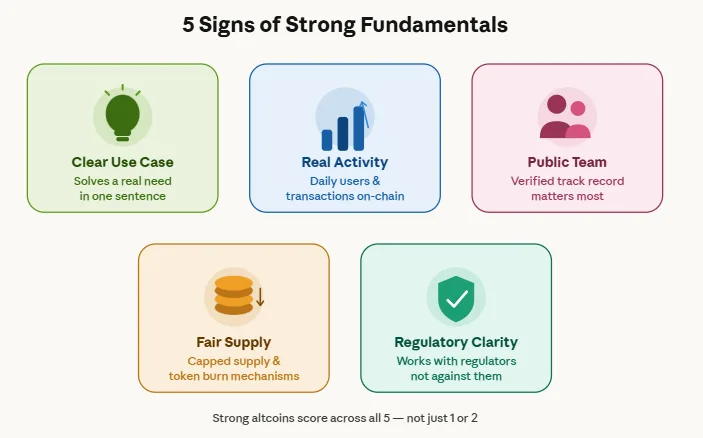
Not every altcoin is worth the same amount of attention. A few things tend to separate the ones worth watching from the ones that quietly disappear:
- A clear use case that solves something people actually need
- A development team that ships updates consistently, not just during bull runs
- Real on-chain activity, meaning actual users making actual transactions
- A token supply structure that doesn’t reward early insiders at everyone else’s expense
- A working relationship with regulators rather than a constant fight against them
A good way to think about it is two restaurants in the same neighborhood. One blew up on social media for a week, had lines around the block, and then closed six months later. The other has no hype, a loyal regular crowd, and has been packed every weekend for three years. The second one has strong fundamentals. The best altcoins to watch follow that exact same pattern.
Best altcoins to watch: The proven tier
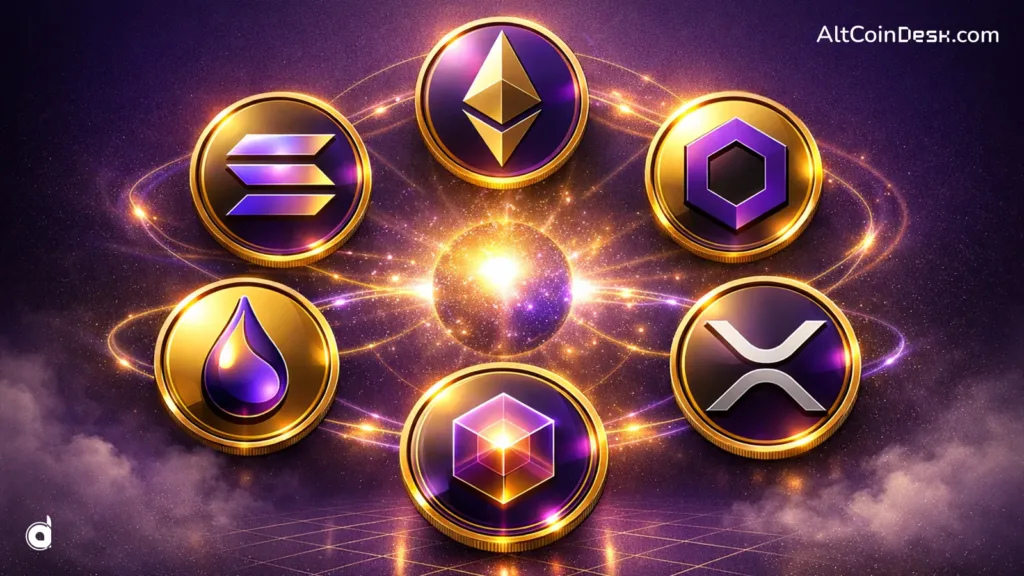
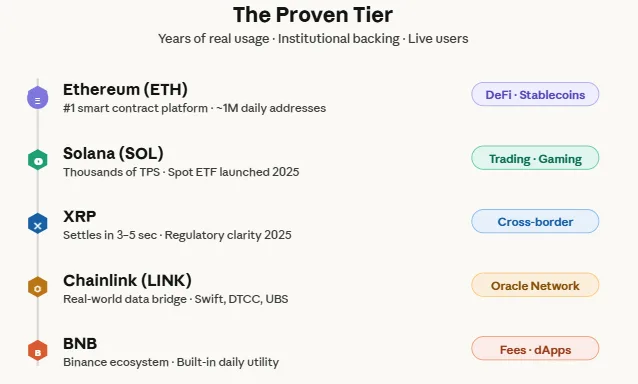
These five have years of real usage behind them. They’re not emerging bets or early-stage projects. They’re proven networks that institutions, developers, and everyday users are already actively depending on.
1. Ethereum (ETH)
Ethereum sits at the center of decentralized finance, stablecoins, and tokenized real-world assets. It’s the most widely used smart contract platform globally, with hundreds of billions in on-chain value and close to a million daily active addresses. Two major network upgrades over the past year have improved its speed and reduced transaction costs considerably.
2. Solana (SOL)
Solana processes thousands of transactions per second at a fraction of Ethereum’s base-layer cost, which is why so much of the high-frequency trading, memecoin, and on-chain gaming activity has ended up there. Spot Solana ETFs launched in the US in 2025, putting it in the same regulated-product bracket as Bitcoin and Ethereum.
3. XRP
Sending money internationally through a bank can take days and cost a frustrating amount in fees. XRP was built to cut through that. The XRP Ledger settles transactions in three to five seconds at fractions of a cent, which is what makes it usable for cross-border payments in the first place.
After a lengthy legal battle, it also got regulatory clarity in August 2025 when Ripple and the SEC jointly dismissed their appeals, leaving the 2023 ruling in place. Ripple partners like Tranglo and SBI Holdings use the ledger for real settlement flows, and spot XRP ETFs have since launched in the US.
4. Chainlink (LINK)
Here’s something worth knowing. A blockchain can’t access the outside world on its own. It can’t look up a stock price, confirm a payment, or check a commodity rate without a bridge. Chainlink is that bridge. Swift, DTCC, and UBS are already using it, which puts it in rare company as a high-utility crypto project with one foot firmly in traditional finance.
5. BNB
BNB has something most altcoins spend years chasing. A built-in reason to be used every single day. It’s the native token of the Binance ecosystem, covering transaction fees, trading discounts, and a wide network of decentralized apps on BNB Chain. When daily utility is baked directly into one of the busiest platforms in crypto, demand tends to hold up regardless of broader market conditions.
Top altcoins by fundamentals: AI and decentralized computing
These two aren’t traditional finance plays. They’re building infrastructure for the AI era, which makes them some of the most compelling top altcoins by fundamentals in the current market. Both solve problems that are only getting bigger as demand for AI continues to grow.
6. Bittensor (TAO)
Right now, a small number of tech giants control the world’s most powerful AI systems. Bittensor is taking a different approach entirely. It’s an open network where developers build and contribute AI models, and get paid based on how useful those models actually are to the network.
Through 2025, it established itself as one of the largest AI-focused tokens by market cap, with growing institutional interest, including a Grayscale trust filing. The network has since grown to support a wide range of specialized subnets, each focused on a different task, from processing language to organizing and indexing data across the web.
7. Render (RENDER)
Render tackles the global shortage of GPU computing power. AI development, 3D rendering, and digital content creation all require enormous processing capacity. Render connects buyers of that capacity with GPU owners who have unused hardware, settling the entire exchange on-chain. It’s one of the clearest high-utility crypto projects operating right at the intersection of AI and blockchain today.
High-utility crypto projects built for enterprise adoption
These three have something most altcoins don’t: real government and corporate institutions actively building on them. They’re fundamentally strong altcoins because the organizations behind them are publicly accountable and have long-term commitments.
8. Avalanche (AVAX)
Avalanche’s subnet design lets companies spin up their own custom blockchain environments, which is why it’s picked up enterprise work with Deloitte and Amazon Web Services. Japanese tokenization platforms are using Avalanche subnets for real estate and corporate bonds, and these are live in production, not pilots.
9. SUI
SUI is a Layer 1 blockchain built by former engineers from Meta’s Diem project. Its object-centric design lets unrelated transactions process in parallel instead of one after another, which is where its speed actually comes from. It uses Move, a programming language built specifically to treat digital assets as first-class objects, which closes off a lot of the bugs that have drained funds on other chains.
10. Hedera (HBAR)
Hedera is governed by a council of major global corporations, including Google and IBM, which is unusual in crypto. Wyoming’s Frontier Stable Token (FRNT), the first US state-issued stablecoin, launched in August 2025 on seven major chains and went live on Hedera in 2026. McLaren Racing also sits on the governing council. None of that is hypothetical. It’s already running.
Altcoin investment research: What to check before going in
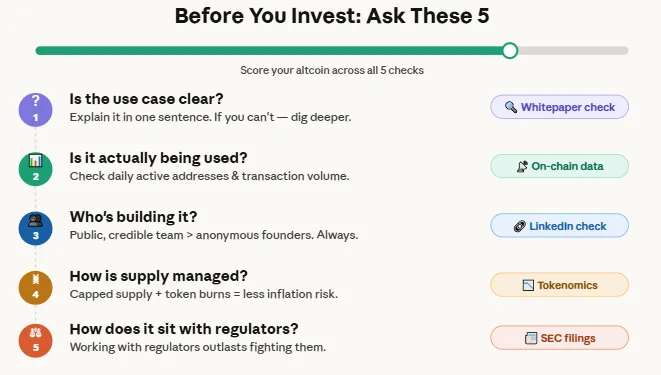
Solid altcoin investment research doesn’t require a finance background. A few practical questions quickly cut through most of the noise.
- Is the use case clear? If it can’t be explained in one sentence, dig deeper before committing.
- Is it actually being used? Daily active addresses and transaction volume reveal real adoption fast.
- Who’s building it? A public, credible team with a verifiable track record matters far more than anonymous founders.
- How is supply managed? Capped supplies and token burn mechanisms reduce long-term inflation pressure.
- How does it sit with regulators? Projects working alongside regulators consistently outlast those that don’t.
The strongest crypto fundamentals consistently show up across all five of these areas, not just one or two. That’s what makes thorough altcoin investment research so valuable before putting any money in.
Top altcoins to invest in: The bigger picture
Chasing trending coins based on social media hype has a pretty consistent track record of ending badly. The top altcoins to invest in are identified in different ways. Through real user growth, development that keeps moving in bear markets, and partnerships that don’t disappear after the announcement.
Every coin on this list has verifiable backing, whether that’s cross-border banking infrastructure, government-issued stablecoins, or decentralized AI systems already running in production.
The strongest crypto fundamentals don’t always come with loud headlines. They show up in network activity, in developer commits, in institutional contracts, and in products people are actually using. The top altcoins to invest in earn their place through consistent execution, and that’s what every project here has demonstrated.