



Bitcoin crossed $126,000 in October 2025 and then dropped hard. The kind of drop that makes people question whether the whole thing was just hype. But what’s building underneath the price action points toward a crypto bull run in 2026 that looks different from what the headlines suggest.
A crypto bull run is a sustained stretch of rising prices across the whole market, usually lasting several months or more. Right now, several signals that have historically shown up before big runs are stacking on top of each other at the same time.

Is a crypto bull run coming in 2026?
The honest answer is nobody knows for certain. But asking if a crypto bull run is coming is the right question right now, because the data is pointing in one direction more consistently than it has in years. The signs of crypto bull run conditions building in this market are worth understanding clearly before prices move.
Crypto bull run signs to watch right now
Not all crypto bull run signs carry the same weight. Some are rooted in Bitcoin’s fixed supply mechanics. Others are about where money is sitting and where it’s about to move. A few are entirely new to this cycle.
1. The Bitcoin halving cycle
Every four years, the amount of Bitcoin that new miners can earn per block gets cut in half. This happened in April 2024, dropping the reward from 6.25 to 3.125 BTC. With less new supply hitting the market and demand remaining the same or growing, prices have historically risen.
That’s the theory, and three previous cycles back it up. Each time, the biggest price peak arrived roughly 12 to 18 months after the halving. That window covers late 2025 through mid-2026. A bitcoin bull run in 2026 fits squarely within that historical pattern. Bitcoin already set a new all-time high within that range, but that doesn’t mean the cycle is over.
In previous halvings, the first major peak was often followed by a consolidation before a second, larger leg up. The steadier pace this cycle is a reflection of how much institutional money is now involved – these buyers accumulate slowly and don’t drive parabolic moves the way retail-driven cycles did.
2. The Federal Reserve cutting rates
High interest rates pull money toward safer assets. When a savings account pays 5% annually, the volatility of crypto is hard to justify. When rates drop toward 1% or lower, that same account stops looking attractive, and capital starts searching for better returns.
The Fed ended its tightening cycle in December 2025, with rate cuts expected through 2026. Bitcoin has tracked global money supply more closely than almost any other asset. Lower yields combined with more money circulating in the economy has historically preceded some of the strongest crypto runs on record.
3. Bitcoin ETF inflows are coming back
When the US approved spot Bitcoin ETFs from 11 issuers, including BlackRock, Fidelity, and Invesco, in January 2024, it changed who could buy crypto. Pension funds, wealth managers, and retirement accounts could suddenly get Bitcoin exposure through a regular brokerage account, no wallets or seed phrases required.
By January 2026, global Bitcoin ETF assets under management had hit $141 billion. After weeks of outflows during the pullback, inflows turned net positive in early March 2026. Institutional buyers accumulate steadily and don’t panic-sell the way retail traders do, which means their re-entry creates a more durable floor under prices. ETF applications for XRP, Solana, and Dogecoin are also pending, and an approval on any of them could trigger a sharp rotation into those assets.
4. Bitcoin is quietly leaving exchanges
This one doesn’t get enough attention. Bitcoin exchange reserves hit a seven-year low in March 2026. Over 47,000 BTC exited major centralized platforms in a single month, according to analysis cited by Bitfinex.
When coins leave exchanges and move into cold wallets, holders aren’t staging for a sale. They’re putting it away. Less available supply combined with any new demand means prices move faster and further. On-chain analysts call it a supply squeeze, and it’s one of the most reliable pre-run signals in Bitcoin’s history.
5. Over $316 billion in stablecoins sitting on the sidelines
Stablecoins are dollar-pegged tokens like USDT and USDC. When their total supply grows, it means cash has entered the crypto ecosystem but hasn’t been deployed into Bitcoin or altcoins yet. The stablecoin market cap has crossed $316 billion as of early April 2026, with some projections placing it as high as $1 trillion by the end of 2026, driven by institutional adoption and the formal US regulatory path created by the GENIUS Act.
A crypto market rally in 2026 needs fuel, and this is where a significant portion of it’s likely to come from. When sentiment shifts, that money doesn’t trickle in. It moves fast.
6. Trump’s administration changed the regulatory picture
For years, the biggest barrier to institutions entering crypto was legal uncertainty. Nobody wanted to allocate serious capital to an asset class where the rules could shift without warning.
That changed fast. Key moves since late 2024:
- The GENIUS Act, signed into law in July 2025, created the first US federal framework for stablecoins
- The Digital Asset Market Clarity Act passed the House in July 2025 with a 294–134 vote and is now moving through Senate committees in 2026, where it would classify most cryptocurrencies as commodities
- The SEC reversed its SAB 121 policy in January 2025, letting banks legally hold crypto in custody
- Morgan Stanley and Bank of America are now actively building out crypto products and services
The conditions for a crypto bull market in 2026 depend heavily on this kind of structural change, and it’s already well underway. When institutions managing trillions of dollars finally get the legal cover they’ve been waiting for, capital moves.
7. Privacy coins are running their own bull run
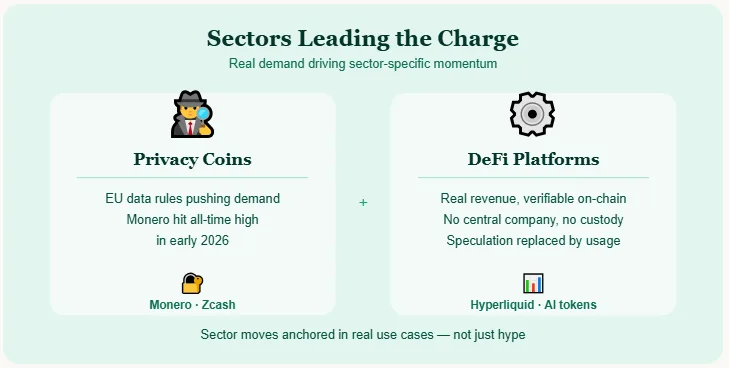
While Bitcoin was pulling back, Monero and Zcash were running. Privacy coins as a sector gained 288% in 2025, while Bitcoin finished 2025 down roughly 6%, and Ethereum also ended the year lower. Monero hit a new all-time high in early 2026, its first since 2018.
The reason is regulation, not hype. The EU’s DAC8 directive kicked in on January 1, 2026, requiring exchanges to collect and share user transaction data. US policy is heading in the same direction. As on-chain surveillance expands, demand for coins that keep transactions untraceable grows with it. Sector-specific moves anchored in real use cases are among the most reliable crypto bull run signs, and this one has genuine demand behind it.
8. Real platforms are now generating real revenue
Hyperliquid is a decentralized exchange for perpetual futures, where users trade price movements without owning the underlying asset and without any central company controlling their funds. It’s crossed $4 trillion in cumulative trading volume and generates close to $1 billion in annualized revenue, all of it verifiable on-chain. It controls roughly 50% of the decentralized perpetuals market and has expanded into oil and equity index trading as well.
Revenue matters here because it shows that parts of crypto have moved past pure speculation. Real usage, real fees. AI-focused tokens are also positioning for a comeback after underperforming as a sector in 2025. Once broader momentum returns, analysts consistently flag them as one of the first areas where fresh capital tends to rotate.
Final thoughts
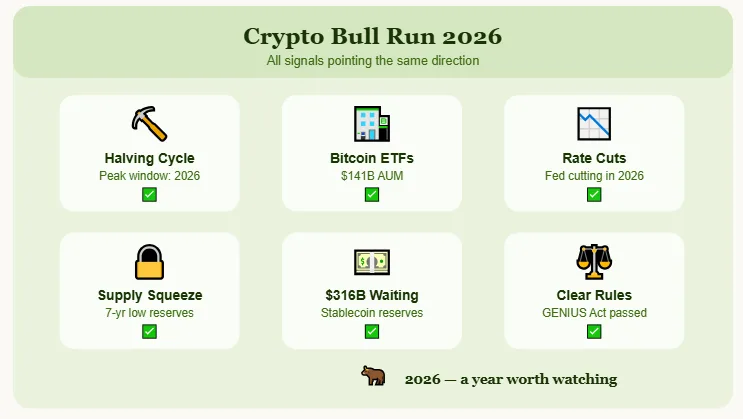
So, is a crypto bull run coming? Looking strictly at the signals, the case is hard to ignore. The halving timeline, the return of ETF inflows, regulatory clarity, record stablecoin reserves, and sector-specific momentum from privacy coins and DeFi platforms are all telling the same story.
Nothing in crypto is ever guaranteed, and any of these signals can flip if macro conditions turn. But the last time this many indicators lined up at once, the market moved in a big way. That alone makes 2026 a year worth watching closely.