


Digital assets promise speed, transparency, and global access, but they also shift responsibility directly to the owner. In crypto, control over funds does not sit with a bank or a clearing institution. It is held by whoever holds the private keys. That simple difference is why crypto custody risk has become one of the most serious issues facing companies, funds, and even experienced crypto investors.
When investors hold a large amount of digital assets, the discussion quickly moves beyond wallets and exchanges. They must start asking how their assets will be protected, who controls transactions, and what happens if something goes wrong. These questions form the foundation of a proper cryptocurrency custody strategy.
Understanding crypto custody risks
Crypto custody risk refers to the possibility that digital assets could be lost, stolen, or become inaccessible because the private keys that control them are compromised or mishandled. Unlike traditional financial systems, blockchain transactions cannot be reversed. If funds are moved without authorization, recovery is extremely unlikely.
Many investors underestimate how broad this risk really is. The risk does not come from one single weakness, but rather emerges from a mix of technical gaps, errors, or dependence on poorly devised crypto custody systems.
Some of the reasons as to why crypto asset custody needs to be handled with a lot of caution include:
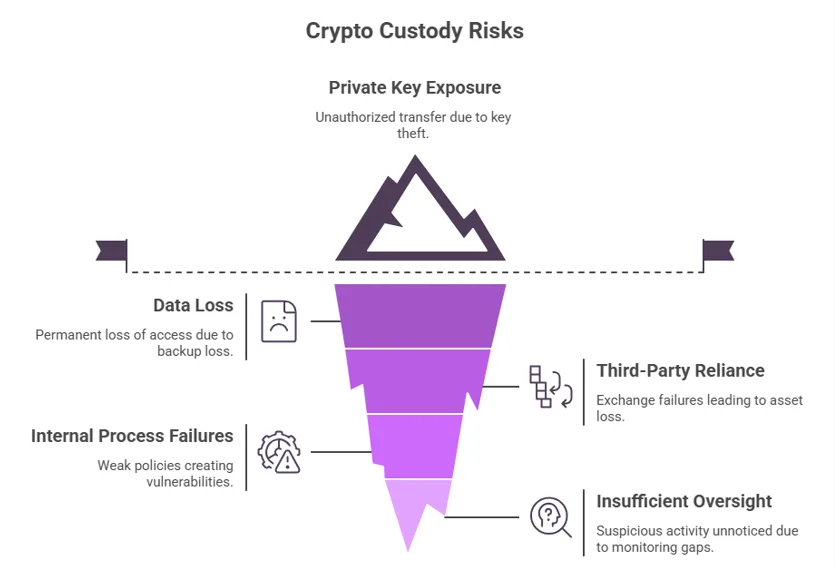
- Private key exposure: The key associated with a wallet can be used to authorize a transfer without personal authorization by any person who obtains the key.
- Data loss: Permanent loss of access can occur due to the loss of backups or seed phrases.
- Overreliance on third parties: Exchanges and custodians may suffer operational failures or financial collapse.
- Internal process failures: Weak access policies or poorly documented transaction procedures can create vulnerabilities.
- Insufficient oversight: When monitoring systems are absent or inconsistent, suspicious activity may go unnoticed until assets are already gone.
These risks apply to both self-custody and third-party custody arrangements. In most cases, loss of assets occurs due to the lack of enterprise-level cryptocurrency custody controls. Investors that understands the structure of custody risks are better positioned to mitigate them before assets grow large enough to attract attention.
Technical defenses that mitigate cryptocurrency custody risks
Innovative technology plays a central role in reducing crypto custody risks. The goal is to remove situations where a single mistake or compromised system could expose entire holdings to risks.
Modern custody infrastructure focuses on spreading responsibility across multiple systems and approvals. Investors who take cryptocurrency custody seriously often adopt a layered security design:
- Multi-party computation systems: Instead of storing a private key in one place, MPC splits the signing process into multiple cryptographic components. A transaction only goes through when these components cooperate.
- Hardware-based key protection: Hardware security modules protect keys inside devices built to resist tampering, extraction attempts, and physical attacks.
- Offline storage: Offline storage, such as cold storage, keeps assets secure for long-term holdings and only leaves smaller balances for daily use.
- Safe signing environments: The transactions are handled through regulated systems, and the identity is checked and authorized before it is cast to the blockchain.
- Several authentication steps: Custody platforms should be accessed with more than a password, and it is usually a combination of devices, credentials, and identity.
While technology does not eliminate the risk completely, it makes the attacks difficult to implement. It also makes sure that in case of an attack, some of the assets remain safeguarded in other layers.
Enhancing controls to minimize personal and operational errors
Crypto custody risks are often due to internal problems, although external threats capture the attention of everyone. Hence, there is a need to have operational discipline in handling crypto asset custody.
However, even seasoned investors or teams might commit expensive errors without having specific guidelines and proper procedures. Nonetheless, crypto custody risks can be mitigated by several governance practices:
- Power division: The approval of transactions should not be pegged on a single person.
- Multi-step approval: Transfers that are of high value must be confirmed by a number of authorized persons.
- Role-based access control: Employees should be granted access according to their individual responsibilities and not to the general access of the system.
- Regular reconciliation procedures: Balances in wallets, transaction records, and custody records are to be reconciled frequently.
- Internal audit reviews: Crypto custody policies and compliance must be checked regularly by independent teams.
- Written recovery procedures: Coded instructions make accessibility possible in case the key personnel leave or systems change.
These controls create accountability in cryptocurrency custody. Since weak internal processes are a significant source of risk as the holdings grow, implementing effective crypto asset custody structures early makes custody management far more stable over time.
Third-party risk management in crypto asset custody
Most institutional investors use third-party custody providers to help make business easier or address regulatory requirements. Although this practice can enhance efficiency, third-party crypto asset custody risks emerge.
A third-party custodian is a firm that manages assets on behalf of investors. In case such a provider experiences financial difficulties, lawsuits, or technical violations, investors’ assets can be compromised.
Institutional investors need to take a careful look at several factors before deciding on the provider:
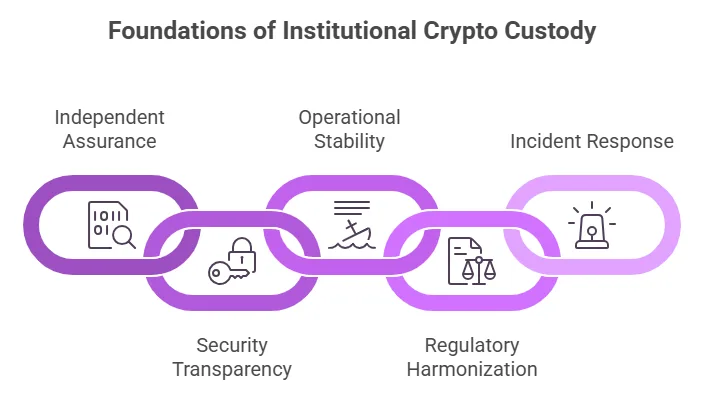
- Independent assurance: Custody providers must make external checks to make sure that their controls are working.
- Security architecture transparency: Investors must know how their private keys are secured and how transactions are authenticated.
- Financial and operational stability: A custodian has to demonstrate that it can operate continuously even during market crashes.
- Harmonization of regulations: Custody providers that operate in more than one jurisdiction must comply with new regulations that affect digital assets.
- Incident response preparedness: Custodians are expected to have specific guidelines to be used in managing breaches, downtime, or any form of suspicious activity.
Historical collapses of high-profile exchanges such as FTX have also shown that even large companies are not immune to collapse. For this reason, investors must embrace hybrid crypto custody models.
The need for a long-term crypto custody strategy
Crypto custody risks mitigation is not limited to the use of tools or having a trustworthy custody provider. Investors must have a long-term strategy that will continue to work even as their assets grow.
A reliable custody model must have decentralized storage of private keys, active monitoring, and clear transactional flows. Having auditors and internal risk management teams can also help to secure digital assets appropriately.
Third-party custodians must also ensure that investors’ digital assets are secured despite operational failures, staff changes, or technical breakdowns. A combination of leadership, compliance teams, and units of operations makes custody risks easier to handle.