



Bitcoin hit an all-time high of $126,080 in October 2025. As of March 2026, it is sitting at around $71,000, wiping over $2 trillion from the total crypto market cap in just a few months. That kind of drop hits differently when you’re unprepared, which is exactly why knowing how to secure crypto assets during market volatility matters more than ever right now.
What tends to catch new holders off guard is that “securing” your crypto actually means two very different things. There’s protecting your money from price crashes, and there’s protecting your actual coins from being lost or stolen forever. Both matter, and skipping either one is how portfolios get wrecked in ways that have nothing to do with the market.
The two risks every crypto holder needs to understand
Think of crypto security like owning a house. The first risk is the value of your house dropping in a bad real estate market. That’s price risk. The second risk is your house actually burning down. That’s a security risk, and no amount of market recovery helps if your coins are already gone.
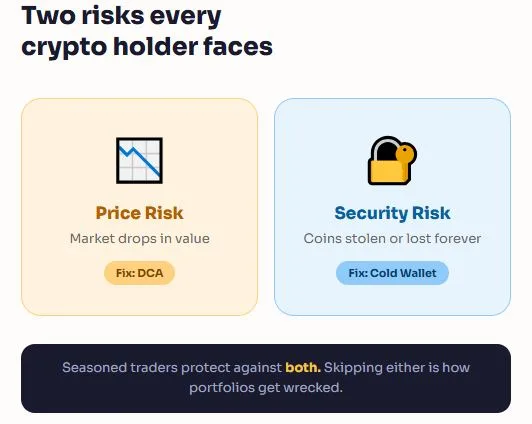
Price risk is about strategy: when to buy, how much to invest, and how to handle a downturn without losing your head. Security risk is about protecting your private keys, your wallets, and your access to your funds.
Both are equally important, and confusing the two is one of the most expensive mistakes a crypto holder can make.
Panic selling is the fastest way to lose money
When prices drop hard, the temptation to sell everything and run is very real. But panic selling almost always locks in your losses right before a recovery happens. It’s the financial equivalent of quitting a job the day before your bonus hits.
Between mid-January and mid-March 2026, spot Bitcoin ETFs saw a net outflow of around $6.81 billion as retail investors rushed to exit falling positions. Those who sold locked in their losses right at the bottom. It gets worse when you look at altcoins specifically.
During the October 2025 crash, Bitcoin fell around 7%, but altcoins collapsed 20 to 27% in the same event. Holders who panic sold at those levels didn’t just miss the recovery. They handed their money directly to the traders, who stayed calm and waited it out.
The lesson is simple. Bitcoin has survived more “it’s over” headlines than any other asset in history, and it has bounced back every single time. Reacting emotionally to every red candle is technically a strategy, just not a winning one.
Stop leaving all your crypto on exchanges
This one is non-negotiable. In February 2025, the Bybit exchange was hacked, and $1.5 billion in crypto was drained in a single attack, making it the largest crypto heist ever recorded. Bybit is one of the bigger, well-known platforms in the space. No exchange is completely untouchable.
The golden rule in crypto is: “Not your keys, not your coins.” When your crypto sits on an exchange, you don’t fully own it in the truest sense. You essentially have an IOU from the platform. If the exchange gets hacked, goes bankrupt, or freezes withdrawals, you become a creditor waiting in line, not a coin holder walking away with your funds.
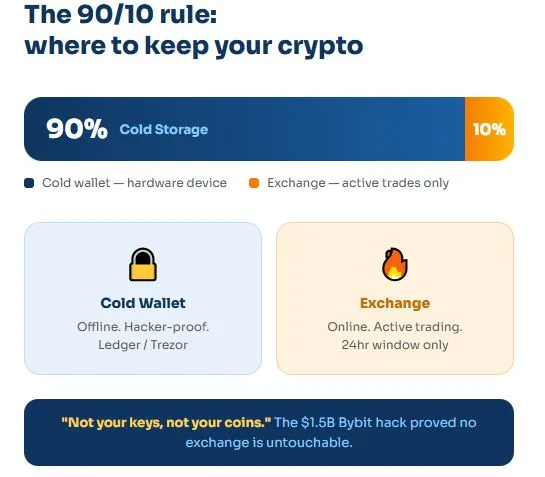
The recommended split is to keep 90% of your holdings in cold storage and only 10% on exchanges for active trading. It sounds like a lot of effort upfront, but once it’s set up, it runs itself.
The smartest way to secure crypto assets: Use a cold wallet
The most reliable way to secure crypto assets long-term is a cold wallet, a physical device that stores your private keys completely offline. If a hot wallet (like a browser extension or an exchange account) is the cash in your back pocket, a cold wallet is a safe bolted to the floor of your house. Hackers can’t steal what’s not connected to the internet.
The most trusted options right now are the Ledger Nano X, which supports over 5,500 cryptocurrencies and works well for first-timers, and the Trezor Model T, which is popular for its open-source transparency. Hardware wallets typically cost between $55 and $149, a small price to pay for protecting a portfolio worth considerably more.
One rule you cannot ignore: your recovery phrase, usually 12 to 24 words written on a card when you first set up the wallet, is the master key to everything. Write it down, store it physically in two separate secure locations, and never photograph it or save it digitally. A hacker who finds your recovery phrase owns your crypto, full stop.
Crypto security during volatility starts with your exchange account
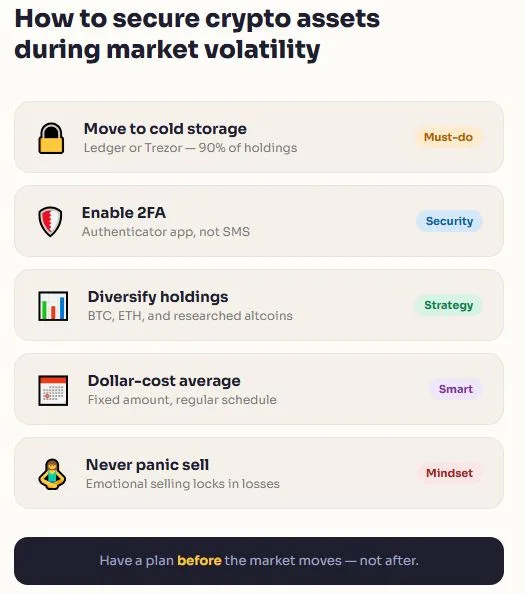
Crypto security during volatility isn’t just about cold wallets. For the portion of funds that do stay on an exchange, your account security carries real weight. Setting up Two-Factor Authentication (2FA) using an authenticator app, rather than SMS, is the bare minimum you should have in place.
SMS-based 2FA can be bypassed through SIM-swapping attacks, which are far more common than many crypto holders realize. Beyond 2FA, stick to exchanges that have strong regulatory compliance, a track record of third-party security audits, and ideally some form of insurance on user funds.
Choosing the right platform is itself a form of crypto security during volatility, because regulated exchanges are held to much higher standards and are significantly less likely to collapse without warning.
Never put all your eggs in one altcoin
Diversification is one of the most powerful tools in a crypto holder’s kit, and the 2025 to 2026 market cycle proved it in the most painful way possible. Many altcoins dropped 90% or more from their highs during the correction, wiped out by thin liquidity and the harsh reality that most tokens were built on hype rather than real utility.
Remember Terra-Luna in 2022? A $45 billion ecosystem evaporated in days because the entire thing was built on speculation with no real backing. It was a very expensive lesson in why hype alone does not make a good investment.
Financial advisors generally recommend keeping total crypto exposure to between 5% and 15% of your overall portfolio, with the rest in more stable asset classes. Within your crypto holdings, spreading across Bitcoin, Ethereum, and a few carefully researched altcoins reduces the damage when any single coin has a rough month.
Dollar-cost averaging turns volatility into an advantage
Dollar-cost averaging, or DCA, is one of the simplest and most effective strategies in crypto. Instead of trying to time the perfect entry (which even seasoned pros get wrong), you invest a fixed amount on a regular schedule, whether weekly or monthly.
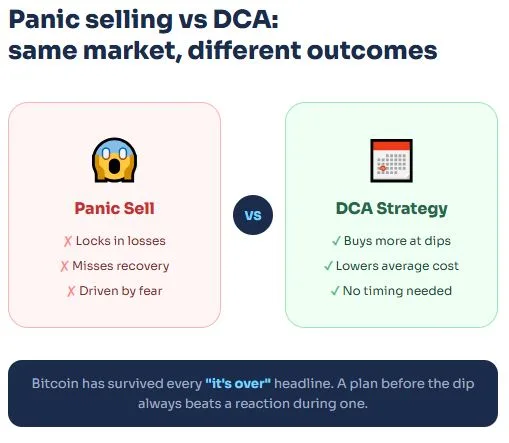
The logic is simple. When prices drop, your fixed investment buys more coins. When prices rise, it buys fewer. Over time, this naturally brings down your average cost per coin without requiring you to predict a single market move. When you use DCA, volatility actually starts working in your favor instead of against you.
Stay calm, stay in control
Knowing how to secure crypto assets during volatile markets is not about predicting what prices will do next. No one has that answer, not the analysts, not the influencers, and definitely not the person on X claiming they called the last three crashes. The traders who come out ahead are the ones who have a plan before the market moves, not after.
The crypto market has always been volatile, and that’s unlikely to change. But volatility is only dangerous when you’re unprepared. Put these strategies in place now, and the next market dip won’t feel like a crisis. It’ll feel like an opportunity.