


Polymarket is a prediction market built on the Polygon blockchain and settled in USDC. Instead of buying stocks, traders buy a “yes” or “no” position on real-world events, such as whether the Fed will cut rates or whether a specific team will win the playoffs. Each outcome is priced between $0 and $1, and a correct prediction pays out the full $1.
Most people who join lose money. On-chain analysis of over 1.7 million Polymarket addresses by blockchain analyst DeFi Oasis found that approximately 70% of traders have ended up in the red. The gap between winning and losing is not about luck. It comes down to process, discipline, and a few Polymarket trading strategies that most beginners never learn.
What Polymarket top traders do differently
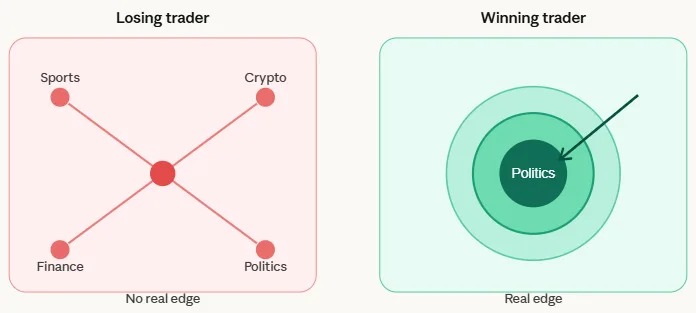
The biggest difference between winning and losing traders is specialization. Top Polymarket traders pick two or three categories where they have real knowledge and stick to those. A politics follower has an edge in election markets, a crypto developer has an edge in ETF or protocol markets. Spreading attention across too many categories is one of the most common beginner mistakes.
The other key difference is how they think about probability. Casual traders ask, “Will this happen?” Strong traders ask, “What is the true probability that this happens, and is the market price wrong?” Those are very different questions, and the second one is where actual profit comes from.
The three formulas that drive Polymarket trading strategies
Top traders use three core concepts to make decisions. These are not complicated once broken down.
Expected value
Expected Value tells a trader whether a bet is worth making. If you believe something has a 60% chance of happening but the market prices it at 40%, that gap is your edge. Most traders set a minimum threshold before entering, somewhere between 3% and 10%, to filter out marginal trades. Note that EV does not account for variance, which is where Kelly comes in.
Kelly Criterion
Kelly Criterion handles position sizing. The formula is f = (bp − q) / b, where b is net odds, p is your win probability, and q is loss probability. Never use Full Kelly. Most traders use a quarter of what the formula suggests to protect against estimation errors. Bets will feel small. That is the point.
Bayesian updating
Bayesian updating means adjusting your probability estimate when new information arrives. If you think there is a 55% chance of a Fed rate cut and stronger inflation data comes in, you lower that number. Most people defend their original position instead. It costs them. This is less a formula and more a habit, but it feeds directly into your EV and Kelly inputs.
Prediction market tips that actually matter
Most losses on Polymarket are not caused by bad luck. They stem from mental errors that recur. These prediction market tips address the most common ones.
Base rate neglect
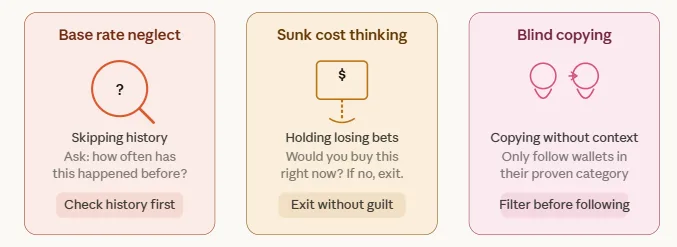
Before deciding something looks likely, ask how often this type of event has actually happened historically. A candidate might look strong in polls, but how often do candidates in that position actually win? Starting with base rates before forming any opinion is a habit that separates disciplined traders from emotional ones.
Sunk cost thinking
If a position drops in value, the only relevant question is whether a trader would buy it right now at the current price with fresh money. If no, exit. The original entry price does not matter anymore.
Copying without filtering
Following a successful wallet sounds smart, but it is risky without context. A trader with an excellent record in crypto markets may have a poor record in political markets. Only follow what they do in the specific category where they have proven edge.
Insider trading is also a real concern in prediction markets. There have been documented cases where newly created wallets entered large positions hours before major geopolitical and political announcements, with timing that investigators found inconsistent with publicly available information.
Both Kalshi and Polymarket have taken steps to address these concerns. Beginners who copy wallets blindly are most exposed to this risk because they have no way of knowing why a position was taken.
How to profit on Polymarket: Start with specialization
There is no single trick to consistent profit on Polymarket. But there is a clear starting point that most successful traders share.
Build domain knowledge first
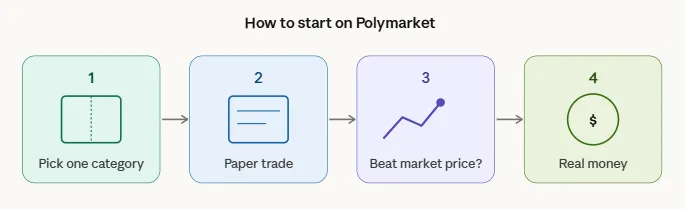
The single most reliable path for a beginner who wants to learn how to profit on Polymarket is to pick one category and go deep. A reader who follows the NFL closely already has more useful information about game outcomes than a general trader reading headlines.
Domain expertise means estimating outcome probabilities more accurately than the market price reflects. That gap is where consistent profit lives.
Paper trade before using real money
For anyone starting out, the practical approach is to paper trade first. Track predictions without real money for a few weeks. If the estimates consistently beat the market price, real money can follow.
A good example of how mispricing creates opportunity: in March 2026, trader LlamaEnjoyer turned $676 into roughly $67,000 in under a minute after UFC announcer Bruce Buffer briefly named the wrong winner of a heavyweight bout. The error sent the actual winner’s shares crashing to 1 cent. The trader recognized the mistake before the broader market corrected itself and bought in during that window – a near 100x return in seconds.
That kind of edge only develops through repetition and focus on one area.
Watch for thin liquidity
Not all Polymarket markets are equally active. A market priced at 55 cents might have a spread wide enough that entering and exiting costs several percentage points on its own. Before placing a trade, check the order book depth. If the bid-ask spread is more than 2–3 cents on a liquid market, the edge needs to be proportionally larger to justify the trade.
Polymarket arbitrage explained for beginners
Polymarket arbitrage means profiting from price differences between markets, without needing to predict the actual outcome.
Cross-platform arbitrage
The simplest version is cross-platform arbitrage. If Polymarket prices a “Bitcoin above $95,000” outcome at 45 cents and Kalshi prices the equivalent contract at 52 cents for “no,” a trader buys both sides for a combined 97 cents and collects $1 at resolution – a guaranteed return regardless of where Bitcoin moves.
In practice, account for gas fees, USDC bridging costs, and how long capital is locked up. On a slow-resolving market, even a 3% spread can look unattractive once annualized. Arb opportunities close quickly, so speed matters.
Resolution rules: The hidden risk
Polymarket arbitrage carries one critical risk beginners often miss. Two platforms may use different resolution rules for what looks like the same event. A government shutdown market might resolve “yes” on one platform based on an official announcement, and “no” on another because the shutdown did not last long enough to meet their specific criteria. Always read the resolution rules on both sides before placing any arbitrage trade.
Regulations and access: What every beginner should know
Polymarket is not available everywhere. Portugal, Argentina, and Brazil have all had regulatory issues with the platform, and the legal situation in many countries can change quickly. Always verify your local status before depositing any funds.
For US traders, Polymarket returned in late 2025 after a $1.4 million CFTC settlement forced it offline in 2022. It is now federally approved, but individual states, including Nevada and Massachusetts, are still pushing back, so check your state status before getting started.
Where to start
Start by picking one market category, learning its resolution rules, and making a small number of trades using the expected value framework. Scale only after seeing consistent results.
For tracking wallet activity and market history, Polymarket’s own activity feed is a reasonable starting point. Community resources like Polymarket Whales (a third-party wallet tracker) can help identify patterns in how experienced traders position themselves, though they should be used as research, not as signals to copy blindly.
Winning on Polymarket is possible. But it requires treating it like a skill, not a shortcut.