


Moving crypto between blockchains is now a routine aspect of decentralized finance (DeFi). Whether you’re shifting liquidity to a cheaper Layer 2 or accessing opportunities on another network, cross-chain bridges are the tools that make it possible.
Cross-chain bridges vary in terms of speed, liquidity, fees, and security. Because of this, you must select the right bridge to transfer crypto between blockchains.
This guide will discuss the best six cross-chain bridges to use in 2026. These picks are based on performance, cost-effectiveness, and reliability.
What is a cross-chain bridge?
A cross-chain bridge is a software that facilitates the movement of assets and information across blockchain networks. Since blockchains are independent, bridges serve as the infrastructure layer that links several blockchains, allowing the free flow of liquidity across ecosystems.
Bridges can handle this process in several ways: Some put the assets under lock on one chain and mint equivalent on the receiving chain, others use liquidity pools, and new systems use intent-based execution where third parties are used to satisfy transactions in real time.
However, these methods have trade-offs in terms of speed, cost, and security, and the choice of the cross-chain bridge to use is very important.
Top 6 cross-chain bridges for 2026
The following are the best cross-chain bridges that you can use to transfer crypto between blockchains.
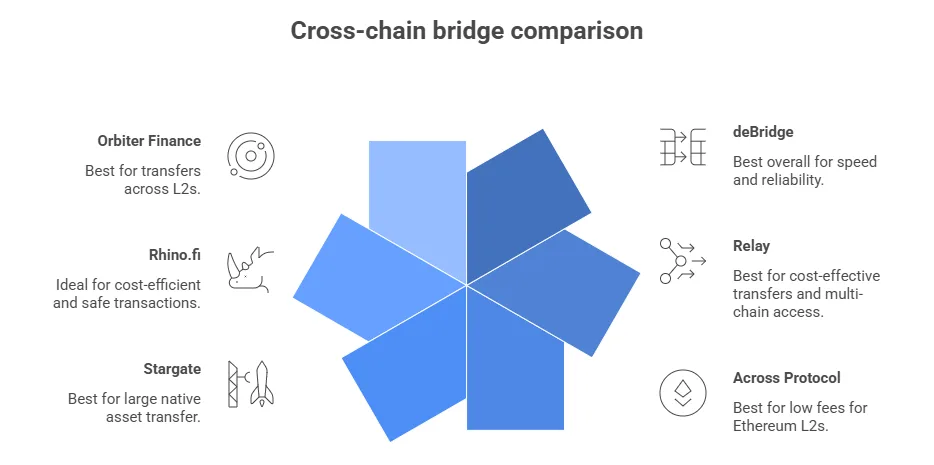
1. deBridge: Best overall for speed and reliability
deBridge is a fast and efficient bridge. Its intent-based design enables liquidity providers to complete transactions in a near-instant manner, eliminating the delays that are normal with cross-chain transfers.
It also transcends mere transfers of tokens and includes cross-chain messaging, which is also handy to developers and other advanced DeFi users. deBridge can be a great option for high-value transactions or users who need fast execution.
Pros
- Sub-2-second settlement speeds
- Good security track record, not having any major exploits.
- Messaging supports complex cross-chain messaging.
- Supports large cross-chain transfers
Cons
- May be complicated for the novices.
- The flat fees are not so good when it comes to small transfers.
- The interface is too complex
2. Relay: Best for cost-effective transfers and multi-chain access
Relay eliminates the problem of high gas costs of gas between the networks. It has a built-in gas abstraction mechanism, enabling one to transact automatically, without any extra process taking place.
Relay covers a vast number of networks, including niche ecosystems, thus being suitable for users who aspire to experiment with new chains or incorporate assets in various environments. It is a fast-executed design based on a relayer, but some trust assumptions are introduced.
Pros
- Removes the need for destination gas tokens.
- Extensive network coverage, niche chains as well.
- Quick performance using the relayer network.
- Simplifies cross-chain experience.
Cons
- The relayer model brings in trust issues.
- Performance depends on liquidity availability.
- Restricted growth outside some of the ecosystems.
3. Across Protocol: Best for low fees for Ethereum L2s
Across Protocol is designed to be efficient, especially in the Ethereum Layer 2 ecosystem. The relayer-based system introduces competition that helps in reducing the fees, while retaining fast execution.
This bridge is one of the most affordable networks for users who need to cross networks, such as Arbitrum, Optimism, and Base, regularly. The transfers are normally done fast and with minimal slip, and performance is predictable.
Pros
- Competition between relayers makes fees very low.
- Rapid and speedy transaction rate.
- Superior security through optimistic oracle design.
- Fit for frequent DeFi use.
Cons
- Lack of support for non-EVM chains.
- Fees can vary during network congestion.
- Less developed routing facilities.
4. Stargate: Best for large native asset transfer
Stargate is one of the best bridges that ensures the effective transfer of large volumes. It features a liquidity model that supports native assets to be transferred without the risks of working with wrapped tokens.
This bridge is especially helpful in the transfers of stablecoins and high-value transactions, where a level of security and liquidity is needed. Although it is not the fastest, it is the most reliable one.
Pros
- Supports unwrapped native assets transfer.
- Deeper liquidity for bigger transactions.
- Proven performance and usage.
- Strong infrastructure backing.
Cons
- Intent-based bridges are faster.
- Fees increase when usage peaks.
- Inflexible compared to aggregator-style platforms.
5. Rhino.fi: Ideal for cost-efficient and safe transactions
Rhino.fi is designed to provide security to cross-chain transfers at an affordable cost. It is built on the StarkEx technology, which helps minimize gas fees and facilitate better security.
It is easy to operate as it enables customers to bridge funds directly into centralized exchanges. Rhino.fi also supports emergency withdrawals, thus ideal for users seeking secure and fast withdrawals.
Pros
- High security provisions and fallback provisions.
- The StarkEx model supports gas-efficient transfers.
- Reciprocates a variety of Layer 2 ecosystems.
- Makes the process of exchanges onboarding easier.
Cons
- Fixed fees are not favorable for small transfers.
- Supports major assets only.
- It is complex to set up.
6. Orbiter Finance: Best for transfers across L2s
Orbiter Finance is fast in the Ethereum rollup system. It involves a maker-based model to conduct transactions in a fast manner without involving the use of conventional validation systems.
This bridge can be used for smaller transfers between the Layer 2 networks. It may not be very effective for large volume transfers, but it is cost-effective for small and quick transactions.
Pros
- Rapid and quicker Layer 2 transfers.
- Small transactions attract low charges.
- No-frills and no-distraction user experience.
- Good results in rollup ecosystems.
Cons
- Not important in transfers of large size.
- Limited asset support
- Relies on maker liquidity.
How to choose a cross-chain bridge effectively
Choosing which cross-chain bridge to use when moving crypto between blockchains narrows down to preference and individual needs. To some extent, your decision may be influenced by the following factors:
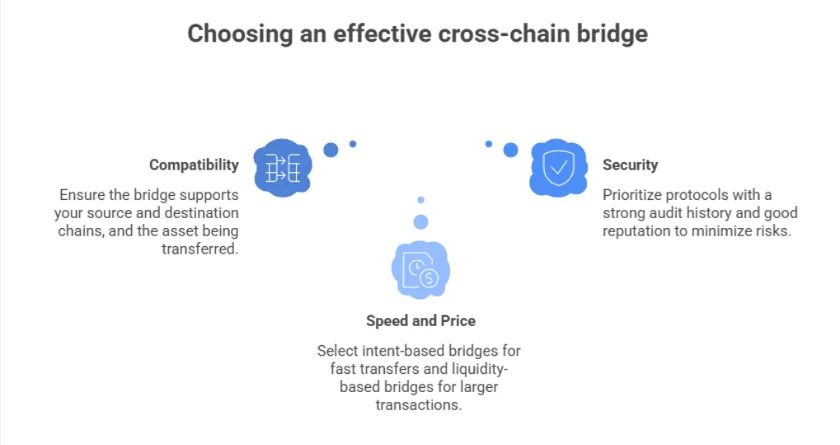
- Compatibility: You must select a bridge that is compatible with the source chain and destination chain. Also, your choice of bridge can be influenced by the particular asset being transferred.
- Speed and price: Intent-based bridges (including deBridge and Across Protocol ) are ideal for fast transfers, whereas liquidity-based bridges (including Stargate ) are more reliable for larger transactions.
- Security: Opt for protocols that have an impressive audit history, are highly liquid, and have a good track record. Bridges are one of the primary targets of crypto exploits in the past, and reputation is important.
When it comes to selecting a bridge, never commit without trying. Performing a small transaction can help to prove that everything is going as planned and minimize the possibility of making expensive errors.
Final verdict
Cross-chain bridges are a fundamental component of moving assets across multi-chain ecosystems. The perfect choice depends on what you desire most: speed, cost, or security.
For example, deBridge and Across Protocol are the best in terms of performance and efficiency, Rhino.fi and Relay are better in terms of usability, and Stargate and Orbiter are better for a particular use case. Nonetheless, combining different models can help achieve better performance depending on your needs.