



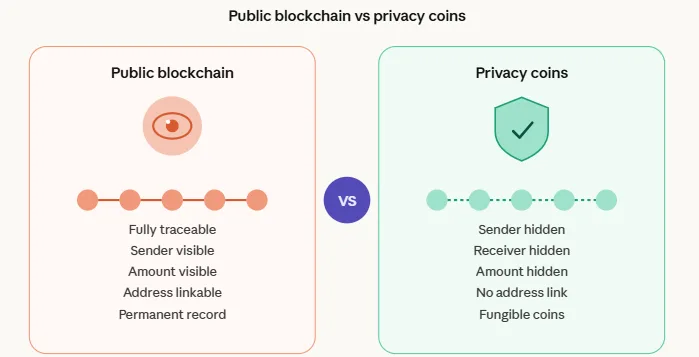
When people first get into crypto, privacy is usually not the first thing on their mind. But the more someone learns about how public blockchains actually work, the more it starts to matter. Every transaction on Bitcoin or Ethereum is recorded forever on a public ledger, and with the right tools, it can be traced back to a real person. That is where privacy coins come in.
This list covers the top 8 privacy coins by market cap for anyone just getting started. The focus is on what each coin actually does, not hype.
What are privacy-focused cryptocurrencies?
Bitcoin is often described as anonymous. It is not. It is pseudonymous, meaning transactions are tied to wallet addresses rather than names, but those addresses can be linked to identities through exchange records or on-chain analysis. Privacy-focused cryptocurrencies close that gap entirely.
In privacy-focused cryptocurrencies, privacy is built into the base layer of the protocol. The transaction hides the sender, the receiver, and the amount by default, or at least gives users the tools to do so.
Why anonymous cryptocurrencies matter
There is a common assumption that anyone who wants financial privacy must have something to hide. That is not really how it works. Anonymous cryptocurrencies are used by people in authoritarian countries who need to move money without government interference, by businesses that do not want competitors tracking their transactions, and by ordinary people who just do not think their financial history should be public.
Cash has always offered privacy that digital payments stripped away. Anonymous cryptocurrencies are an attempt to bring that back.
Privacy coins list: Top 8 by market cap
This list of privacy coins includes only coins with a market cap above $10 million. Market cap is the total value of a coin in circulation, calculated by multiplying the current price by the total supply in the market.
They fall into three categories: large cap sits above $1 billion, mid cap runs from $100 million to $1 billion, and small cap covers $10 million to $100 million. These categories reflect relative sizing within the privacy coins sector and do not follow the same thresholds used for the broader crypto market.
Market cap figures are approximate and based on data from early 2026. Rankings and valuations shift frequently, so it is worth verifying current numbers before making any decisions.
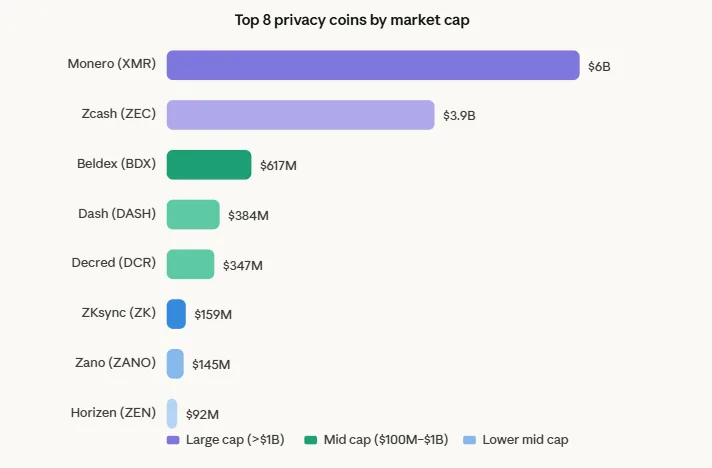
1. Monero (XMR), ~$6 billion (large cap)
Monero has been the go-to privacy coin for years and still holds that position. Every transaction is private by default using three mechanisms. Ring signatures blend the sender’s transaction with others so the origin cannot be pinpointed. Stealth addresses create a one-time address for every transaction, so the recipient’s real address never appears on-chain. RingCT hides the amount being sent.
Because privacy is mandatory, every XMR coin is fungible, meaning no coin can be flagged based on its history. It consistently tops any serious privacy coins list.
2. Zcash (ZEC), ~$3.9 billion (large cap)
Zcash brought zk-SNARKs to crypto, a form of zero-knowledge proof that lets someone prove a transaction is valid without revealing a single detail about it. Not the sender, not the receiver, not the amount.
The catch is that privacy on Zcash is optional. Most users still choose transparent addresses, which means the anonymity pool for shielded transactions is smaller than it could be. The technology is strong, but adoption of the private features has been slow.
3. Beldex (BDX), ~$617 million (mid cap)
Beldex started as a Monero fork and inherits solid base-layer privacy. What sets it apart is the ecosystem built around the coin: BChat, an encrypted messenger, BelNet, a decentralized VPN, a privacy-first browser, and BelPay for merchants.
Most privacy coins focus purely on transactions. Beldex is building a broader toolkit for people who want to keep their entire digital activity private.
4. Dash (DASH), ~$384 million (mid cap)
Dash launched as Darkcoin, a privacy-first coin, before pivoting hard toward everyday payments. PrivateSend, its mixing feature, is still functional, but rarely the reason anyone picks it up today.
Dash makes this list on market cap alone – it has real-world usage in Venezuela and parts of Africa as a payments tool, but anyone specifically shopping for privacy should look elsewhere on this list first.
5. Decred (DCR), ~$347 million (mid cap)
Decred is a bit of an odd one on this list because privacy is not really its identity. The project is built around giving token holders genuine control over how the blockchain is run, including votes on upgrades and how the treasury gets spent. That part actually works and is taken seriously by its community.
The privacy feature, CoinShuffle++, handles mixing directly between users with no server sitting in the middle. For someone who values both privacy and not having developers make all the decisions, Decred covers both.
6. ZKsync (ZK), ~$159 million (mid cap)
ZKsync is not a privacy coin in the traditional sense, and it does not claim to be. It is a Layer 2 scaling solution built on Ethereum that uses ZK-Rollups to batch transactions and settle them on the mainchain as a single proof. The side effect is that individual transaction details do not get exposed on Ethereum’s public ledger. It earns a spot on this list specifically for Ethereum users who want reduced on-chain exposure without switching ecosystems or wallets.
7. Zano (ZANO), ~$145 million (mid cap)
Zano quietly does a lot of things well. It uses ring signatures and confidential transactions, runs on a hybrid Proof-of-Work and Proof-of-Stake setup, and lets developers build their own private tokens on top of it through a confidential asset layer. Those tokens carry the same privacy properties as the base coin, which is not something many projects offer.
It also has Ionic Swaps, which allow cross-chain trades without leaking user data in the process. Not many people talk about Zano, but the technical foundations are genuinely solid.
8. Horizen (ZEN), ~$92 million (small cap)
Horizen began as a Zcash fork and grew into a platform for building privacy-preserving sidechains through its Zendoo protocol. Businesses can deploy their own private blockchains connected to the Horizen mainchain, useful anywhere organizations need to handle sensitive data without putting it on a public ledger.
Privacy coins market cap: What the numbers tell us
Monero and Zcash sit in a different category from everyone else in the privacy coins market cap breakdown. Both have been around long enough to build serious trust. The rest of the privacy coins market cap sits in the mid cap range, with several projects taking different approaches to the same problem, which reflects a space that is still developing.
Privacy coins comparison: Mandatory vs optional
The most useful lens for any privacy coin comparison is whether privacy is automatic or only when a user chooses it. Monero, Beldex, and Zano make it mandatory, which creates a stronger and more consistent anonymity pool. Zcash, Dash, and Decred make it optional, which helps with exchange listings but comes with a tradeoff: when most users choose the transparent option, shielded transactions can stand out more.
Any solid privacy coins comparison also needs to account for availability, since Monero has been delisted from several major exchanges in certain regions due to compliance pressure.
Top privacy coins: What beginners should check first
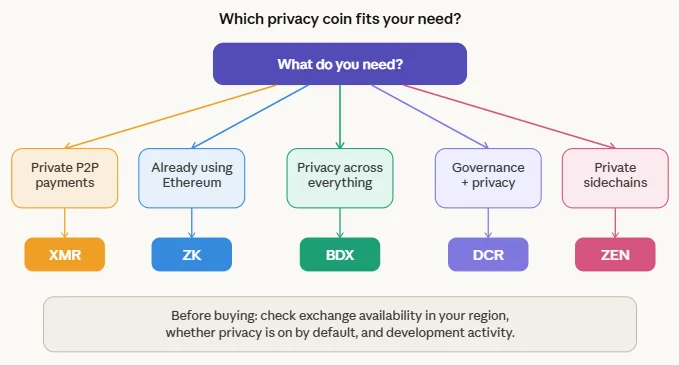
The best way to approach top privacy coins for the first time is to start with a specific use case. Someone who wants private peer-to-peer payments will likely land on Monero. Someone already on Ethereum will find ZKsync more practical. Someone who wants privacy across messaging, browsing, and payments should look at Beldex. The top privacy coins each solve a slightly different version of the problem.
Before buying, it is worth checking exchange availability in the relevant region, how active the development team is, and whether privacy is on by default or needs to be manually enabled.
Final takeaway
Privacy in crypto is no longer a niche concern. As governments and analytics firms get better at tracing on-chain activity, the case for privacy coins gets stronger. The eight projects in this list are the most established options in the space, each with real technology behind them and communities that have been building for years.
None of them are perfect, and regulatory pressure on the sector is real. But for anyone serious about financial privacy, these coins are the most credible starting points available right now.