

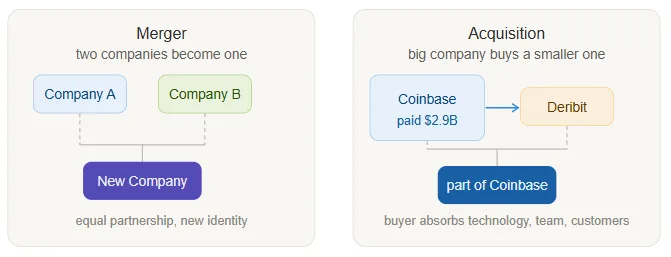
M&A stands for mergers and acquisitions, which is when one company buys another, taking its technology, licenses, team, and customers with it. In crypto, this looks like a blockchain company writing a billion-dollar check to absorb a smaller firm and instantly gain capabilities that would’ve taken years to build.
A trend is just a pattern repeating across an industry. Crypto M&A trends, then, means looking at what kinds of deals are happening, who’s doing them, and why the same logic keeps showing up across different companies.
The crypto industry spent years being dismissed as too volatile and too unregulated for serious business to take root in. That changed in 2025, when crypto M&A trends hit all-time records and drew in players that had never touched digital assets before. The era of building everything from the ground up is giving way to an era of acquiring capabilities and scaling fast.
This piece breaks down the record numbers, the biggest deals, why traditional finance is buying its way into crypto, and where things stand heading through 2026.
The numbers behind crypto’s most active M&A year ever
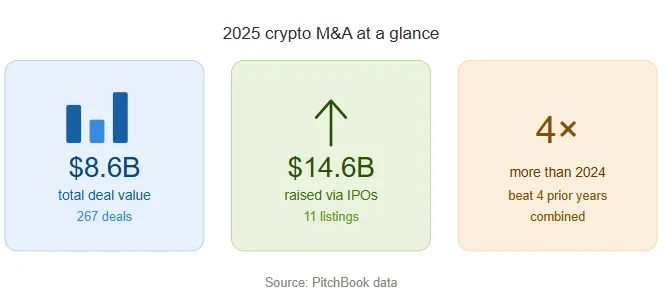
In 2025, crypto M&A activity reached approximately $8.6 billion across 267 completed deals. That total exceeded the combined value of the four previous years. Advisory firm Architect Partners, using a different methodology, estimated the figure closer to $12.9 billion.
Public markets moved in parallel. At least 11 crypto companies listed publicly in 2025, raising roughly $14.6 billion globally. In 2024, that same category brought in just $310 million from four listings. The shift from private funding to public markets, and from organic growth to acquisition, reflects an industry that’s consolidating rather than just expanding.
Even with some market turbulence toward the end of 2025, crypto M&A activity remained steady. Companies weren’t pulling back. They were positioning.
The strategic logic behind every major crypto acquisition
Earlier waves of crypto acquisitions were largely opportunistic. When FTX collapsed and the market cratered in 2022, stronger players swooped in and picked up distressed assets for cents on the dollar. The blockchain M&A trends seen in 2025 were entirely different. Buyers weren’t waiting for someone to fail. They were going after specific capabilities they needed to stay competitive in a market that was finally attracting institutional money and regulatory scrutiny.
What they were buying tells you everything about where the industry is headed. Regulatory licenses and compliance infrastructure topped the list, followed by payments rails, stablecoin technology, derivatives platforms, custody solutions, and enterprise treasury systems.
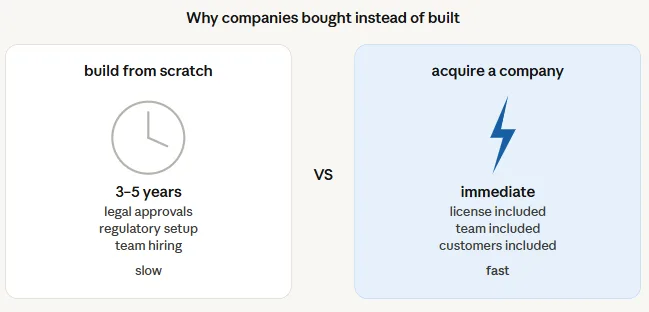
The reasoning isn’t complicated. Building any of those from scratch takes years of engineering work, legal approvals, and regulatory relationships. Buying a company that already has them cuts that timeline down dramatically.
What changed in 2025 that made billion-dollar deals possible
Regulatory clarity was the single biggest unlock. For years, crypto companies operated in a legal grey zone that made large acquisitions risky. Buyers couldn’t be sure what they were actually purchasing in terms of legal standing, and sellers couldn’t command fair valuations amid uncertainty.
That changed in 2025. The Trump administration took an openly pro-crypto stance from early in the year, and the GENIUS Act established a federal framework for stablecoins that gave institutions a clear path to engage with digital assets without regulatory exposure. The OCC also granted conditional approval for five national trust bank charters tied to digital assets, covering BitGo, Circle, Fidelity Digital Assets, Paxos, and Ripple. That single move brought stablecoin and custody infrastructure under federal banking oversight for the first time.
For acquirers, this meant deals that would’ve been legally complicated a year earlier were suddenly executable. For sellers, it meant their licenses and compliance infrastructure had real, defensible value. That alignment between buyer appetite and seller leverage is what turned 2025 into a record year.
Who spent what and why: Crypto’s landmark deals of 2025
Three companies drove the bulk of 2025’s deal value, each with a different strategic playbook.
Coinbase
Coinbase led deal activity with six acquisitions during the year. The largest was its $2.9 billion purchase of Deribit, one of the world’s leading crypto options and futures exchanges, and the single largest acquisition in crypto history. That deal gave Coinbase a major foothold in derivatives trading outside the United States. Its other five acquisitions that year covered:
- Spindl, a blockchain-based advertising platform
- Roam, a blockchain-based search engine team
- Echo, an on-chain capital raising platform
- Vector.Fun, a meme coin exchange
- Liquifi, a token management company
Together, they expanded Coinbase’s presence across a wide range of crypto services in a single year.
Ripple
Ripple made four major moves. It purchased Hidden Road, a global prime brokerage (a firm that provides financing, clearing, and execution services to institutional traders), for $1.25 billion, making it the first crypto firm to own that type of institutional service.
It also acquired the corporate treasury management company GTreasury for $1 billion, the stablecoin payments platform Rail for $200 million, and the wallet and custody firm Palisade. The strategy was to build out institutional infrastructure and strengthen the real-world utility of its stablecoin.
Kraken
Kraken closed five deals, starting with futures trading platform NinjaTrader for $1.5 billion, its largest acquisition of the year. It followed with no-code trading platform Capitalise.ai, then multi-asset investment platform Breakout, then acquired Small Exchange for $100 million, giving Kraken the ability to build regulated derivatives markets for US clients. It rounded out the year by acquiring Backed Finance AG, the company behind tokenized equities platform xStocks.
TradFi didn’t build its way into crypto, it bought its way in
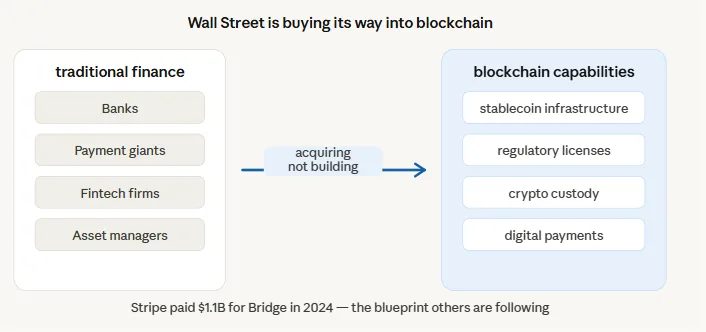
One of the more significant developments in 2025 was who started showing up as buyers. It wasn’t only crypto-native companies acquiring other crypto companies. Established financial institutions and payments businesses began using M&A to enter digital assets faster than they could build internally.
Major financial institutions, including Fidelity and Bank of America, signaled interest in growing their digital asset offerings through acquisitions. Payment giants, including Visa, Mastercard, and PayPal, are moving in the same direction, exploring blockchain integration through deals rather than building in-house. Stripe already made that move concrete in 2024, acquiring Bridge, a stablecoin infrastructure company, for $1.1 billion.
The entry of firms with deep capital and regulatory relationships changes the stakes for the entire industry. For most people, that’s a faster path to crypto adoption than any marketing campaign or price rally has ever managed.
How crypto M&A quietly changes the apps you already use
Most people aren’t going to download a new app to try crypto. But if their banking app adds a stablecoin payment option, or their payroll platform starts settling in digital assets, they don’t have to. The technology arrives inside something they’re already opening every day, and the learning curve that kept majority of the people out quietly disappears.
Stripe’s acquisition of Bridge is a good example of this. Stripe processes payments for millions of businesses worldwide. By bringing stablecoin infrastructure in-house, it can now offer those businesses faster, cheaper cross-border payments without them ever needing to understand the blockchain technology underneath.
There’s also a regulatory argument here. When established institutions have large financial commitments in crypto, they’ve got a strong incentive to push for clear and workable regulation. That tends to support stability over time, even if the short-term market stays unpredictable.
Consolidation continues, but the easy wins are gone
The 2026 picture is more complicated than last year’s momentum suggested it would be. The IPO wave that defined 2025 has hit early turbulence. BitGo became the first major crypto listing of 2026, but its stock has fallen roughly 54% from its offering price. Kraken, which filed confidentially with the SEC in November 2025, has since paused its IPO plans, citing difficult market conditions.
That doesn’t mean activity has stopped. Industry insiders expect 2026 to bring more participation from traditional companies in M&A, alongside the potential for the first merger of equals between large crypto or stablecoin companies. With crypto capabilities increasingly embedded in mainstream finance, 2026 is shaping up to be another year of aggressive consolidation as companies race to build comprehensive, end-to-end platforms.
The consolidation era that defined 2025 isn’t over. It’s just getting more selective.