


Cryptocurrencies have now become a norm in the modern-day financial sector. Yet many individuals still find it hard to buy or sell these digital assets. However, crypto ATMs make the process simple, even for beginners.
A crypto automated teller machine (crypto ATM) allows users to buy or sell top cryptocurrencies using money or an electronic wallet. These machines have gained popularity among beginners and users interested in easy and secure means of accessing crypto.
How do crypto ATMs work?
A crypto ATM is an electronic machine that is connected to cryptocurrency exchanges to enable individuals to purchase or sell cryptocurrencies in a simplified and rapid way. These terminals have real-time prices of certain cryptocurrencies and will be able to make secure transactions.
To buy crypto using a crypto ATM, you have to choose the type of cryptocurrency you want to buy or sell, link your wallet by scanning a QR code, and deposit the money. The tokens are then sent to the wallet address in a near-instant transaction.
On the other hand, selling requires you to scan a QR code and then send your crypto to the ATM, which then pays out the funds to you in cash.
These terminals operate just like conventional bank ATM or ticketing machines. The only variation is that they enable the two-way process of buying and selling, unlike bank ATMs or ticketing booths, which mostly support buying with no selling.
Any activity of all crypto ATMs is logged in the blockchain (permanent digital ledger), which guarantees the transparency of all the transactions. The records are immutable; that is, once a transaction is verified, it cannot be changed.
The majority of crypto ATMs are situated in high-traffic areas, such as shopping centers, gas stations, airports, and restaurants. With Bitcoin ATMs dominating, there are limited machines that accept several altcoins.
How does a Bitcoin ATM work? Step-by-Step Guide
The process of using a Bitcoin ATM has a straightforward set of steps:
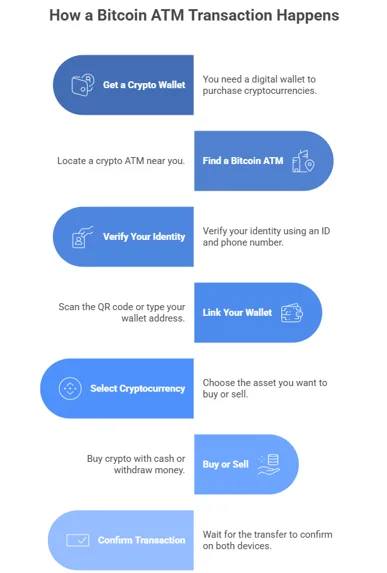
- Get a crypto wallet: To purchase cryptocurrencies, you are going to need a digital wallet. You can opt for software-based or hardware-based wallets, but do remember to note your wallet and address.
- Find a Bitcoin ATM: After getting a wallet, you then have to locate a crypto ATM near you. Bitcoin machines are available in most locations compared to altcoin machines, for Ethereum and other altcoins; thus, location matters.
- Verify your identity: In most cases, you will ned to verify your identity using an ID or a social security number (SSN). A working phone number is also needed to verify your identity.
- Link your wallet: You can begin to set up a wallet. Scan the QR code or type your wallet address to connect the crypto ATM to your profile.
- Select cryptocurrency: Select the asset that you would like to sell or purchase. Bitcoin appears on most machines, while others also support Ethereum and Litecoin, plus several smaller coins available on certain kiosks.
- Buy or sell: You can buy crypto using cash or take money out after sending coins from the wallet you already control.
- Confirm transaction: You must wait until your transfer shows confirmed on both the machine and your wallet. A receipt will help you maintain a record of the crypto transaction.
Pros and cons of crypto ATMs
Crypto ATMs have both advantages and disadvantages, which include the following. Understanding these advantages and disadvantages is crucial for you to determine whether crypto ATMs are worthwhile.
Benefits:
- User-friendliness: The machines are user-friendly, and even beginners can make transactions within minutes.
- Accessibility: Crypto ATMs allow anybody to buy or sell cryptocurrencies in a fast and secure manner.
- Financial inclusion: This service can be used by individuals who do not have access to traditional banking services or access to crypto exchanges.
- Swift transactions: A blockchain transaction is nearly instant, and you can buy or sell cryptocurrencies fast.
- Public access: Most of the machines operate 24 hours and can be accessed by anyone.
Drawbacks:
- High transaction costs: Compared to online crypto exchanges, the ATM fees are significantly more expensive, and some of the services even impose fees on the entire transaction at a rate of up to 20%.
- Transaction limits: In all crypto-ATMs, there are transaction limits that cover both the minimum and the maximum amount of money that you can transact in a single day.
- Price mark-ups: Some crypto ATM operators mark up tokens, increasing their prices compared to the market prices.
- Security risks: Bad actors may set up illegitimate crypto ATM machines, resulting in loss of funds.
Although crypto ATMs have their drawbacks, the advantages outweigh the disadvantages, and therefore, these terminals are ideal to use, particularly in cases where there is limited access to crypto exchanges.
Crypto ATM fees
Crypto ATMs are more expensive to use than online exchanges. Most crypto ATMs charge between 4% and 20% in transaction fees. Smaller service providers, like CoinFlip, charge about 6-10% per transaction. Bigger operators, like Bitcoin Depot, on the other hand, can impose a transaction fee of up to 20%.
The high fees are a trade-off for convenience, automatic transactions, accessibility, and markups set by the crypto ATM operators. Despite the high fees, however, these machines offer swift crypto transactions on the go.
How secure are crypto ATMs?
Cryptocurrency ATMs have minimal risks when used in a reasonable way. However, the risks are not completely absent. A recent report by Certik revealed that crypto ATM fraud has been rising recently.
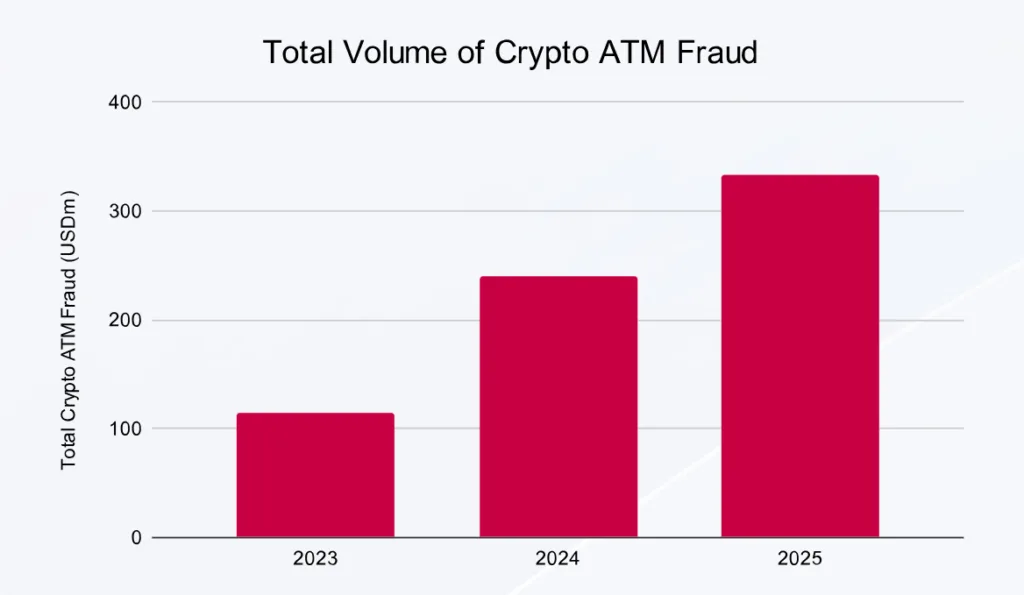
The report noted that the losses at the crypto ATMs had soared to a high of $333.5 million in 2025 due to the speed and irreversibility of the machines. It also showed that the FBI registered more than 12000 complaints between January and November 2025. These complaints marked a 33% increase from 2024.
Despite the risks, however, you can use various ways to reduce crypto ATM risks. For example, you should only use crypto ATMs in open areas, and better still, have a friend by your side when transacting big sums. Also, always verify that the transaction completed on both the ATM and your wallet.
Crypto ATMs’ regulatory environment
The rules and regulations around cryptocurrency ATMs differ based on jurisdictions. Certain nations are apprehensive, while some provide clear guidelines for the setup and use of crypto ATMS.
Most countries require crypto ATMs to comply with KYC (Know Your Customer) and AML (Anti-Money Laundering) standards. This gives authorities oversight to prevent suspicious transactions.
The UK FCA closed over 2000 ATMs installed by the illegal providers in 2024 alone. However, Canada has a friendly regulatory environment, allowing extensive use of ATMs without much verification.
Countries that permit the use of crypto ATMs include the United States, Canada, Germany, Romania, Mexico, and Argentina. However, the service is banned in the United Kingdom, China, New Zealand, and Singapore. Brazil, South Africa, and the United Arab Emirates (UAE) have also emerged as new jurisdictions supporting active use of crypto ATMs.
Finding a crypto ATM near you
Online research comes in handy when it comes to finding a crypto ATM near you. However, some platforms, such as CoinATMRadar, can allow you to locate cryptocurrency ATMs in your neighborhood. Since supply is not always the same, particularly with altcoins, it is prudent to perform extensive research using more than one platform.
How secure and safe to use a crypto ATM is, is often depends on the location and operator. It is essential to carry out comprehensive research prior to using any crypto ATM to buy or sell crypto.
Moreover, do not forget to observe the best security practices of crypto ATMs, as you can easily lose money to fraudulent and illegal crypto ATM operators.