

Token sales have become a standard method that crypto projects use to raise money without having to rely on banks or traditional investors. As more people adopt blockchain, many new crypto projects are coming to this model, as it enables them to reach a global audience and receive funding in a short period of time.
For investors, token sales are a way to get access to new projects early on before they appear on exchanges or in the mainstream. Understanding how token sales work is important for investors interested in participating in crypto without just buying coins from crypto exchanges.
These early-stage token sales present high-upside potential in some instances. However, risks are common too, and that’s why you need to understand the methods of crypto token sales fully before committing your capital.
What is a crypto token sale?
A crypto token sale is a fundraising method that new crypto projects use to raise funds for the development of key services, features, or operations. It involves early-stage commitment to a future project. However, in some instances, some projects deliver working tools, products, or services before the token sales.
In most scenarios, the tokens are built on existing blockchains such as Bitcoin, Ethereum, Solana, and others, to allow early participants to exchange stablecoins and top cryptos for the new tokens in the token sale. Some projects also support fiat purchases, allowing non-crypto holders to participate in the blockchain token sales.
Since the majority of the tokens allow access to a platform or service, or ownership rights to a platform that does not exist yet, the value of the tokens is defined by the success of the project and user traction.
To investors, token sales offer a low entry price, but come with increased risk. The token can become worthless in case the project fails.
The process of a blockchain token sale
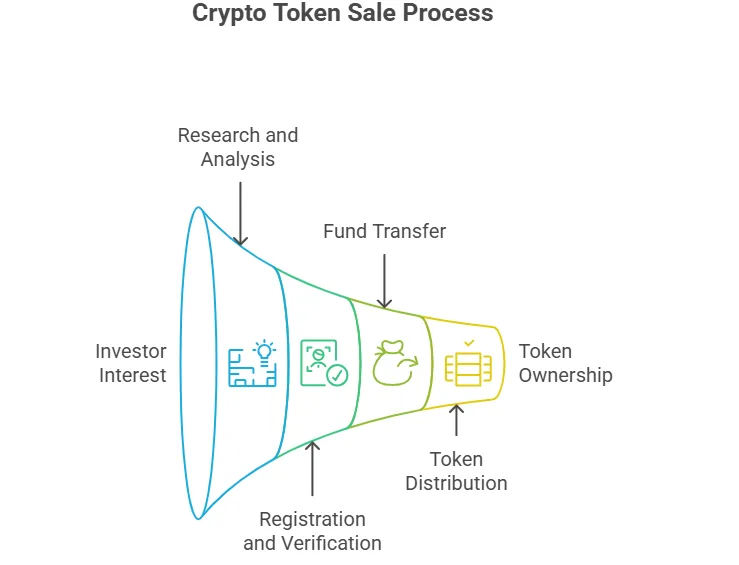
Although each project may have some slight differences, most token sales follow a similar process. First, investors go through the whitepaper, road map, and the project’s token structure. This step is important to know what the project is building and if it is realistic.
Then users are required to register and verify their identity, aiding in meeting regulatory requirements as well as controlling who gets to participate. After verification, investors transfer money, typically in the form of cryptocurrency or fiat, to the designated wallet/website. Investors then receive the tokens as per the terms of the sale.
Upon completion of the sale, tokens are dispensed, and in certain arrangements, a few of them may be locked for early investors or on the project development team.
Types of token sales
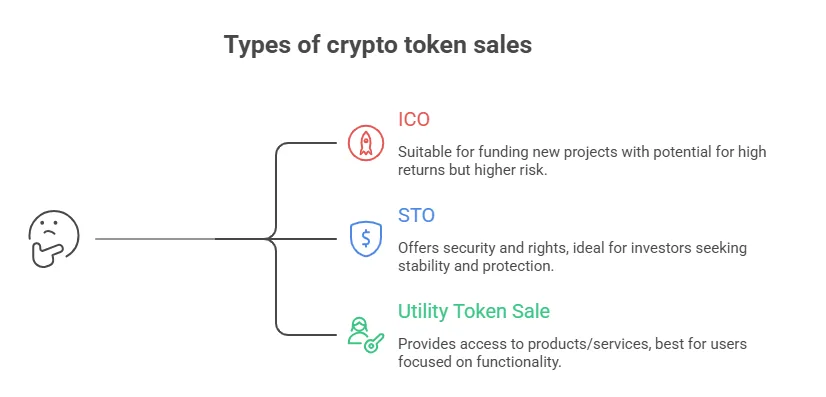
There are three main types of token sales. Each has a different structure, level of risk, and regulatory approach.
1. Initial coin offerings (ICOs)
An initial coin offering is one of the earliest models used in crypto fundraising. In an ICO, a project sells its tokens directly to the public, usually before the platform is live. This model became popular because it allows anyone to invest without restrictions.
ICOs are simple in structure. A project releases a whitepaper, sets a token price, and opens the sale. Investors send funds and receive the tokens in return. While this model opens the door to huge opportunities, it has also resulted in many failed or fraudulent projects because of the lack of regulation.
Pros
- Low entry price for early investors
- Open access to participating internationally
- High potential returns if the project is successful
Cons
- High chances of scams/poor quality projects
- No guaranteed investor protection
- Many projects fall short of delivering
2. Security token offerings (STOs)
A security token offering is a form of crypto token sale that brings regulation into token sales. The tokens sold in an STO represent the ownership of underlying assets such as company shares, real estate, or revenue streams. Such tokens are categorized as securities and have to comply with the law.
STOs’ underlying structure ensures investor protection. However, they may feature participation limitations based on location or investor status.
Pros
- Legal rights and protections for investors
- Backed by real-world assets
- Increased transparency with respect to ICOs
Cons
- Restricted access because of regulations
- Slower process, more complex process
- Reduces the possibilities of low short-term profits
3. Utility token sales
Utility token sales involve the sale of tokens in order to finance the development of a project and are used within its ecosystem. The tokens sold are intended to provide utility or serve a particular purpose in the project. Hence, these tokens do not represent ownership but service access to services, features, or products.
For instance, some type of token may be needed to buy things or just to provide access that would otherwise only be available if bought on the platform, or to take part in governance. The value of the token is dependent on the adoption of the platform.
Pros
- Clear use inside a platform or ecosystem
- Widely accessible to users
- High growth potential if increase in adoption
Cons
- No ownership or legal rights
- Value is completely dependent on project success
- Can be overvalued at the early hype stage
Airdrops: An alternative to crypto token sales
Airdrops are commonly associated with token sales, but they are not the same thing. This form of early token access helps investors get free tokens. Often, new projects issue out free tokens as a way to drive project adoption, reward loyal users, or incentivize community building.
Most crypto airdrops only require user registration, active platform use, or the ownership of particular cryptocurrencies. Airdrops do not involve any financial investment, but rather demand participation.
Just like tokens purchased through token sales, some airdropped tokens can gain value over time, while others don’t. Even though airdrops are not categorized as a fundraising process, they are still an integral part of how tokens are distributed in the crypto space.
Benefits of participating in a token sale
Token sales remain popular with investors because of the opportunities they are entitled to, which are not always available elsewhere in the market.
- Early access: Investors get early access to new projects before the rest of the crowd, meaning they get to enjoy price explosions before everyone else.
- Liquidity: Most tokens are tradable post-launch, implying that investors can sell them for profit realization.
- Diversification of portfolio: Presale cryptos allow investors to diversify their risk into various high-upside crypto projects.
- Direct project support: The funds raised during token sales go directly into project development or support daily team operations, thus supporting innovation.
Risks to consider before participating in crypto token sales
Despite their high upside potential, crypto token sales also come with some risks. Before participating, investors must fully understand the underlying risks.
- Project failure: Some projects fail, leading to loss of invested funds
- Market volatility: Crypto tokens are prone to market volatility and could crash right after listing on exchanges
- Regulatory uncertainty: Regulations vary depending on jurisdictions, meaning some countries may limit access to blockchain token sales
- Scams and fraud: Some projects are sub-par and could result in rug pulls in some instances
- Weak tokenomics: Token supply matters a lot in crypto, and some token sales may feature insider advantage to developers who get to control price movements after launch
Final thoughts
Crypto token sales give blockchain teams a way to raise capital before their product or platform is fully live. Investors who join early get access to tokens at initial prices, while developers secure funding without relying on banks or traditional financing routes.
There are several types of token sales, including ICOs, STOs, and utility token offerings. Each comes with its own structure, benefits, and level of risk. Airdrops add another angle, letting users receive free tokens as part of early promotion or community building.
That said, the potential for high returns comes with serious downsides. Investors must perform extensive research and careful decision-making before joining any crypto token sale.