



Did you know that the first buyer of almost every new altcoin launch isn’t a human? There’s an automated program that gets in before anyone else, locks in the lowest entry price, and is already holding a position by the time regular traders are loading up their wallets. By the time your transaction confirms, the price you’re paying was largely set by that program.
That program is called a sniper bot. Once you fully understand what it does, a lot of things start making sense: why launch charts spike so violently in the first few seconds, why getting in “early” still somehow feels like buying the top, and why the timing never quite works out the way you expected.
What is a sniper bot in crypto?
A sniper bot is an automated program built to execute trades in milliseconds, designed to get into specific moments like a new token going live before anyone else can.
Here’s the number that puts it in perspective. Your average reaction time as a human is around 250 milliseconds. A sniper bot acts in under 1 millisecond. That’s not a minor difference. That’s the gap between getting in at launch price and getting in after a bot has already pushed it up significantly while you were still typing your wallet password.
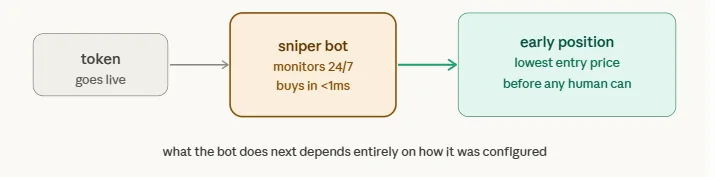
The blockchain waiting room bots exploit (yes, there’s a line)
Every blockchain has a mempool, basically a waiting room where transactions sit in line before they get officially recorded on-chain. Sniper bots are parked at the edge of that waiting room at all times, scanning for anything that looks like an opportunity: a new token launching, liquidity getting added to a decentralized exchange like Uniswap or Raydium.
The second one pops up, the bot moves. It pays a higher gas fee to cut the line and secures a position before any human trader even knows the token exists.
A concert ticket scalper with a supercomputer is probably the most honest comparison here. By the time the sale opens, the bot has already bought hundreds of tickets and is flipping them at twice the price.
Meme coins are why sniper bots went mainstream
Sniper bots existed before crypto, first appearing in eBay auctions to place last-second winning bids, but the meme coin boom is what turned them into a serious trading tool.
Tokens like Shiba Inu, PEPE, and Dogwifhat showed that a coin could go from nothing to millions in market cap within hours, and bots were built specifically to capture that window before anyone else could.
Take the MEV bot ‘jaredfromsubway.eth’ as a reference point. In its first two months alone, it burned through over $7 million in gas fees across hundreds of thousands of transactions, and analysts who tracked it estimated the actual net profit landed somewhere between $3.5 and $4.5 million.
A large portion of that came from sandwich attacks on PEPE and WOJAK traders during the height of memecoin season in 2023.
Then there’s the HAWK memecoin launch. Bots and insiders grabbed an estimated 80-90% of the supply within seconds of it going live. One wallet alone sniped 17.5% of the total supply and flipped it for a $1.3 million profit in under two hours.
According to Pantera Capital, by May 2024, Solana accounted for 85% of all new tokens appearing on DEXs, and sniper bots were active at virtually every single one of those launches.
The $10K to $3M trade that actually happened
On July 1, 2024, a sniper bot spent 70 SOL, worth roughly $9,923 at the time, on $BAKED tokens on Raydium. Thirty minutes later, those tokens were sold for 21,581 SOL, or about $3.05 million. That’s a 307x return, documented by blockchain analytics firm Lookonchain.
The trader had no insider connections and had lost money on two similar attempts before this one. The bot was simply faster than the 19 insider wallets at launch and exited before they could dump the price, turning a $9,923 bet into $3.05 million on timing alone.
Who builds these bots, and where does AI come in?
Sniper bots are built by developers, anywhere from solo coders to full professional firms. But the more interesting shift lately is how much AI has been added to the mix.
Older bots were pretty blunt instruments. They fired when a trigger condition was met, and that was it. Modern ones use machine learning to assess whether a token looks legitimate, adjust gas strategies based on network conditions, and optimize entry and exit timing based on historical patterns.
According to industry research, the crypto trading bot market was valued at $1.4 billion in 2024 and is projected to reach $4.8 billion by 2033. Unibot alone has processed over $895 million in sniping trades on Uniswap.
Sniper bots vs copy trading: One is a passenger, one is a pilot
Copy trading and sniper bots both involve automation, but they work in completely different ways.
Copy trading is passive. You pick someone who knows what they’re doing, a platform mirrors their trades in your account, and your main job is just choosing who to follow.
With a sniper bot, you’re the one setting the rules, defining the targets, and configuring the gas settings. The bot executes based entirely on what you told it to do, which also means if it loses money, there’s no one else to look at.
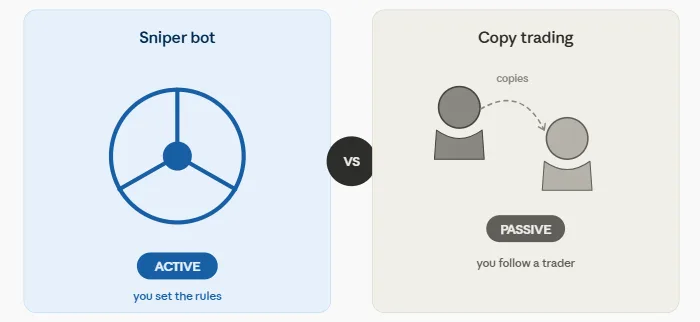
Copy trading suits someone who wants market exposure without building a strategy from scratch, while sniper bots suit someone who wants direct control and is prepared to put in the configuration work upfront.
Being first doesn’t mean winning
The profit stories around sniper bots travel much further than the loss stories, which creates a skewed picture of how reliable they actually are. Speed helps you get in early, but it doesn’t make the underlying token a good investment, and even the fastest bot can’t save you from a project that rugs five minutes after launch.
In one documented case, a sniper bot spent roughly $1.9 million to snipe $WATER tokens and lost over $700,000 when wallets allegedly linked to the development team sold into the launch and collapsed the price almost immediately.
And if you’re thinking about buying a sniper bot from someone in a Telegram group, that’s a well-documented scam category. The seller collects the fee and disappears before the bot does anything.
How to trade without becoming someone’s exit liquidity
The most practical step any altcoin trader can take is to avoid buying any token in the first few minutes after launch. That window is almost entirely bot activity, and entering it usually means buying from a bot at an already inflated price.
Using limit orders instead of market orders prevents you from paying whatever elevated price a bot has pushed a token to, and if a token spikes 10x in under a minute, treat it as a warning rather than an invitation because that kind of movement is bot-driven the vast majority of the time.
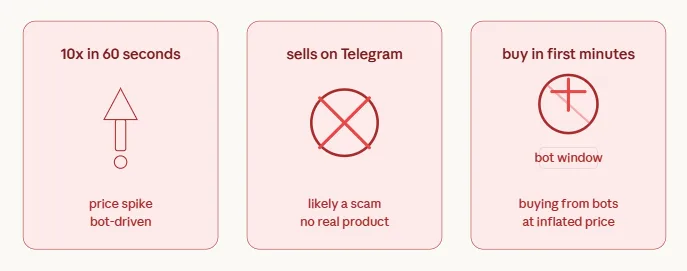
The traders who get burned most consistently around launches are usually the ones who moved quickly but without understanding what was already happening in that market before they clicked buy.
So where does that leave you?
Sniper bots aren’t going anywhere, and they’re getting smarter as AI continues to improve how they operate. Understanding what a sniper bot is in crypto has moved from a niche technical topic to something directly relevant every time a new token goes live.
Doing well around launches isn’t about being faster than the bots. It’s about knowing when they’re most active, staying out of their window, and making decisions based on something more solid than a 60-second price chart that three different bots just painted.