


Crypto has evolved far beyond just buying and holding coins, and one of the most popular ways to trade today is through perpetual futures. These contracts let you speculate on whether an asset’s price will go up or down without actually owning it, and unlike regular futures, they never expire.
If you’ve ever opened a perpetual futures trade and noticed a small percentage quietly being applied every eight hours, that’s the funding rate in crypto perpetual contracts. It’s not a platform fee, it’s not arbitrary, and once you understand it, you’ll check it before every single trade.
The funding rate keeps contract prices anchored to the real market, moves money directly between traders, and signals more about market sentiment than most traders ever stop to consider.
What is a perpetual contract, and why does it need a funding rate?
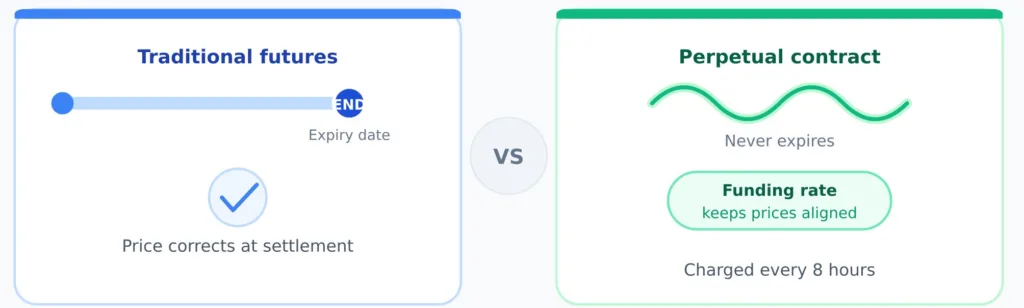
In a perpetual futures contract, you open a long position if you think an asset’s price is going up, meaning you profit if it rises, or a short if you think it’s heading down, meaning you profit if it falls. Unlike traditional futures, there’s no settlement date forcing the trade to close.
That open-ended structure creates a problem the market has to solve on its own. Without that built-in deadline, nothing naturally corrects the contract price when it starts moving away from the real market price.
Take Solana as an example: if a large number of traders open long positions on SOL’s perpetual contract at the same time, all that buying pushes the contract price above what Solana is actually worth on the spot market, which is the live price of the asset on a regular exchange where it’s bought and sold directly. The further that gap grows, the more the contract stops reflecting any useful reality.
The funding rate fixes this by acting as a financial nudge: the side that has pushed the price out of line gets charged a fee, which gets paid directly to the other side. Over time, that fee pressure rebalances the market and pulls the contract price back toward spot.
How does the funding rate crypto mechanism actually work?
The funding rate is a periodic payment exchanged directly between traders. Depending on which side of the market is too crowded, either long traders pay short traders, or short traders pay long traders.
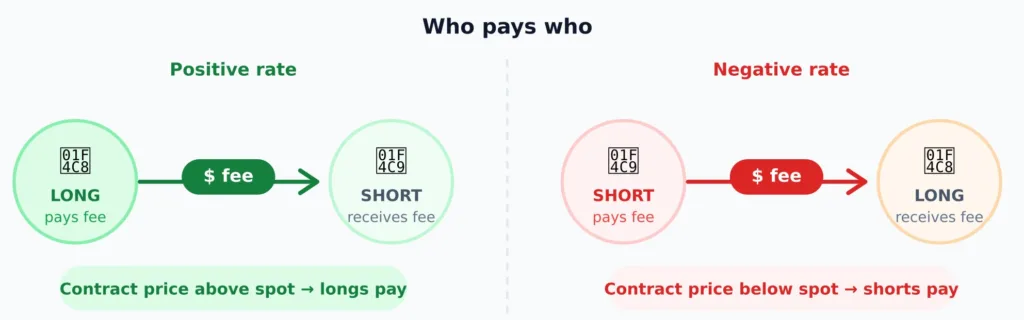
When the contract price rises above the spot price, the funding rate turns positive, and long traders pay short traders. Over time, that cost makes staying long less appealing, draws more shorts in, and the contract price works its way back down toward the real price.
When the contract price drops below the spot price, the rate flips negative, and shorts become the ones paying. That shifts the incentive toward opening longs, which pulls the contract price back up.
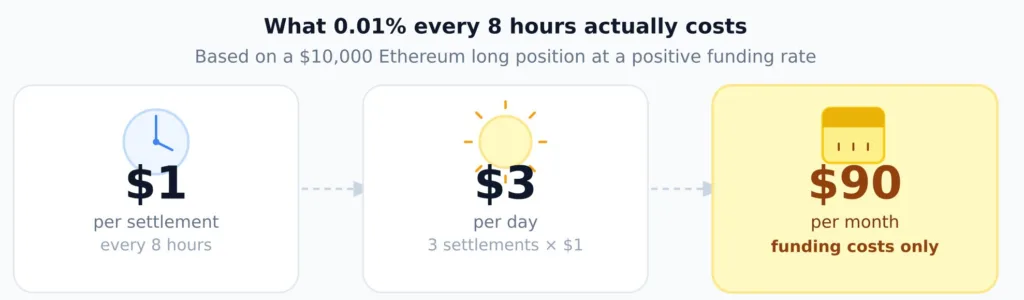
The rate itself looks tiny at first. On a $10,000 Ethereum long position at a funding rate of 0.01% every 8 hours, you’re paying $1 per settlement. That works out to $3 a day, and at that rate over a full month, roughly $90 in funding costs alone, before price movement or trading fees even enter the picture. Add leverage, and those numbers scale up fast.
Perpetual futures funding rate: Positive vs. negative
The easiest way to see this in practice is with a concrete example. Say Solana is sitting at $150 on the spot market, but its perpetual contract is trading at $153 because optimism about SOL is running hot. The positive rate makes staying long progressively more expensive, pushing some traders to close or flip short, which nudges the contract price back toward $150. The market essentially taxes the crowded side until balance is restored.
The negative scenario tends to look different in tone. It usually shows up during periods of fear or heavy selling, when traders pile into shorts after a sharp drop, convinced the price has further to fall. When that overcrowding flips the rate negative, short traders start paying longs instead.
To keep it simple:
- Positive rate: Contract price is above spot, longs pay shorts
- Negative rate: Contract price is below spot, shorts pay longs
One thing worth noting: if you’re on the receiving side during a sustained period of elevated funding, you’re collecting a steady payment simply for holding your position open. That’s not nothing, especially during prolonged one-sided markets.
Crypto funding rate explained: What it signals about the market mood
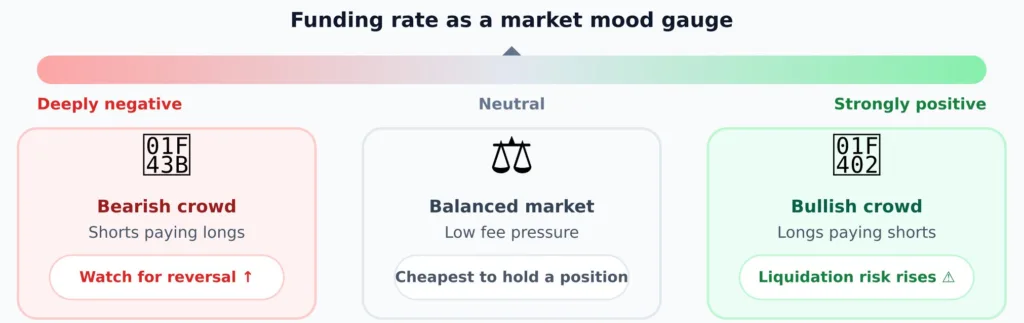
Beyond the cost, the funding rate is also a live read on market sentiment. A consistently high positive rate means a large number of traders are holding long positions with borrowed money, which amplifies both their gains and their losses, and a deeply negative rate means shorts are dominating. When too many traders are on the same side with borrowed money, the market becomes unstable. A small move in the wrong direction is all it takes to start a chain reaction.
When funding rates stay extremely high for too long, the market becomes vulnerable to a wave of liquidations. Traders paying elevated fees start closing positions just to stop the bleeding, prices dip, leveraged longs get forced out, and the cycle keeps going until forced closures drain the overcrowded side and funding normalizes. By the time most traders connect the dots, their position has already been closed out.
Deeply negative funding rates tell a different story. When the crowd has pushed so heavily into shorts that the rate turns sharply negative, it often signals that pessimism has stretched itself too thin and a reversal may be building.
That said, treating the funding rate as a guaranteed price predictor goes too far. A deeply negative rate can persist for weeks while price keeps grinding lower, and a high positive rate can hold through an entire bull run.
Use it as one signal among several. A practical example: if funding is deeply negative, price has been falling hard, but volume is starting to dry up, all three together suggest the selling may be exhausting itself rather than accelerating. The same logic applies in reverse when funding is extremely high and bullish momentum starts stalling.
Mistakes new traders commonly make with funding rates
Not checking the funding rate before opening a trade.
Opening a large long position during a period of high positive funding means the fee is already working against you from the very first time it gets charged, before the trade has had any chance to develop.
Assuming the rate stays the same while you’re in the trade.
Funding rates can flip within a few hours during volatile conditions, so a rate that seemed manageable at entry can become a real drain by the time you’re several days into the position.
Forgetting to count funding fees as part of your actual profit.
A trade that looks like a 5% winner on price movement alone can land as a break-even result once several days of elevated fees are accounted for. The actual return on any perpetual trade is the price move minus every funding payment made along the way.
Takeaway
The funding rate in crypto perpetual contracts does two jobs at once: it keeps contract prices tethered to the real market, and it doubles as one of the more honest signals of where market sentiment actually stands.
The cost side is straightforward once you know the math. The signal side takes a little more practice, but checking the funding rate before any perpetual trade on Ethereum, Solana, or any other altcoin is a small habit that pays for itself. The traders who skip it have a funny habit of wondering where their profits went.