



Open Interest (OI) often exposes what price charts hide in crypto futures markets. It tracks the number of open contracts still active across longs and shorts. When used correctly, crypto futures open interest helps traders see whether real positions are building or fading beneath the surface.
It is one of the few metrics that separates actual market commitment from surface-level price movement. Instead of showing what the market did, it shows what is still exposed after trading settles. That is why open interest trading is widely used to read underlying positioning in derivatives markets.
Understanding open interest in the futures market
Open interest represents the total number of derivative contracts that remain open at a given time. These are positions that have not been closed, settled, or offset by an opposing trade. Each contract includes both a buyer and a seller, but crypto futures open interest counts the contract itself rather than each side separately.
The number rises when new contracts are created between participants entering fresh positions. It falls when both sides close an existing contract and remove it from the market. If a contract simply changes hands between traders, open interest usually stays unchanged because the exposure still exists.
This makes open interest a measure of commitment rather than activity. It reflects how much exposure remains active after trading has taken place, which is why it plays a central role in open interest trading analysis.
The Role of open interest in determining market trends
Open interest helps traders to analyze whether a market trend is backed by investors. When the price moves in the same direction as the open interest, it indicates the market is experiencing an entry of a new position, or rather a closing of the existing market position.
Once the prices rise and open interest is high, then it is generally an indication that new positions are accompanying the move. This usually indicates deeper belief, since traders are actually committing their money. Conversely, when the open interest goes down, and the prices are going up, the action is most likely to be a short-covering move as opposed to a long-term buying push.
The principle is also true of falling markets. Rising open interest as the price falls implies that new bearish positions are being established, and declining open interest could imply that traders are unwinding positions instead of creating new ones. These relations assist traders in determining whether a trend is reinforcing or slowing down.
How open interest crypto differs from trading volume
The open interest and the trading volume are mistakenly used interchangeably, yet they are used to measure entirely different things. Volume tracks activity, while crypto futures open interest tracks outstanding exposure that remains in the market.
| Metric | What it measures | What it shows |
| Open Interest | Open contracts | Investor participation and commitment |
| Trading Volume | Contracts traded within a specific period | Market activity and liquidity |
A market can have very high volume without any increase in open interest. This usually means traders are actively buying and selling, but mostly transferring existing positions rather than creating new ones.
On the other hand, open interest can rise even when volume is moderate. This indicates that most of the trades are generating fresh exposure in the market. Collectively, these measures provide a better understanding of whether activity around the market is meaningful or just noise.
The importance of open interest in crypto trading
Open interest is especially important in crypto markets because of high leverage usage. It is a rough measure of the accumulation of exposure in the derivatives markets. When open interest rises, it often reflects increasing participation and capital entering positions.
Nonetheless, an increase in open interest in crypto is not necessarily a good indication. It may reflect the crowded positioning in highly leveraged environments that can create the risk of liquidation at an acute time. A fall in market against traders who are highly leveraged may result in open interest falling very quickly due to forced closing of positions.
This makes open interest a useful risk indicator as well as a participation metric. It helps traders in determining whether the markets are becoming overextended or healthy in terms of activity.
How to read open interest in perpetual crypto futures?
Perpetual futures are not similar to ordinary contracts since they do not expire. This enables unrestricted interest to accumulate without the rollovers of contracts, and trends are easier to follow over time.
Crypto futures open interest in such markets must always be analyzed in conjunction with funding rates and liquidation information. The balance between the long and short positions is depicted by the funding rates, and the forced position close-out when volatility happens can be seen in the liquidation data.
Important aspects to observe in perpetual markets:
- Open interest increasing with no fluctuating prices indicates healthy participation.
- Rising open interest with extreme funding shows crowded positions.
- Falling open interest in times of volatility usually signals rising liquidations.
- A sudden drop in open interest suggests compelled deleveraging in the market.
A combination of these signals helps traders to know that exposure is accumulating in a sustainable way, or it is growing weak when leveraged.
Limitations of open interest as a trading signal
Open interest is useful, but it has clear limitations that traders must understand. The most important thing is that it is not directional, since every contract includes both a long and a short position. It shows the size of the market’s exposure, not which side is winning.
It does not differentiate the type of participants. Instead, hedgers, speculators, and market makers all contribute to open interest equally. This makes it difficult to determine the intent behind position changes.
Another limitation is that open interest does not show position size or concentration. Total exposure can be large and concentrated in a few large traders. However, in the absence of further information, this risk is not visible.
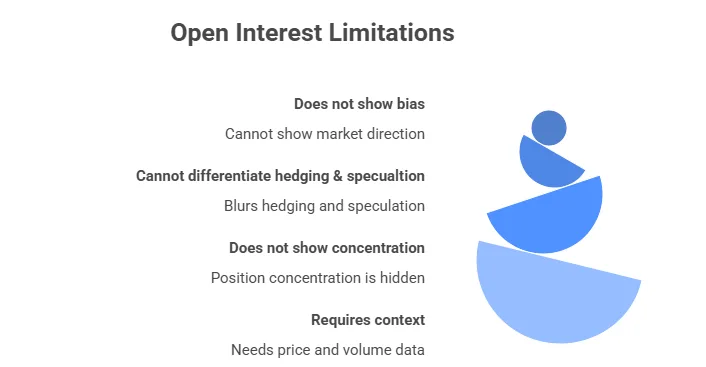
The main drawbacks of open interest include:
- Cannot show bullish or bearish bias.
- Does not differentiate between hedging and speculation.
- Does not disclose position concentration.
- Requires price and trading volume context.
Due to these disadvantages, traders must always consider combining open interest with other signals.
Closing thoughts
Open interest is one of the most important crypto futures indicators as it shows how many contracts are open and the level of investor participation in a trend. It does not show whether traders are long or short on its own, but it becomes more useful when combined with volume, funding rates, moving averages, RSI, and key support or resistance levels. Together, these tools help confirm whether momentum is strengthening or weakening.