


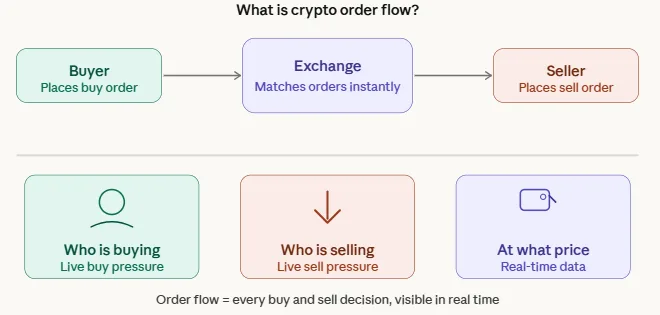
Every price move in crypto starts with an order. Someone buying, someone selling. When enough of those orders pile up in the same direction at the same time, the price moves. Order flow is a market analysis technique that tracks the live movement of those buy and sell orders to understand why prices move and where they might go next.
Once you understand order flow, price moves stop feeling random. This guide walks you through everything you need to know: the order book, liquidity, slippage, and the role of large traders called whales.
What is order flow in crypto trading?
Let’s take a giant noticeboard as an example here. Buyers pin up what they’re willing to pay. Sellers pin up what they want to charge. The moment a buyer’s number matches a seller’s number, the trade happens automatically. Now run that across a million people, every second, on a digital screen. That’s a crypto exchange.
Charts show you the past. They tell you where the price has been. Order flow shows you the present, what’s actually happening in the market right now. That’s what makes it so different from anything most beginners start with.
The order book: Where all orders live
Before a trade actually happens, every intention to buy or sell sits in a place called the order book. It’s that noticeboard, constantly updating in real time with every new offer coming in from both sides.
- Bids (buy orders): Buyers saying, “I want Bitcoin and here’s the most I’ll pay”
- Asks (sell orders): Sellers saying, “Here’s the lowest price I’ll accept”
- The spread: The gap between the lowest ask and the highest bid
When the spread is small, the market is healthy and active. When it’s wide, fewer people are trading, and things get a bit more unpredictable. Watching the order book for just a few minutes on any exchange will show you something fascinating. Orders appear, disappear, and fill constantly. That movement is crypto order flow in action.
Market orders vs. limit orders: Which one should you use?
There are two main ways to place a trade, and understanding the difference will save you money.
A market order is the “I want this now” option. You hit buy or sell and the exchange fills it immediately at whatever price is available. It’s the fastest way in, but you’re handing over control of what you actually pay.
A limit order works the opposite way. You decide the price first, and the trade only goes through if the market gets there. If it never does, your order just sits and waits. You stay in control, but there’s no guarantee it fills.
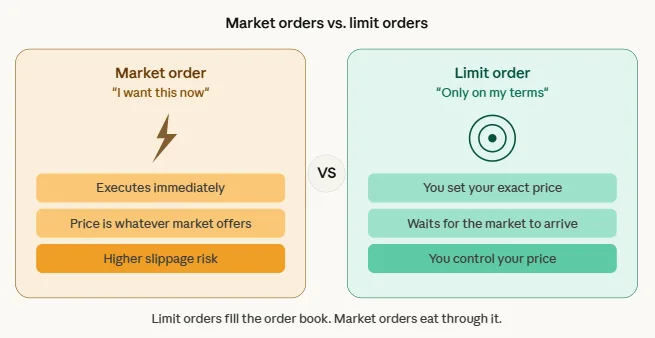
Here’s why this matters for order flow trading in crypto: limit orders fill the order book and give the market its depth. Market orders come in and eat through that depth. When you see a price move suddenly, it’s usually because a wave of market orders just wiped out a chunk of the order book in seconds.
Liquidity: How deep is the water?
Liquidity is one of those words that sounds complicated, but it’s really just asking one question: how easy is it to buy or sell without moving the price?
A highly liquid market, like Bitcoin on a major exchange, has thousands of orders stacked up at every price level. You can buy a decent amount without the price budging much. An illiquid market, like a tiny altcoin with barely any traders, has very few orders at each price level. Even a small purchase can send the price jumping.
Think of it this way. Dropping a stone into a lake barely causes a ripple. Dropping the same stone into a puddle splashes everything. Liquidity is the depth of the water.
When liquidity is thin, order flow becomes more volatile, and one big trade can swing the market dramatically. When it’s deep, the market is calmer and a lot more predictable.
Slippage: When you don’t get the price you expected
You see Bitcoin listed at $100,000 and hit buy. By the time your order actually fills, the price is $100,150. That $150 difference is called slippage. In simple terms, slippage is the difference between the price you expected and the price you actually got, and it happens to everyone.
The main causes of slippage are:
- Low liquidity: There aren’t enough orders at your target price, so your trade fills at progressively worse prices
- Large order size: Your trade eats through multiple price levels, raising your average cost
- Market volatility: Prices shift in the seconds between placing and filling your order
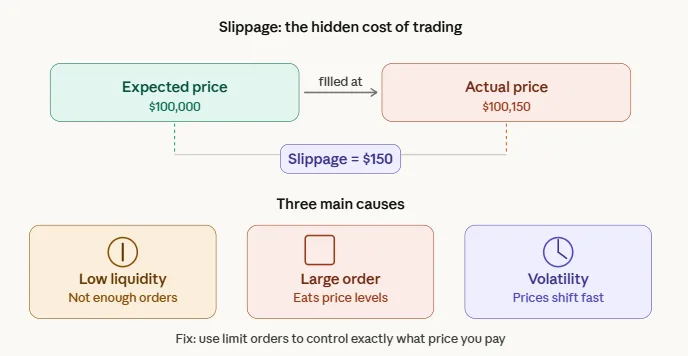
If you’re buying a large amount of a low-liquidity coin, part of your purchase fills at $1.00, more at $1.05, more at $1.12, and so on. Your actual average price ends up being far worse than the number you saw on screen.
Using limit orders is one of the simplest ways to protect yourself. Instead of accepting whatever price you get, you set the maximum you’re willing to pay and wait for the market to come to you.
Whales: The big fish that move the ocean
Not everyone in the market is a small retail trader. Some participants hold enormous amounts of cryptocurrency. They’re called whales, and they can move markets just by placing a single trade.
When a whale decides to sell a large amount of Bitcoin all at once, that sell order can instantly wipe out thousands of buy orders stacked in the order book. The price drops sharply in seconds. Smaller traders who weren’t paying attention suddenly find their positions in the red.
Whales know exactly how their own size affects the market, so they:
- Split large orders into smaller chunks to avoid detection
- Trade during quieter hours when fewer people are watching
- Monitor order flow analysis in crypto closely to time their moves
Many retail traders now track on-chain data and live order feeds to spot unusually large orders before they fully impact the price, trying to stay one step ahead.
Factors that shape order flow trading in crypto
Order flow doesn’t exist in a vacuum. Several forces push and pull it at any given moment.
Time of day plays a big role. Crypto never closes, so liquidity shifts constantly as different parts of the world wake up and start trading. During quieter overnight hours, even a mid-sized order can move the price in ways it simply wouldn’t during peak trading windows.
News and events can flip order flow completely without warning. When Elon Musk tweeted that Tesla would accept Dogecoin, DOGE jumped over 20% in minutes. Anyone who placed a market order in that chaos got filled at a far worse price than expected. That’s what happens when a flood of one-sided orders hits a market all at once.
Algorithms and trading bots also shape the flow constantly. A large portion of crypto volume comes from automated systems reacting to market conditions faster than any human can. Learning to recognize their patterns takes time, but it’s a core part of becoming fluent in order flow analysis in crypto.
How order flow analysis connects everything
The order book, liquidity, slippage, whales – they aren’t separate things to memorize. They’re one system, and every price move you’ll ever see is just that system playing out in real time. Once that clicks, the market stops feeling random.
The best way to make it real is to open an order book and watch. No trades, no money on the line, just observation. Notice where the big limit orders are sitting and how fast they disappear when the market pushes through them. The market is always talking. Order flow is how you learn to listen.