

Somewhere behind every crypto trade, every DeFi transaction, and every digital payment happening right now, one coin keeps showing up. It’s called Tether (USDT), and it never moons, never crashes, and never makes anyone a millionaire. It just works, quietly, in the background, every single day.
And yet it’s the third-largest cryptocurrency in the world by market cap, moves more daily volume than almost anything else in the space, and holds the entire crypto trading market together in ways most people don’t fully appreciate.
The role of Tether (USDT) in the cryptocurrency ecosystem is worth understanding properly.
What is a stablecoin, and why does one even exist?
Most cryptocurrencies are volatile by nature. Bitcoin can gain 15% on a Tuesday morning and give it all back by Thursday. That volatility is part of what makes crypto exciting to trade, but it also makes it genuinely impractical for everyday use. You wouldn’t want to price something in Bitcoin if the value might drop 20% before the transaction clears.
A stablecoin is a cryptocurrency designed to hold one fixed price, almost always $1. You still get everything useful about crypto, fast transfers, no banks involved, available around the clock, without your balance randomly shifting while you sleep.
Think of it as the digital version of keeping cash in your pocket. Whatever chaos is happening in the market, your dollar stays a dollar.
Role of Tether (USDT) explained: What it is and how it works
Tether (USDT) is the world’s largest stablecoin, pegged 1:1 to the US dollar, and has been around since 2014, which in crypto years is basically ancient history.
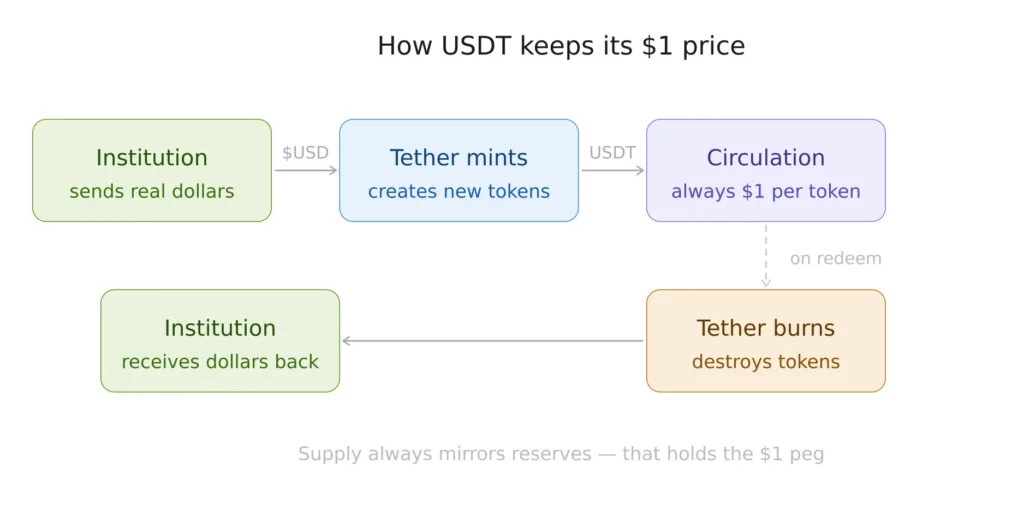
For every USDT token in circulation, Tether Limited holds one dollar’s worth of assets in reserve, mostly US Treasury bills and cash equivalents. When someone wants USDT, they send real dollars, and Tether creates the tokens. When they want out, the tokens get destroyed, and the dollars go back. That’s what keeps the price at $1.
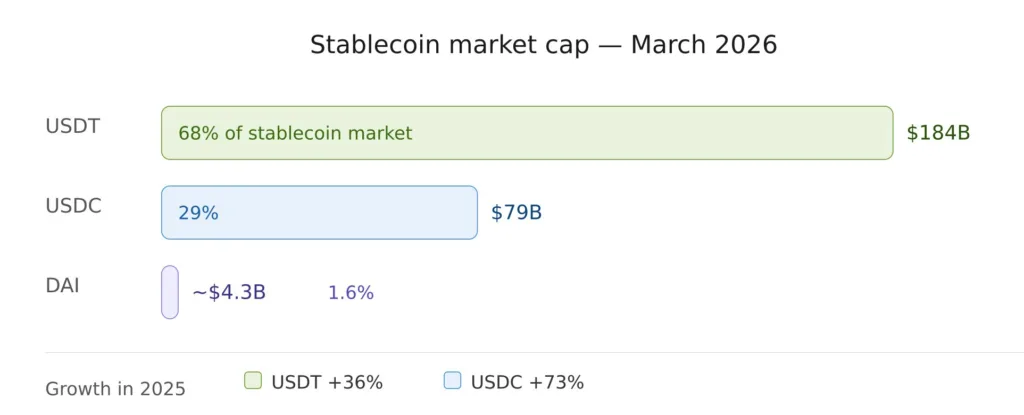
USDT runs across 10 major blockchains, including Ethereum, Tron, and Solana, with over 60% of the supply sitting on Tron because of its low transaction costs. As of March 2026, there are roughly $184 billion worth of USDT in circulation.
For a coin that never does anything exciting, that’s a remarkable place to be.
The real role of stablecoins in crypto: What USDT does every day
Most people assume USDT is just a place to wait out a bear market, but that barely scratches the surface of what the USDT stablecoin actually does on a daily basis.
On almost every major exchange, most trading pairs are quoted in USDT. When you buy crypto, you’re usually exchanging USDT for it. When you want to exit a position without sending money back to your bank, you convert to USDT and stay inside the ecosystem. Without it, every trade would need to route through the banking system, slow, expensive, and closed on weekends.
Beyond trading, USDT has become a real payment tool. In 2025, it settled over $156 billion in transfers under $1,000, covering everything from rent and payroll to money sent across borders. Running on a cheap network like Tron, it costs almost nothing and arrives in seconds. People also deposit USDT into DeFi lending platforms like Aave to earn interest on their dollars while keeping their value stable.
All in, USDT handled roughly $13.3 trillion in total transaction volume in 2025, as part of a record $33 trillion in stablecoin flows across the market.
The transparency problem: What you might not hear about Tether
You don’t hear much about Tether’s transparency issues in casual crypto conversation, but they’re worth understanding.
In 2021, the CFTC fined Tether $41 million after finding that between 2016 and 2018, Tether only held sufficient fiat reserves to fully back USDT on 27.6% of the days sampled, with the rest sitting in commercial paper, loans, and less liquid instruments.
Tether settled and shifted its reserves toward Treasury bills, but the deeper issue remains: Tether has never received a full independent audit. Their quarterly attestations, prepared by BDO, are point-in-time snapshots rather than a comprehensive audit, and Tether’s own CEO has called getting one a “top priority,” which tells you it hasn’t happened yet.
That matters beyond just trusting Tether as a company. So much of crypto trading flows through USDT pairs that a serious loss of confidence in Tether wouldn’t stay contained to USDT holders. It would ripple across the entire market.
USDC and the competition that’s actually catching up
USDT is not the only stablecoin around, and in 2026, the competition has become more serious than ever before.
USDC is issued by Circle, launched in 2018, and built around exactly what Tether lacks: transparency and regulatory compliance. Circle publishes monthly reserve reports verified by a Big Four accounting firm and is fully compliant with the GENIUS Act, the first real federal framework for stablecoin issuers in the US. Visa launched USDC settlement for US banks in December 2025, and Mastercard followed with a Circle partnership for USDC settlement across Europe, the Middle East, and Africa.
USDC’s market cap sits at around $79 billion compared to USDT’s $184 billion, so Tether is still larger. But USDC grew 73% in 2025 while USDT grew 36%, and in March 2026, USDC overtook USDT in transaction volume for the first time since launch, capturing 64% of total stablecoin transaction volume.
USDC is what your bank would pick. USDT is what most of the world actually uses right now.
What about decentralized alternatives?
Both USDT and USDC share one fundamental thing: they depend on a company holding real dollars in a real bank account. You’re trusting Tether or Circle to have the money. For people who find that uncomfortable, decentralized stablecoins offer a genuinely different option.
DAI is one of the most established ones out there. Instead of a company backing it with dollars, DAI is backed by crypto collateral locked inside smart contracts on the Ethereum blockchain. Nobody owns it, nobody controls it, and the rules are written into the code itself.
That said, the collateral backing DAI is crypto, which means it’s volatile by nature, and when markets move hard and fast, holding the $1 peg becomes genuinely difficult in ways that don’t apply to stablecoins backed by actual dollars in a bank.
It’s a different approach to the problem, not necessarily a simpler one, but for anyone who got into crypto specifically to move away from centralized finance, that distinction matters.
Why USDT is still on top, and where things are heading
Despite the transparency concerns and growing competition, USDT keeps growing because it works at scale. It’s fast, available across major blockchains, deeply woven into crypto trading infrastructure, and trusted in a practical sense by the market, even while questions about Tether the company persist.
But the stablecoin market in 2026 looks genuinely different. USDC is growing faster, is winning on transaction volume, and institutions like Visa and Mastercard are choosing it deliberately. DAI offers a decentralized path for those who don’t want to trust any company at all.
And Tether’s own audit gap remains unresolved. The players are clearer than ever, and so are the differences between them. For anyone navigating crypto, understanding those differences is just part of knowing how this market actually works.