


Yield farming has become one of the most talked-about ways investors use to earn passive income in crypto. Often called liquidity mining, DeFi yield farming lets users put their tokens to work and earn rewards for helping supply liquidity to decentralized finance platforms.
Fundamentally, the concept of yield farming crypto is based on the idea of depositing cryptocurrencies into DeFi systems, whereby you get to receive interest, fees, or native tokens in return. Protocols lend or borrow the deposited assets or trade in a decentralized manner to form value and reward participants for their ‘farmed tokens.’
Yield farming is, however, not a risk-free venture, and returns vary depending on the liquidity pool, platform, and market conditions. This calls for full familiarization with the concept of DeFi yield farming before you jump in.
How does yield farming work?
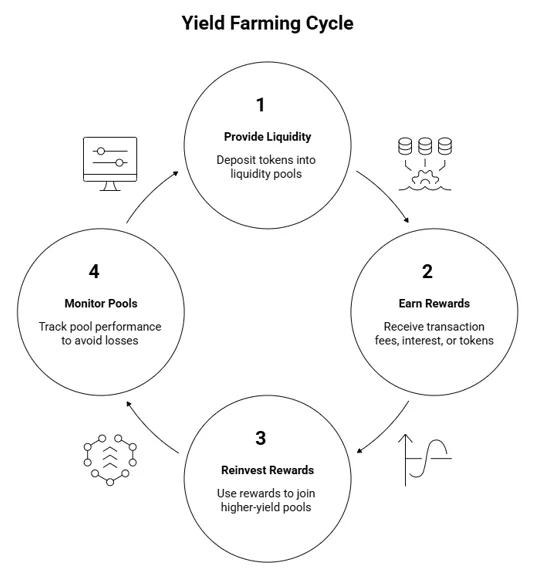
Yield farming allows you to lock your tokens for a particular period of time. The tokens are used to provide liquidity across DeFi platforms, and you get rewarded for the farmed tokens. Below is how the process happens.
Providing liquidity
You first begin by depositing assets into a liquidity pool. These tokens are used by the DeFi protocol to offer liquidity to various activities, including trading or lending. The protocols then collect transaction fees and the interest rates, which are later shared amongst pool members as rewards for the farmed tokens.
Earning rewards
DeFi platforms reward liquidity providers (LPs) in various forms. In some instances, the platforms may share transaction fees earned in the pools, interest on loans issued with lent tokens, or by giving governance tokens, which allow you to vote on the decisions regarding the protocol.
Other platforms may issue you with new tokens as a reward for providing liquidity. You can use these tokens to join fresh pools to generate more returns.
Reinvestment and strategy
Yield farming tends to be cyclical. You can take out the rewards earned from one pool and put them in a different pool that offers better returns. However, it is important to monitor the pools regularly, because reward rates can change suddenly, and that can reduce your earnings or even lead to losses.
Examples of platforms offering yield farming
Various DeFi projects provide yield farming. Below are some top options:
- Uniswap
- Aave
- Pancakeswap
- Curve finance
Key elements of DeFi yield farming
Yield farming in DeFi is supported by various components, including liquidity pools, smart contracts, and governance tokens, in some instances.
1. Liquidity Pools
These are smart contract systems where users deposit tokens so they can be used for yield farming activities. These pools provide liquidity to lending protocols, decentralized exchanges, or other financial services. Generally, the performance of the pool determines the amount of rewards.
2. Automated market makers (AMMs)
AMMs are programs that adjust trading within liquidity pools automatically based on market activity. These programs support order book-free trading systems. AMMs require LPs to provide adequate liquidity and facilitate transactions.
3. Governance Tokens
Many DeFi protocols distribute governance tokens to liquidity providers as part of the incentives they offer. Governance tokens grant you voting rights to vote on protocol changes or future funding proposals.
The risks involved in DeFi yield farming
Yield farming is lucrative, but it comes with certain risks, including:
- Volatility: The price of assets confined in liquidity pools can increase or decrease. When the price of your assets falls, chances are that you are likely to receive lower returns or even incur losses.
- Impermanent Loss: This refers to a situation where assets in the pool decrease in value; therefore, it makes more sense to keep them out of the liquidity pool.
- Rug Pulls and Scams: Yield farming can expose you to scam projects whereby creators empty the pools and flee with deposited assets. To prevent this, you must only join credible DeFi yield farming projects.
- Liquidity shortages: Insufficient pool liquidity may result in slippage, hence reducing returns. Liquidity shortages may occur once most members withdraw assets from the pool at the same time.
- Fluctuating rewards: Yield farming crypto rewards are usually not fixed, meaning APRs or APYs changes affect the rewards you get to receive.
How yield farming rewards are calculated
DeFi yield farming rewards are determined by various variables such as the pool’s trading volume, tokens, and the algorithm used by the platform.
- Compounding: This is presented as Annual Percentage Yield (APY)
- Simple interest: It is presented as Annual Percentage Rate (APR)
Capital supplied to the pool, a protocol’s rewards model, incentive tokens, and compounding or reinvestment strategy can be used to determine returns from DeFi yield farming.
Websites like DefiLlama, Zapper, and Yieldwatch can help you see a rough estimate of potential earnings. A platform like Yearn Finance may also help to scan across pools for identification of the best APR for maximum returns.
Yield farming vs staking
Yield farming and staking are different, despite both being associated with passive income earning from DeFi activities.
Yield Farming
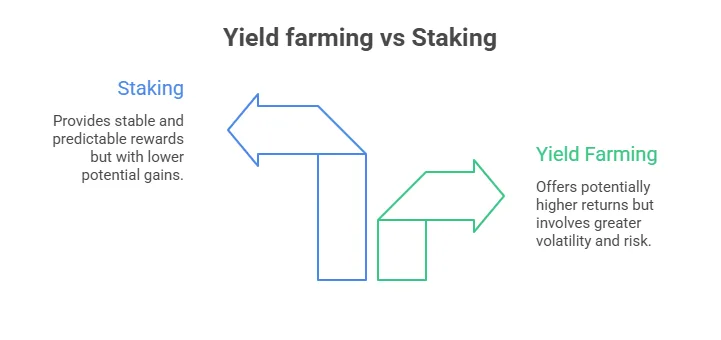
This strategy involves liquidity provision on DeFi protocols. Yield farming crypto returns vary depending on the prices of the farmed tokens and changes in designated reward models (APY or APR).
Staking
Staking is the process of locking tokens to authenticate a blockchain network and verify transactions. This model features premeditated and less volatile rewards. However, the rewards tend to be lower than those in yield farming.
The future of yield farming
The concept of yield farming in DeFi is developing fast. Models that are unsustainable in terms of token emissions are being replaced with approaches that are associated with real yield, based on actual platform revenue, such as fees and lending interest.
Robotic programs are also coming up to streamline agricultural practices, minimize the risks, and enhance yields on autopilot. Cross-chain yield farming could also make the process more open to LPs to transfer tokens across blockchains in pursuit of higher yields.
Closing thoughts
Yield farming has become a widely used approach for earning passive income in crypto. When you understand how it works, the risks involved, and how to reinvest rewards, it can turn DeFi yield farming crypto into a practical income strategy.
That said, risks such as impermanent loss, market volatility, rug pulls, and shifting reward structures should not be overlooked. In the future, yield farming could become more sustainable, with fixed yields, AI-fast strategies, and cross-chain opportunities.