
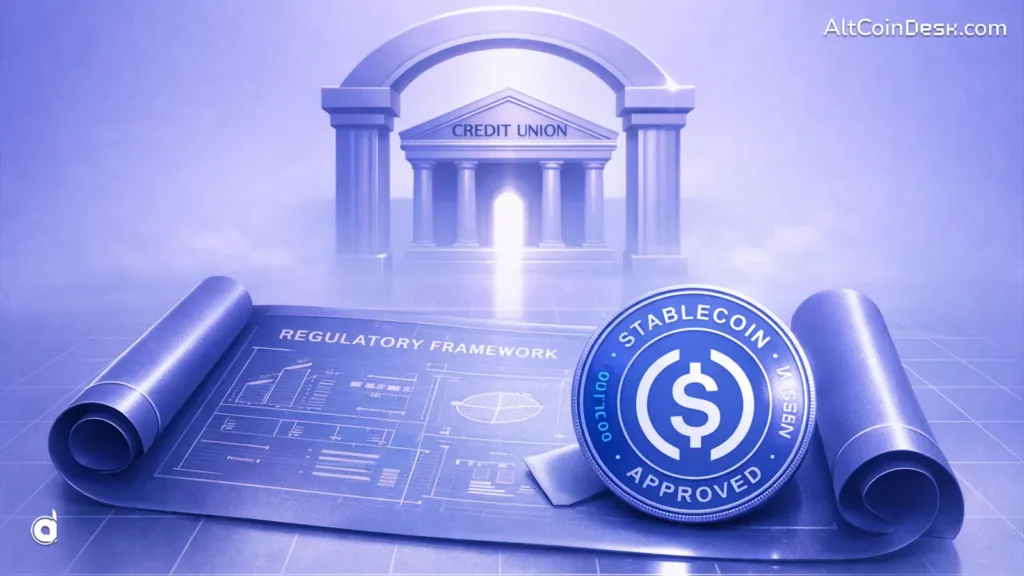

The U.S. National Credit Union Administration (NCUA) announced its first-ever Notice of Proposed Rulemaking under the GENIUS Act for federal credit union subsidiaries seeking to become a permitted stablecoin issuer. An analyst stated that this is a not about innovation but it’s a scuffle that has shifted from risk debates to who gets control to mint the digital dollar inside the U.S.
Under the GENIUS Act, which charges the NCUA, the subsidiary of a federal credit union would need to secure an NCUA-permitted payment stablecoin issuer (PPSI) license before issuing coins. “This proposed rule is the first step in NCUA’s implementation of the GENIUS Act,” said NCUA Chairman Kyle Hauptman.
In addition, an excerpt from the proposed rule states, “As explained in more detail later in this preamble, the GENIUS Act does not allow Federally Insured Credit Unions (FICU) to directly issue payment stablecoins and instead provides that they must be issued through FICU subsidiaries that receive an NCUA-PPSI license.”
Analyst Laveneet Bansal mentioned that the NCUA proposal makes one thing clear: stablecoin issuance is no longer the sole domain of bank-charter politics. By formalizing a pathway for credit unions to issue payment stablecoins, the agency is carving out its own jurisdictional ground just as banking lobby groups push the Office of the Comptroller of the Currency to restrict crypto access to charters.
“This isn’t about innovation; it’s about regulatory turf. The stablecoin fight is moving from risk debates to control over who gets to mint digital dollars inside the U.S. system.”
However, President Donald Trump, in one of his speeches during the 2024 election, stated, “As your president, I will never allow the creation of a Central Bank Digital Currency. Such a currency would give our federal government absolute control over your money.” He stated that in case such a thing were to take place, then the federal government would have full control over the people’s money.