


Ethereum (ETH) revisited its 6-month low of $3,000 after the Open Interest (OI) dropped drastically by almost 50% since August. Historical data shows that these deep drops in open interest often precede major structural moves — either a continuation to the downside with less leverage or a healthier reversal.
The ETH futures OI dropped to $45 billion from as high as $75 billion in August. Within a span of 4 months, the OI dropped by 40%. The OI signifies the number of open contracts. When the OI drastically drops, it means that traders are risk averse and stepping away from leveraged positions.
But here’s the thing. If you just take the OI, it consists of long and short leverage positions. So when the OI drops, it is not possible to state whether long or short positions are being closed. However, if the price of the crypto falls when the OI drops, it clearly shows that the long positions are closing.

The below chart substantiates Ethereum’s price crash. From recording $4,700 in August, the coin slipped to $3,000, a drop of 36%. After this drop, the coin is now fluctuating near its six-month low, as it tries to start a new beginning.
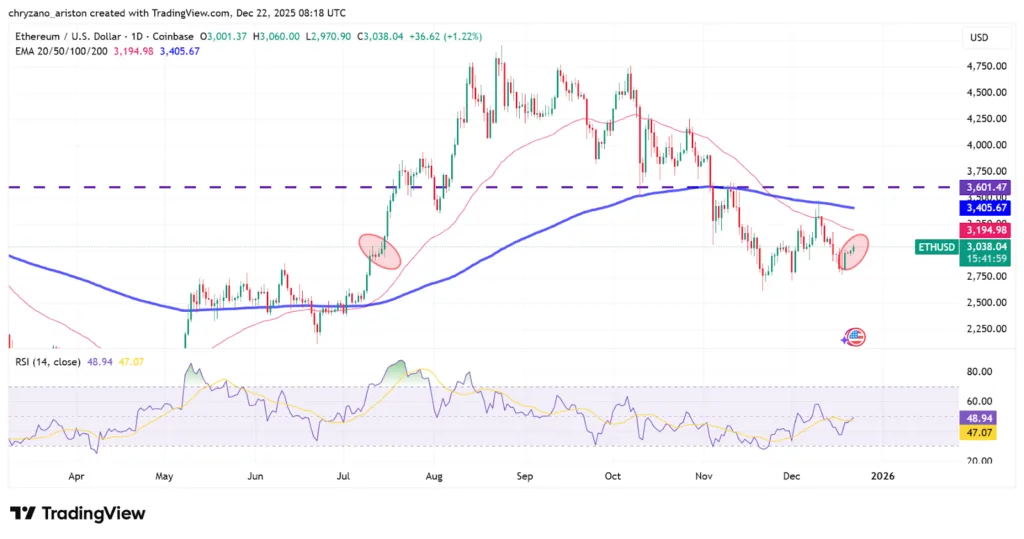
ETH has tested the 50-day moving average (MA) quite a few times but has not been able to break above it since October. The coin could once again test the 50-day MA, which is close to the $3.2K level. The Relative Strength Index (RSI) is rising as it makes higher lows, along with the coin. This indicator shows that this time around, the rally is not just excitement, but there is volume and purpose behind it.
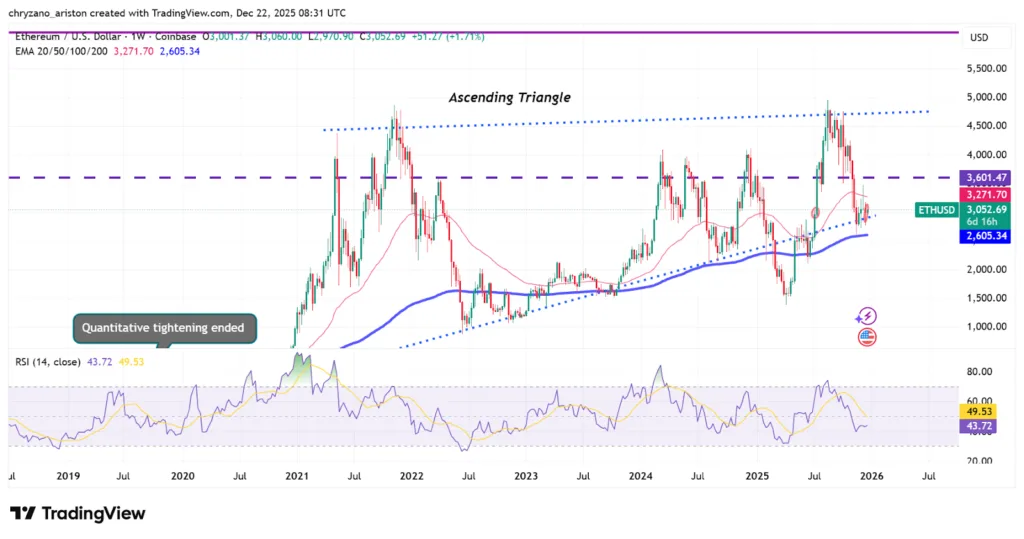
If this momentum continues, ETH could go well above the 50-day MA at $3.2K, then test and break the 200-day MA at $3.4K, and thereafter hit $3.6K. However, based on the ascending triangle forming on the weekly chart, ETH has the legs to hit above $6K in the future.