


LINK whales have gone into a buying frenzy despite gloomy market conditions, a byproduct of the rising tension in the Middle East. The LINK whales have gone into this buying mode, spotting LINK at the 2024 levels.
With large holders steadily increasing their outflows to exchanges. Even as the broader altcoin market remains under pressure, on-chain data shows a noticeable uptick in significant withdrawals, particularly among the largest transactions.
Considering the top withdrawal activity, there are clear spikes, and over 8,000 LINKs were withdrawn in a single day from major exchanges like Binance, which shows concentrated moves by high-net-worth participants.
Not only has the number shot up in a day spiked, the average size of these top withdrawals has been gradually increasing, rising from roughly 2,000 LINK per day in earlier periods to closer to 2,600 LINK more recently. If the withdrawals had spiked for just one day, it could have been dismissed as an outlier. However, when the average itself increases, it warrants attention. This consistent growth in outflows suggests that larger players are not just making isolated moves but are gradually scaling their positioning over time.
Pros of tracking whale activity
Tracking whale activity is important because it offers a hint into how informed or well-capitalized participants are behaving behind the scenes. Whales typically have access to better information, better infrastructure, and longer time horizons compared to retail traders, so their movements can sometimes signal shifts in sentiment before they become reflected in price action.
When there is an outflow from exchange, seasoned traders often interpret it as accumulation behavior, as funds moved off exchanges are less likely to be sold in the short term. Rather than selling these tokens in the market, it can indicate a preference for holding assets in cold storage, staking, or deploying them in other strategies but keeping them ready for immediate liquidation.
From a retail trader’s perspective, having a look at these flows helps in identifying potential accumulation phases during periods of weakness. For example, if we take a look at a price chart and we observe that the price is moving down or sideways, and we also observe a decline in the balances due to withdrawal, this may also indicate that the selling pressure is being absorbed by the large players.
However, this does not necessarily mean a reversal, but rather a slowdown in selling pressure in the near future. If we observe a consistent flow into exchanges, this may indicate a potential selling pressure, where people are preparing to sell to the markets.
Traders use whale movements as an additional indicator, but in unison with technical analysis. For instance, if there is a base formation for the LINK token and selling is increasing, traders may take this as an early accumulation and start to scale into positions, rather than waiting for a breakout.
Others who are not reluctant might wait for the prices to move first before settling into a position. They use it as a confirmation factor when the price eventually starts to trend upward. They believe that price moves underlying demand rather than short-term speculation. Ultimately, whether you enter early or wait for the confirmation depends on your risk appetite, and market experience plays a crucial role.
Whale tracking also helps in risk management. For example, if a trader observes a growing whale accumulation pattern, what if prices continue to decline? This might indicate that whales are still accumulating, and volatility might continue.
If whale inflows into exchanges begin to build, this might indicate a potential period where whales are preparing to take profits, potentially leading to increased selling pressure or a local top.
In relation to LINK, we can observe a growing trend in top-tier withdrawals and a growing average outflow size, potentially indicating a gradual accumulation pattern among whales.
Although this does not confirm a trend reversal, this does provide a vital layer of context when assessing market structure. So let’s take a look at what the technicals have to say about LINK.
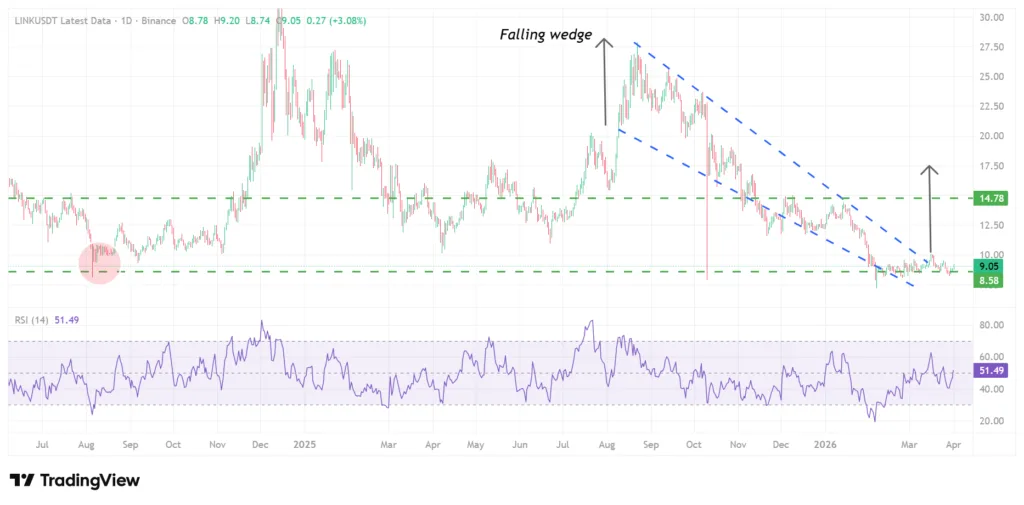
Looking at the chart above, LINK is on the verge of breaking out of the fall as it tests the upper trendline of the wedge. The last time the price of LINK sank to this level ($9) was in August 2024. Going by history, the token recovered from this level and hit resistance when the price reached about $12.50. After testing this resistance level for about two months, LINK broke through and rose above $30. This pattern is not uncommon.
The Relative Strength Index (RSI) indicator is making higher highs and higher lows, indicating the coin is gaining momentum. Once the coin gathers enough momentum, it is likely to break out from the falling wedge and create a giant spike.
A falling wedge is created when the price is making lower highs and lower lows, but the rate at which the price is falling is slowing down as the two trend lines are converging. Although the falling wedge appears to be a bearish chart, the reality is that the selling is slowing down, and the buyers are entering the market earlier and earlier with each fall in the market.
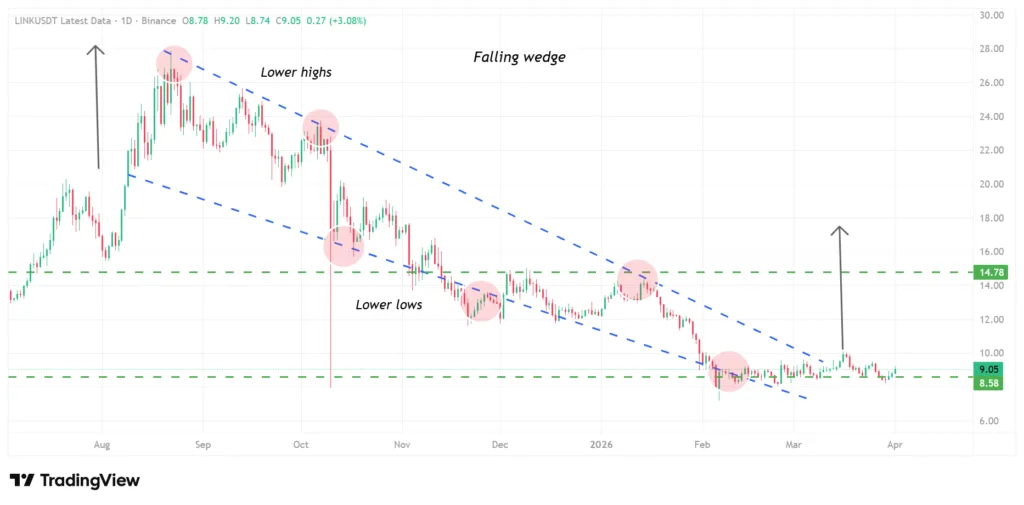
In determining the target, the height of the wedge is usually measured from the widest part and projected upwards from the breakout point. The height is an estimation of the potential move that could take place. However, the estimation is not guaranteed, but it is usually the most commonly referenced value. Given that LINK breaks out textbook style, there is a high chance that it could surpass $17.50.