

As LIDO’s market price has fallen to a historic low level, Lido’s decentralized autonomous organization is considering launching a buyback program to uplift the prices.
The LDO community has expressed concern as Lido prices have dropped below the June 2022 level. Back in February 2024, LDO was trading above $3, and thereafter, the market was not in favor of the LDO community.
LDO:ETH ratio declines by 63%
As such, LDO is trading at historically depressed levels compared to ETH. The official LDO blog post read, “The LDO:ETH ratio currently sits at approximately 0.00016, a 63% discount to the 2-year median of 0.00043, and a 70% discount to the ~0.0005 that characterized most of the prior two years.”
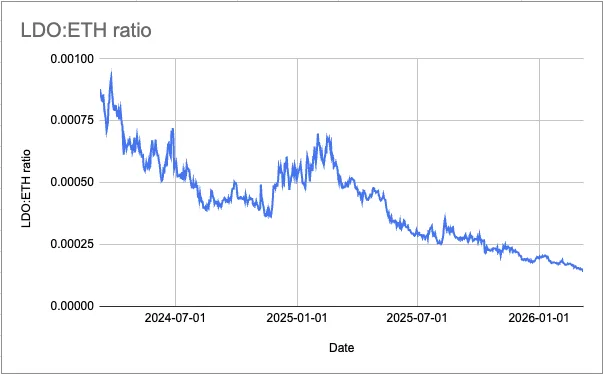
It further stated that it is not a routine fluctuation. It represents one of the most significant dislocations between LDO’s market price and its underlying protocol fundamentals in the token’s history.
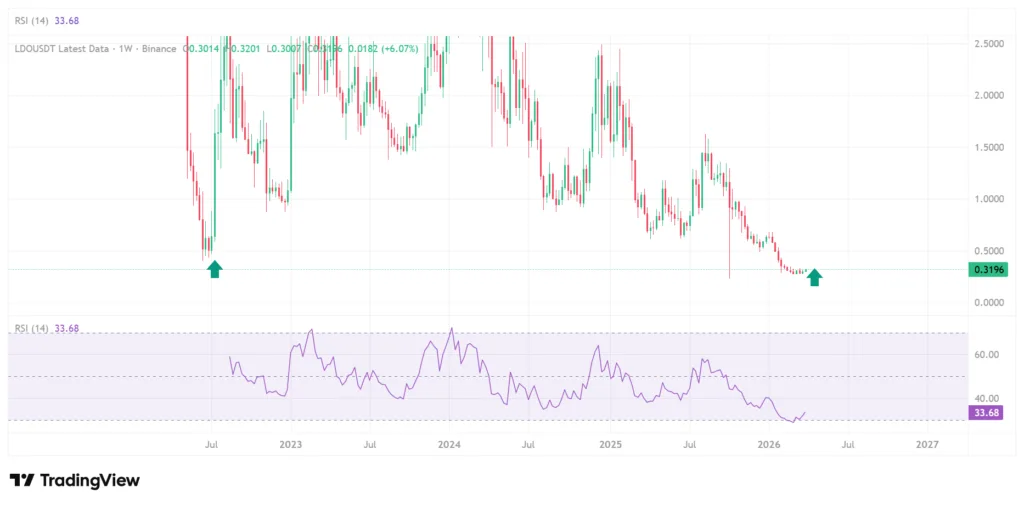
When looking at the price charts, LDO’s all-time high was $3.50, and the prices are now nearly 100% below the all-time high, as LDO trades at $0.13. Ever since LDO reached this all-time high back in February 2024, the macro trend has always been sliding down with lower highs and lower lows.
Macrodowntrend continued as sellers dominated
Although there were instances where the price recovered after a bottom, the bears were quick to seize the opportunity and sold at the new lower highs. With every bottom, buyers bought the dip, while sellers continued gaining profits at the new tops. This behavior shows persistent selling pressure. Every rally gets sold off, meaning demand was not strong enough to flip the trend. Until price starts making higher highs and higher lows, the market remains bearish.
Even the relative strength index shows the waning strength of the bears, as it also did dip with the prices. However, the RSI has now changed its direction of motion upwards just at the nick of time before going into the oversold region. Now the RSI is at 33, and it is facing upwards, and maybe the bullish momentum could take over.
Seeing LDO in dire straits, the Lido DAO wants to allow the growth committee to buy back tokens. As such, the committee intends to use up to 10,000 stETH (staked ETH from its treasury) to accumulate LDO tokens from the market.
Normally, these kinds of operations follow a predefined system, but this proposal allows them to operate that automated framework, giving them more discretion to buy when market conditions are favorable.
Let’s do some calculations: if there is a buyback of around 10,000 ETH (≈$21.59M) then around 67 million LDO will be bought, and this represents about 7–8% of its circulating supply—it represents a meaningful demand shock rather than a guaranteed price driver.
In practice, such a buyback introduces consistent buying pressure while removing a portion of supply from the market, which can help strengthen price support and improve market structure.
However, the actual price impact depends heavily on liquidity and overall market conditions: in thinner markets, sustained buy pressure of this size can contribute to sharp upward moves, while in more liquid or heavily sold environments, it may mainly absorb selling pressure and stabilize price rather than trigger an immediate rally.
Buybacks should be accompanied by other factors for price recovery
Ultimately, buybacks tend to reinforce bullish scenarios and reduce downside volatility, but their effect is amplified only when accompanied by strong demand and favorable sentiment.
For instance, BNB also did a buyback, and it gave positive results. However, the growth of BNB was not solely because of these buybacks. Rather, it has been a combination of everything. Binance has always been using a part of its earnings in the form of BNB buybacks. Thus, the supply of BNB has been reduced over time, which has led to deflationary pressure on the asset.
The major factor that helped the BNB asset soar in price was the growth of the Binance ecosystem. It included the growth of the Binance exchange itself. Moreover, there has been the development of BNB Chain, which has witnessed massive usage from DeFi, NFTs, and other sectors.
Thus, BNB has gained utility because of the ecosystem. It has been used for discount on trading fees, gas fees, staking, token launches, and more. So, there has been a natural increase in demand for BNB. Thus, the buybacks have been more of a supplement in this regard.