



After the KelpDAO exploit that drained $300 million and shook the confidence of the Aave community, the token is still searching for a fair price. With the prices crashing and then recovering to $93, it looks like Aave has formed its bottom, and the decline has come to an end.
Aave lost psychological level of $100 during the exploit
Aave crashed below its psychological level of $100, and it is priced at just above $91 after Kelp, a liquid restaking protocol, was exploited. With this exploit, investors could no longer trust the protocol with their holdings.
As such, they started to pull out of Aave because it triggered a sudden loss of confidence in the safety of lending pools and raised concerns about potential bad debt in the system. During this exit, more than $8 billion was removed from its TVL.
According to a data researcher who goes by the pseudonym Emperor Osmo, the total value locked/staked has fallen significantly, dropping from over $36B in mid-January to under $17B as of today. In addition, the weekly protocol revenue had plunged 62% before rsETH liquidations temporarily reversed it.
To make matters worse, BGD Labs, the team responsible for Aave V3, left in early April.
Today’s $4.35M in daily fees is liquidation fees, which are temporary.
The researcher mentioned that “At $93, $AAVE is roughly fairly valued on trailing 365-day numbers, P/S 11.4x on $123M rev.” However, if the revenue stays at $73.9M, that implies a P/S of 18.9x; the bear case is ~$39–$81.
The p/s is the price-to-sales ratio. It is a ratio of the market capitalization/total revenue. This value dictates how much investors are willing to pay for each dollar of revenue that the protocol produces.
In standard terms a low P/S (e.g. 1–5x): potentially undervalued (cheap relative to revenue). Medium P/S (e.g. 5–15x): fairly valued (depends on growth) while High P/S (20x+): priced for strong future growth expectations.
However, Aave is not yet in the gutter, as there are some good things happening. For instance, the 50 million annual buyback program.
The buyback program on Aave is a mechanism where the protocol uses a portion of its annual revenue – around $50 million in this case – to purchase AAVE tokens directly from the open market.
This is no different from share buybacks in traditional finance, where a company uses the profits it made to reduce the supply of its own shares. In Aave’s case, the goal is to create consistent buying pressure on the token, support its long-term value, and align token performance with protocol usage.
$50 million worth token buybacks
With a market capitalization of about $1.4 billion, this $50 million annual allocation represents roughly a 3.6% “buyback yield,” meaning the protocol is effectively generating demand equivalent to 3.6% of its total valuation each year. This structure helps reduce circulating supply pressure over time and ties the token’s value more directly to the revenue the protocol produces.
Arbitrum recovers 30,000 ETH
On Arbitrum, a portion of the funds linked to the rsETH exploit was successfully traced and frozen before they could be fully laundered off-chain. Specifically, the Arbitrum Security Council intervened and froze around 30,766 ETH, valued at roughly $71 million at the time.
This ETH represented real liquidity that had been moved through Aave markets on Arbitrum but had not yet been fully bridged out or obscured through mixing routes.
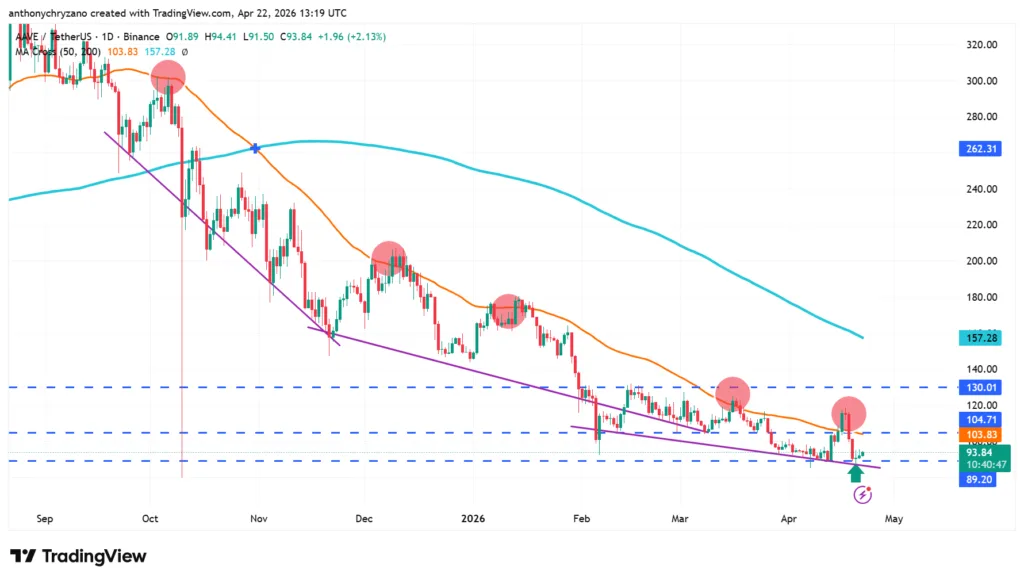
As shown in the chart above, the crashing Aave prices have started to round up. From a steep price crash back in September-December, the gradient of the crash reduced from December until March, and now it is nearly horizontal. This shows that the crash might have come to an end.
When observing closely, Aave even tried to cross above the 50-day moving average but was rejected, as at other times. However, the important thing to note here is how the broader price momentum has changed from a decline to a consolidation phase.
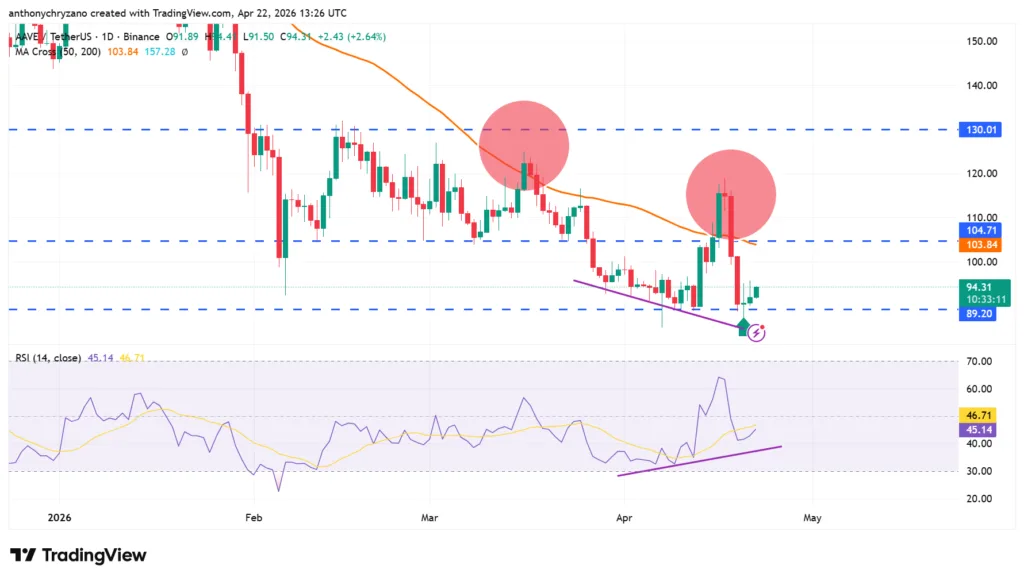
When zooming in to the recovery phase, Aave is building momentum. As shown in the chart above, the relative strength index is making higher lows while the Aave price is making lower lows; this shows bullish momentum is building underneath. The bulls will be building momentum undercover until they reach the threshold and the price can’t stay in the downtrend any longer.
The green candlestick emerging now could be the beginning of the next bull rally as the price pushes towards the psychological $100 level.