



Crypto markets aren’t acting like crypto anymore. The people buying, the reasons they’re buying, and even the mood around the whole thing feel different from what folks saw in 2021 or 2022. If crypto used to seem like a rowdy casino, it’s starting to look more like a regulated financial product with boring quarterly updates.
That shift didn’t happen overnight, and every data insight on the subject points to the same conclusion. Big institutions showed up, rules got clearer, and the numbers keep proving that crypto markets have genuinely grown up.
A quick crypto market analysis to set the scene
Bitcoin still sits at the top of the crypto world. As of late April 2026, it’s trading around $75,536, with a market cap near $1.51 trillion. Ethereum comes in second but plays a different role, sitting around $2,312 with a market cap close to $279 billion. Bitcoin works like digital gold. Ethereum works more like a computer that runs crypto apps and contracts.
The total crypto market cap now hovers around $2.6 trillion. Prices haven’t been setting fresh records like they did last fall, when Bitcoin hit its all-time high around $126,000 in October 2025. A solid crypto market analysis looks past the daily chart and asks who’s buying, why, and with what kind of money.
Those answers now point to Wall Street firms, sovereign funds, and corporate treasuries rather than retail traders fueled by stimulus checks. That’s the single biggest thing any serious crypto market analysis keeps coming back to this year.
Why crypto is rising in 2026
To understand why crypto is rising in 2026, it helps to look at the structural changes, not just the charts. Three things stand out.
First, spot ETFs changed who can buy crypto without friction. Bitcoin ETFs hold around $110 billion in assets, and Ethereum ETFs have crossed $20 billion. Regular folks with a brokerage account can now get exposure the same way they’d buy an S&P 500 fund.
Second, stablecoins have quietly become a massive part of the plumbing. The stablecoin market cap sits near $300 billion, with forecasts from firms like 21Shares pointing toward $1 trillion in the coming year. Banks, fintechs, and payment companies use them to move money across borders in seconds instead of days.
Third, regulation finally caught up. A proper framework for stablecoins passed, and bank rules got friendlier toward digital assets. That unlocked institutional money sitting on the sidelines for years.
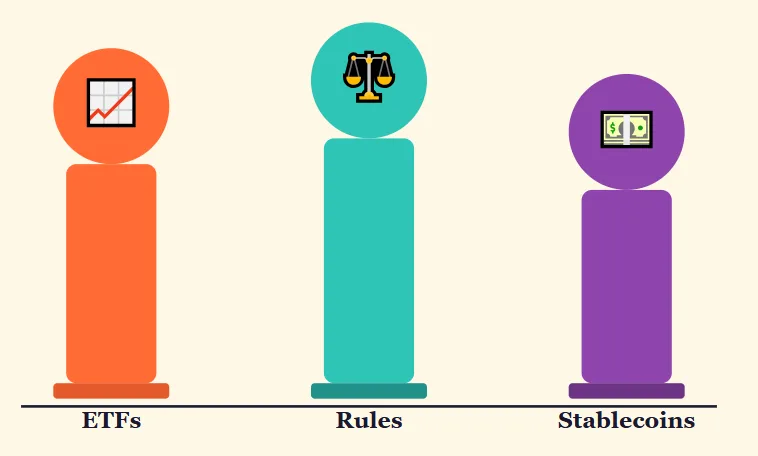
So the honest answer to why crypto is rising in 2026 sounds boring: better rails, better laws, better buyers. It’s a hundred small upgrades stacked together.
The big crypto market trends 2026 everyone’s watching
A handful of crypto market trends 2026 keep coming up across analyst reports. Each one has real money and real users behind it.
- Real-world asset tokenization: Ethereum now hosts more than $20 billion in tokenized Treasuries, real estate, and private equity.
- Stablecoin adoption: Visa, Mastercard, and PayPal have all plugged stablecoin rails straight into their payment systems.
- Layer-2 networks: Cheaper, faster versions of Ethereum like Base and Arbitrum are where big firms actually settle trades.
- AI and crypto overlap: Projects mixing machine learning with blockchain infrastructure have become a legitimate category.
- Altcoin ETFs: After Bitcoin and Ethereum got their funds, spot ETFs for Solana, XRP, and Litecoin launched in late 2025.
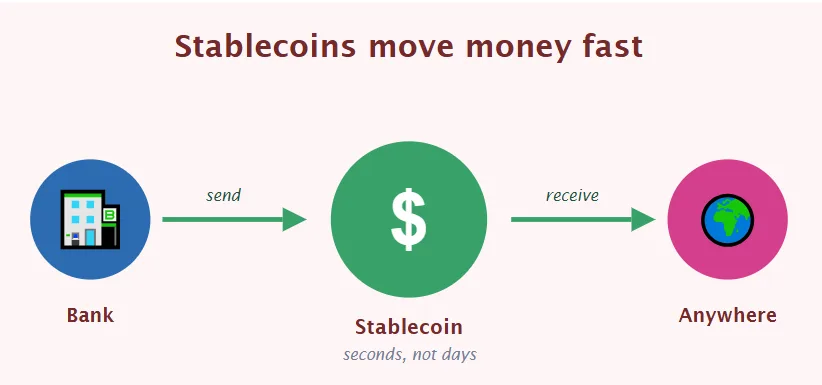
None of these crypto market trends 2026 are theoretical anymore. They have revenue, users, and serious institutional involvement behind them.
What a proper crypto market analysis 2026 reveals
A careful crypto market analysis 2026 shows two things clearly: lower volatility and longer cycles. When big ETFs and corporate treasuries hold a chunk of the supply, prices don’t collapse as fast on bad news, and they don’t spike as violently on good news.
Bitcoin’s link with the broader economy has tightened too. Its correlation with the S&P 500 now sits around 84%, and with gold around 87%. That means Fed policy and inflation data now matter as much as anything happening inside crypto itself.
Bitcoin dominance, meaning Bitcoin’s share of the total crypto market, sits near 57% in April 2026, with the CMC Altcoin Season Index firmly in Bitcoin Season territory. Money keeps flowing toward the biggest, most established coins rather than spraying into thousands of random tokens. That single pattern shapes every honest crypto market analysis 2026 does on capital flows.
Crypto data insights that show the shift
The numbers tell a story headlines often miss. The clearest crypto data insights from early 2026 reports:
- Bitcoin ETFs and treasuries now hold around 12% of the global Bitcoin supply, effectively removing those coins from active trading.
- Stablecoin market capitalization sits near $300 billion, with projections hitting $1 trillion by year-end.
- Around 61% of current crypto holders say they plan to buy more, while only about 6% of non-holders plan to join.
- Price targets from major banks like Standard Chartered sit around $150,000 for Bitcoin by end of 2026, with Bitwise and Bernstein going as high as $200,000.
What these numbers add up to is a market being built on a different foundation. Less hype cycle, more infrastructure. Good crypto data insights aren’t just about what Bitcoin did today. They’re about who owns it, how they got in, and how long they plan to stay.
Reading crypto market sentiment 2026
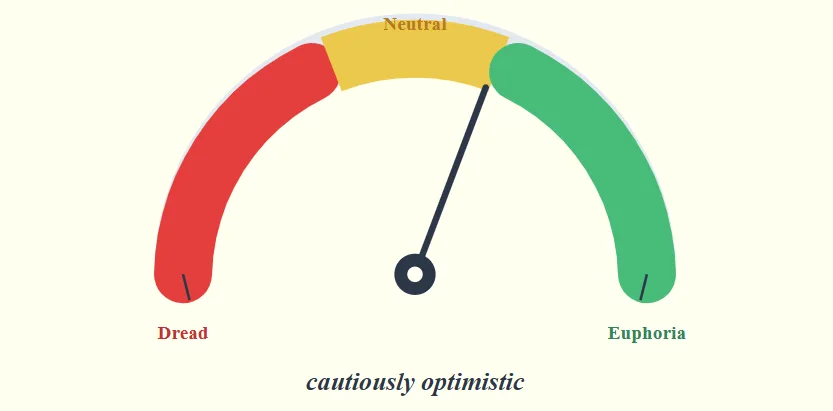
Crypto market sentiment 2026 sits in an odd spot. The mood has settled somewhere between the euphoria of late 2021 and the dread of late 2022. A Nomura and Laser Digital survey from April 2026 found 31% of institutional investors now hold a positive outlook on crypto, up from 25% in the previous study, with negative views dropping to 18%.
Retail investors are mostly holding rather than piling in. Surveys show 61% of existing crypto owners plan to add to their positions, while new entrants stay cautious. That split matters. It means the current rise isn’t being powered by fresh retail money.
Geopolitics has crept into the conversation too. Recent US and Iran tensions triggered roughly $250 million in crypto liquidations inside 24 hours. Once an asset reaches that stage, it stops acting like a niche bet and starts behaving like a line item on a balance sheet. Reading crypto market sentiment 2026 correctly means paying attention to global macro news as much as crypto-specific drama.
What it all means going forward
Crypto in 2026 feels calmer because it’s held up by different hands. ETFs, banks, corporate treasuries, and clearer laws have replaced a lot of the chaos that used to define the space. The trade-off is less explosive growth, but also fewer brutal collapses.
For anyone just walking in, the best starting point is understanding that the story has moved on from overnight riches. A technology is slowly embedding itself into regular finance, and the numbers keep backing that up.