


Institutions do not want to sit on the crypto sidelines anymore. As the market matures, firms are actively repositioning and looking at where capital can work most efficiently. As a result, the conversation around DeFi vs TradFi is growing deeper as firms try to figure out effective institutional crypto capital allocation.
These institutions are comparing both systems side by side to determine where they get better execution, stronger returns, and acceptable risk exposure. Each offers something different, and that difference is shaping capital allocation decisions.
This article will dive into DeFi vs TradFi to identify the key differences and when each is suitable for institutions.
What is DeFi
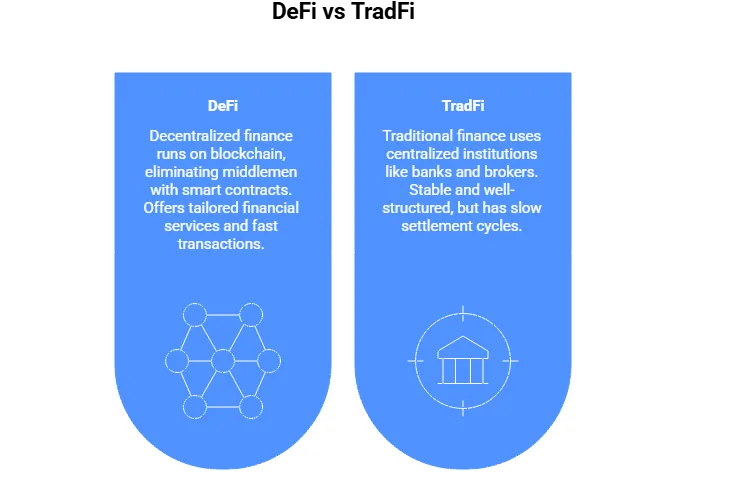
Decentralized finance (DeFi) is a form of financial system that runs on blockchain technology. This form of finance eliminates middlemen and substitutes them with smart contracts. These smart contracts are automatically executed, without the need to use banks or brokers.
DeFi offers institutions access to tailored financial services and investment opportunities. Some of the opportunities where institutions invest in DeFi include lending protocols, staking, liquidity pools, and exchange-traded funds (ETFs). Additionally, the settlement of transactions is fast, and it can take just a few minutes, thereby enhancing the efficiency of capital.
Nevertheless, there is a set of evident risks in DeFi. The major weaknesses are smart contract vulnerabilities, protocol failure, and the lack of regulatory clarity, which complicate the massive implementation. However, institutions tend to tackle DeFi with regulated exposure, via custodians, risk constructs, or restricted allocations to avoid these risks.
What is TradFi
Traditional finance (TradFi) is the conventional financial framework that operates based on centralized institutions such as banks, asset managers, and regulated exchanges. This form of finance works under strict legal provisions and uses middlemen for transactions and custody.
Despite the advent of DeFi, TradFi is still needed by the institutions since it is stable and well-structured. Regulated custodians hold assets and perform transactions in a specified process. TradFi also allows risks to be measured beforehand due to the established and tested frameworks. These markets are also profound and able to accommodate huge amounts of capital.
Nonetheless, TradFi has several limitations, including slow settlement cycles, costly cross-border transactions, and slow infrastructure. Despite the limitations, TradFi is still the basis of institutional capital.
Key differences DeFi vs TradFi
DeFi vs TradFi have differences which justify how institutions make decisions about where to invest funds. Some of the key differences include:
1. Control and Custody
TradFi outsources custody to banks and other regulated parties. Institutions use third-party custodians to protect assets and minimize operational risks. However, third-party custodians create counterparty exposure risks.
On the other hand, DeFi supports internalized custody. Institutions use wallets to hold assets and have control of private keys. This eliminates middlemen and transfers the entire liability to the owner of the asset.
2. Accessibility and availability
TradFi markets operated on fixed hours and jurisdictional markets. Additionally, access is regulated, licensed, and subject to geographic boundaries.
The DeFi markets are open 24/7, all year round. This allows capital to be moved freely and can be redistributed 24/7 on the global protocols. The constant availability optimizes treasury and liquidity management, especially for companies dealing with time zones.
3. Openness and transparency
TradFi is a closed system whereby information is unreliable, not real-time, and can be very costly if not done correctly.
On the other hand, DeFi is totally transparent. All DeFi transactions and positions, as well as liquidity pools, are on-chain and real-time. This helps organizations to track their activities more effectively, but also puts strategies and flows in the hands of competitors.
4. Speed and efficiency
The settlement of TradFi may require one to three days, depending on the asset class. This capitalizes and creates settlement risk.
DeFi transactions can be settled in a few minutes or seconds. This enhances capital efficiency since capital can be redeployed in almost real time. It is one of the significant reasons institutional experimentation with tokenized assets takes place.
5. Regulation and compliance
TradFi is fully regulated, therefore, giving investors legal cover and protection. Compliance in this kind of finance is intricately constructed into the system.
On the other hand, DeFi is not fully regulated, although some countries seek to have clear regulations. Consequently, there tends to be limited capital deployment through compliant, regulated funds or hybrid formats.
6. Yield Generation
TradFi yields are stable but very compressed. The returns are driven by interest rates, dividends, and fixed-income products.
Staking, lending, and liquidity provision have a higher payoff in DeFi. These yields are not fixed and are normally linked to a higher risk, including smart contract vulnerabilities and token volatility.
TradFi vs DeFi comparison
| Category | DeFi | TradFi |
| Control & Custody | Assets are held in wallets controlled by the institution. Full control, but full responsibility. | Assets are held by banks or custodians. This reduces workload but adds counterparty risk. |
| Accessibility & Availability | Operates 24/7 with no geographic limits. Investors can transfer their funds anytime. | Operates in business hours only. Access is regulated and properly licensed. |
| Openness & Transparency | Fully transparent. On-chain transactions, positions, and liquidity are all visible in real time. | Limited visibility. Institutions control and tend to delay or limit data. |
| Speed & Efficiency | Transactions settle within minutes or seconds. Capital can be reused almost instantly. | Settlement takes 1–3 days, depending on the asset. Capital is tied up during this period. |
| Regulation & Compliance | Rules are still evolving. Less clarity, which increases risk for large allocations. | Powerful regulatory framework and inherent compliance, as well as investor protection. |
| Yield Generation | Higher potential stakeholder, lending, and liquidity yields, but with the increased risk | Reduced and consistent interest, bonds, and dividend returns. |
DeFi vs TradFi: Scenarios to use each
In reference to DeFi vs TradFi, institutions implement either of the systems depending on the goal they wish to reach. Some of the main situations to use either are as follows:
When to use DeFi:
- Pursuing better returns: DeFi offers higher staking, lending, liquidity, and yield-farming returns.
- Need rapid execution: DeFi is ideal in the context that capital should be targeted to be deployed and redeployed rapidly, with none of the delays in settlement.
- Operating across borders: It is not restricted to geography, hence it is accessible worldwide.
- Managing crypto-native assets: On-chain systems have more effective management of digital assets.
- Testing new financial strategies: The DeFi is available to test future financial products and architectures.
When to use TradFi:
- Focusing on capital preservation: TradFi has less risky terms for long-term strategies.
- Complying with the regulatory requirements: Institutions must be compliant with the regimes.
- Handling a large amount of transactions: This liquidity is high, and this implies that there is reduced market impact.
- Handling money for clients: Investors desire to have controlled settings and legal security.
- Operating with fiat systems: TradFi is still used to pay, give salaries, and provide traditional services.
Final thoughts
In the TradFi vs DeFi comparison, the goal is not about which is superior. Instead, institutional crypto capital allocation should focus on efficiency because both all fit a particular purpose. DeFi is used when institutional investors require fast and convenient management of crypto-related assets.
TradFi, on the other hand, may be utilized when the stability, availability of regulatory protection, and scalable infrastructure are vital. Most institutions, however, are not choosing one over the other. They are combining the two to have a balanced financial approach.