


DeFi has come a long way from the early days of four-digit APYs that disappeared within weeks. What’s left standing is a more mature set of protocols paying out from real activity: loan interest, trading fees, and revenue earned from genuine use. Total value locked has ranged between $85 and $120 billion through 2026, and the best DeFi yield protocols in 2026 have been tested through multiple market cycles.
For anyone stepping in for the first time, the most important thing to understand isn’t which token is trending. It’s what separates yield that’s real from yield backed by freshly minted tokens that lose value the moment they’re distributed.
Real yield DeFi: What it means
When a protocol advertises 40% APY, that number can come from completely different sources. Real yield DeFi means returns funded by actual economic activity: loan interest, trading fees, or fees earned for providing security to other protocols. The opposite is inflationary yield, which is rewards paid in tokens the protocol is printing on a schedule. Those tend to drop in value as supply grows, eating into whatever number was advertised.
The formula is simple: real yield equals nominal APY minus token inflation minus the price depreciation of whatever token is paying out. A 7% return funded by a token inflating at 4% leaves far less than it looks like on the surface. This became the defining theme heading into 2026, and the DeFi protocols generating real yield in 2026 are the ones that survived because their numbers were backed by actual revenue.
What to look for in a DeFi yield protocol
Not every protocol that shows up in a search result deserves attention. A few things separate the ones worth using from the ones that just look good on paper.
The first is where the yield actually comes from. If a protocol can’t clearly explain what activity is generating the return, that’s a red flag. Real yield traces back to something: a borrower paying interest, a trader paying a fee, or a protocol paying for security. If it traces back to newly minted tokens and nothing else, the yield has a shelf life.
The second is security track record. Protocols audited by firms like Trail of Bits or OpenZeppelin, and to a lesser extent CertiK, which has faced criticism over audit quality in several high-profile cases, carry meaningfully less risk. TVL is a useful signal here too. Sustained, growing deposits over time show that users have kept their money in and that nothing has gone catastrophically wrong.
The third is liquidity. A high APY on a pool with very little capital behind it is easy to produce and hard to exit. The protocols below all have deep, established liquidity across major assets.
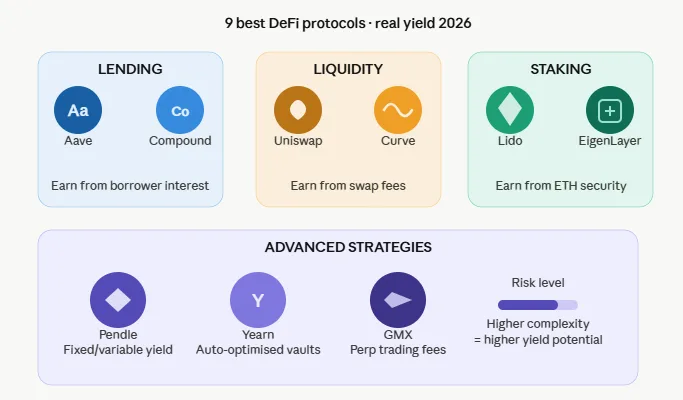
1. Aave
Aave is the largest lending protocol in DeFi by total value locked, holding tens of billions in deposits. Someone deposits USDC, a borrower uses it, and the depositor earns the interest. No price speculation involved.
Yields on stablecoins come from genuine borrowing demand, not governance token inflation. It runs across Arbitrum, Base, and other chains, which keeps transaction costs low. For a first-time user, depositing a stablecoin into Aave is one of the more straightforward entry points in DeFi lending, though it carries integration risk. In April 2026, a third-party exploit involving a collateral token caused billions in TVL outflows from the protocol within 48 hours.
2. Compound
Compound was one of the earliest protocols to prove that decentralized lending could work at scale. It adjusts interest rates automatically based on supply and demand. When more people borrow, rates climb. When fewer do, they drop.
It’s transparent, reliable, and straightforward. For anyone building their first DeFi position, Compound remains one of the most approachable top DeFi lending platforms available.
3. Lido
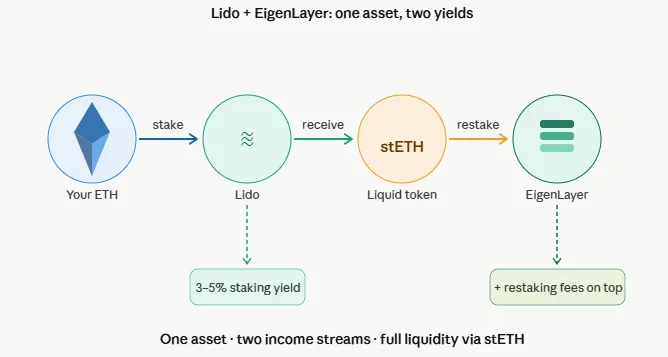
Traditional Ethereum staking locks up ETH with no access to it. Lido changed that by issuing stETH, a token representing staked ETH that earns staking rewards while still being usable across DeFi for lending, providing liquidity, or posting as collateral.
One asset working in two places at once is a core feature of how passive income DeFi 2026 is structured. Lido made it mainstream. Base staking yields sit in the 3-5% range, but using stETH in other protocols on top of that compounds the return further.
4. EigenLayer
EigenLayer lets users restake already-staked ETH to help secure additional protocols. Those protocols pay fees for using Ethereum’s security, and those fees flow back to restakers.
It’s distributed over a hundred million dollars in rewards since mainnet launch. No token printing involved, just fees from protocols paying for shared security. It’s one of the more significant passive income DeFi 2026 developments for ETH holders, and it’s been growing steadily with institutional interest following regulatory clarity.
5. Uniswap
Uniswap V3 introduced concentrated liquidity, which lets users focus their capital within specific price ranges instead of spreading it evenly across all possible prices. More focus means more fees earned per dollar deposited, but it needs active management.
The risk to know is impermanent loss. If someone provides ETH-USDC liquidity and ETH’s price moves significantly, the pool rebalances automatically, and they can end up holding less ETH than if they’d just held it. On stablecoin-to-stablecoin pairs, that risk is close to zero.
6. Curve Finance
Curve focuses specifically on stablecoin swaps, which is why impermanent loss is rarely a concern for depositors there. Yields are steadier, the risk profile is lower than on volatile pairs, and the protocol processes billions in volume consistently.
For anyone working through a DeFi yield farming guide for the first time, Curve’s stablecoin pools are one of the most practical places to start earning without taking on significant price exposure.
7. Pendle
Pendle splits yield-bearing assets into two separately tradeable parts: the principal token and the yield token. Users can lock in a fixed return by selling the yield portion upfront, or hold the yield token if they expect rates to rise.
It held billions in TVL through 2026 and is increasingly used in both retail and institutional strategies. Stablecoin pools on Pendle have offered yields above 14%, though these figures often include points programs and incentives on top of base protocol fees. The purely fee-backed portion is typically lower, which is why it keeps appearing in any serious DeFi yield farming guide covering 2026.
8. Yearn Finance
Yearn automates yield optimization. Instead of manually shifting capital between Aave, Curve, and Compound to chase better rates, Yearn’s vaults handle the switching and compounding on their own.
Gas costs are pooled across all depositors, making the strategy efficient even for smaller amounts. It’s a strong option for anyone wanting real yield DeFi exposure without actively managing positions across multiple protocols.
9. GMX
GMX is a decentralized perpetuals exchange where traders pay fees to open and close leveraged positions. Those fees go directly to liquidity providers. No token inflation, no emissions schedule.
It consistently ranks among the best DeFi yield protocols because every dollar paid out traces back to actual trading activity. Liquidity providers on GMX are essentially taking the other side of leveraged trades and earning the fee income that comes with it.
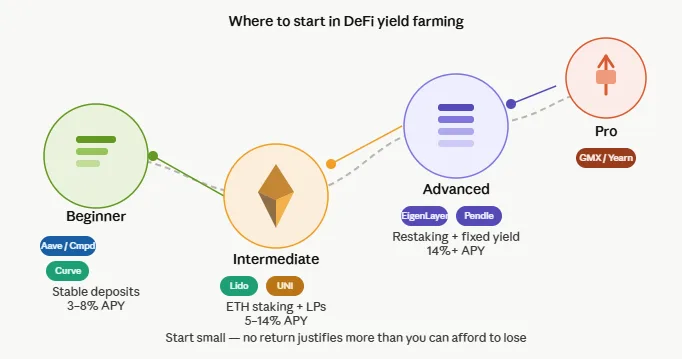
Start small, stay informed
The nine protocols above cover the full range from beginner-friendly stablecoin deposits to more hands-on liquidity strategies. There’s no single right starting point. It depends on how much risk someone’s comfortable with, how actively they want to manage a position, and which blockchain they’re already using.
Security is always part of the equation. Smart contracts can carry vulnerabilities, and even well-audited code isn’t immune. The DeFi protocols 2026 offers are more transparent and better audited than ever, but no return justifies putting in more than someone can genuinely afford to lose.