


The crypto market review you actually needed lands at a fascinating moment.
Bitcoin is playing the “will it or won’t it” game near $75,900; Ethereum is sitting in the corner pretending it has a plan; Tether is quietly printing relevance like a bored central bank; XRP just shoved BNB off the rankings podium; and BNB is doing what BNB always does, surviving on stubborn utility.
Welcome to April 2026, where macro drama, Middle East geopolitics, and a sprinkle of regulatory fairy dust have turned the top five cryptocurrencies into the most chaotic reality show on the internet. Grab your coffee. This one gets interesting.
Bitcoin is consolidating, not crying
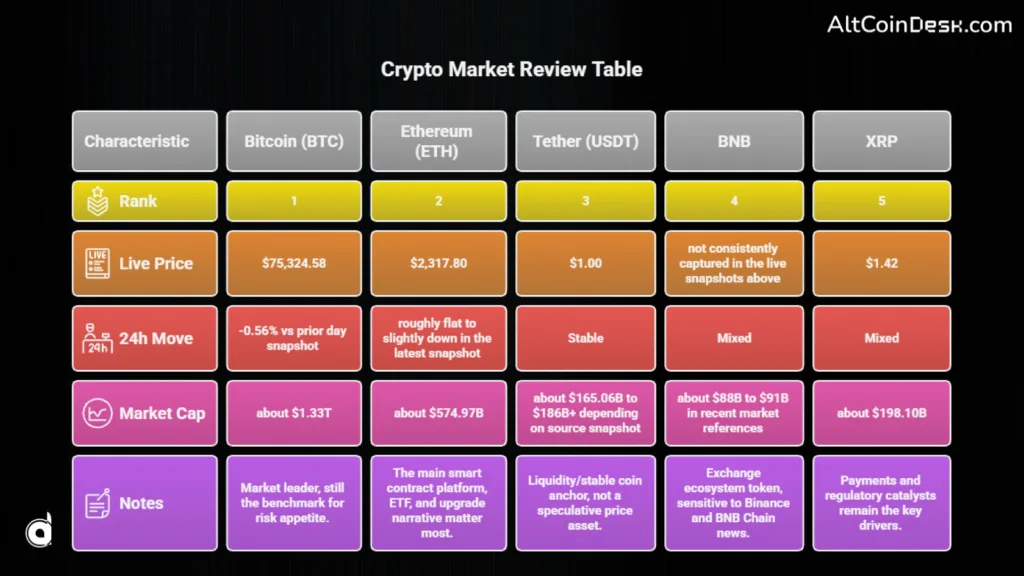
Let us begin with the king. Bitcoin opened Tuesday, April 21, at $75,854 and climbed to $76,535 by mid-morning, a solid 2.7% jump from Monday’s $73,854. To put that into perspective, BTC spent most of Q1 2026 looking like it owed the market money. January closed at minus 10.1%, February dropped 14.8%, and March managed a barely-there 0.19% gain. April was supposed to be its comeback arc, and so far, it is doing a passable impression of one.
Technically, the EMA cluster sits at the $75,000 to $75,500 zone as immediate resistance, while $73,500 is holding firm as the floor traders keep returning to. The MACD histogram has flattened from its deeply negative lows, meaning sellers are getting tired. The RSI hovers near 42, not yet screaming “buy everything” but no longer threatening panic either. The bull thesis for Bitcoin in April is historically compelling: the month averages a 30% return across BTC’s lifetime, and on-chain analysts keep pointing to a five-red-monthly-candle analog with 2018 to 2019 that preceded a 317% rally. History does not repeat, but it does love to plagiarize itself.
Bitcoin also briefly spiked to a two-month high near $77,400 on April 17 after Iran announced the reopening of the Strait of Hormuz, dragging traditional markets higher in the process. The strategic Bitcoin reserve narrative in Washington, with the current administration proposing to hold and grow the government’s BTC stockpile, functions as long-term fuel even when short-term charts look uncertain.
Ethereum is doing fine, allegedly
Ethereum opened April 21 at $2,314 and pushed toward $2,322 by mid-morning, a 2.2% lift from Monday. Respectable? Yes. Thrilling? The Ethereum community would prefer you not answer that.
The ETH story right now is a tug of war between two competing narratives. On one side: improving ETF flows, a dominant smart-contract platform position, and price models targeting $2,400 to $2,500 if the token clears $2,292 with conviction. On the other side, short-seller firm Culper Research publicly disclosed a short position in ETH in early 2026, arguing that the Fusaka upgrade debate weakened fee revenues by collapsing the gas market and enabling spam transactions. That is not exactly the institutional endorsement you frame on the wall.
Technically, ETH needs to hold above the $2,052 Fibonacci support level to avoid a slide toward the $1,742 base. A sustained push through $2,350 on volume would change the entire conversation and open the targets that multiple forecasts have penciled in for the coming weeks. For now, Ethereum is in that infuriating consolidation phase where you check the chart hourly, and it stares back at you with complete emotional indifference.

Tether: the market’s most boring superpower
Nobody writes love letters to Tether. Nobody tattoos USDT on their forearm. And yet here it sits, between $165 billion and $186 billion in market cap depending on the snapshot, doing more heavy lifting for the crypto ecosystem than almost any other asset in the top five.
Tether at $1.00 is not the story. The story is what rising USDT supply signals: capital waiting on the sidelines, exchange liquidity staying deep, and big money positioning before it moves. Recent announcements around the Tether wallet and broader consumer wallet integration suggest the company is not content to stay in the trading lane. It wants everyday users, not just exchange desks. That ambition, if it succeeds, makes Tether structurally more interesting than a price chart that never blinks.
Watch USDT for volume trends, not price. If stablecoin supply keeps expanding while BTC holds above $73,500, that is a reasonably healthy sign that dry powder is accumulating for the next move.
XRP shoved BNB and is now eyeing Ethereum
This is where the broader digital assets story gets genuinely theatrical. XRP has reclaimed fourth place in global crypto rankings by flipping BNB, with a market cap near $91 billion as it trades in the $1.42 to $1.50 range. The two assets have swapped positions multiple times since March 2026 in what is effectively the world’s most expensive game of musical chairs.
The March 17 catalyst that rewrote the rulebook: the SEC and CFTC jointly classified XRP as a digital commodity, freeing banks and asset managers that had avoided the token over securities concerns to hold and trade it without legal anxiety. Spot XRP ETFs pulled in $65 million through mid-April 2026, the largest monthly inflow of the year. Ripple’s On-Demand Liquidity corridors keep generating organic buying pressure that does not depend on retail hype cycles.
Price targets for the year range from $2.60 on the conservative side to $3 to $4 at mid-cycle optimism, with some Wall Street desks projecting as high as $8 if regulatory tailwinds hold. For XRP to catch Ethereum at its current $233 billion market cap, the token would need to reach roughly $4.79, a 219% move. Outlandish? Maybe. Three years ago, people said XRP would not survive the SEC at all.

BNB: the fighter who refuses to fall
BNB is the cryptocurrency equivalent of that action hero who gets knocked through a wall, stands up, dusts off their jacket, and says absolutely nothing. It has lost the fourth-place ranking to XRP. It has weathered Binance-related regulatory headlines that would make lesser tokens crumble. And it is still sitting at roughly $88 billion to $91 billion in market cap, still powering one of the busiest blockchain ecosystems in existence.
BNB is not a headline asset right now. It is a utility asset. BNB Chain’s throughput improvements and developer incentive programs are not the kind of announcements that trend on social media, but they are the structural execution that keeps an ecosystem relevant when Ethereum is expensive, and Solana is everyone’s favorite talking point. The near-term technical picture for BNB tracks BTC direction closely, with Binance-related sentiment functioning as an added variable that can move the token faster than the fundamentals suggest it should.
The actual note: watch, do not chase
This particular crypto markets roundup lands during a moment the industry calls “selectively bullish.” Not euphoric, not broken, but building. Bitcoin holds its leadership role, Ethereum is rebuilding its catalyst story, Tether is expanding its consumer footprint, XRP is writing the most compelling institutional and legal narrative of the year, and BNB keeps compounding quietly while everyone else argues about what is next.
Watch BTC for overall market direction and the $75,500 resistance test. Watch ETH for a clean break above $2,350 as your signal that the consolidation is ending. Watch the USDT supply for liquidity positioning hints. Watch XRP for the next regulatory or ETF catalyst, because those moves make this token faster than almost anything else. And watch BNB for genuine developer adoption signals beyond DeFi and meme coin activity.
The market is not sleeping. It is catching its breath. And if April’s historical averages have anything to say about it, that breath might not last long.