

Opening your phone and typing “Ethereum vs Bitcoin” into Google at 2 am while questioning your financial future is a debate that refuses to die, and honestly, it keeps getting more interesting.
The Bitcoin vs. Ethereum 2026 debate has officially moved from crypto Twitter arguments to pension fund boardrooms, and the stakes have never been higher. Bitcoin is sitting somewhere around $88,000 after sliding off a jaw-dropping peak of $126,198. Ethereum, ever the dramatic one, is hovering near $2,300 after its own identity crisis from $4,954.
Both are nursing their wounds. Both are plotting their next move. And both are absolutely worth understanding before you do anything rash with your portfolio. So grab something warm to drink. Here are ten things the rest of the internet is not telling you clearly enough.
1. Bitcoin’s midlife crisis
Bitcoin peaked near $126,198 in late 2025 and has since slid about 30% to around $88,000. In any other market, a 30% drop would send analysts into a spiral of dark reports and dramatic headlines. In crypto, it is practically a Tuesday.
What matters more is that Bitcoin has delivered roughly 16,200% gains over the past decade. That is not a typo. If you had parked your savings in Bitcoin ten years ago, you would be reading this from somewhere considerably more comfortable than wherever you are now.
2. Ethereum cried harder
If Bitcoin had a midlife crisis, Ethereum had a full existential breakdown. It dropped about 40% from its $4,954 high to hover near $2,300 now. Despite that, it has delivered approximately 18,030% gains over a decade, which is somehow even more ridiculous than Bitcoin’s number.
The lesson here is not to panic when prices fall. The lesson is to understand why the asset fell and whether the fundamentals still hold. Spoiler: for Ethereum, they more than hold.
3. The Glamsterdam upgrade
Here is where it gets genuinely exciting. Ethereum’s upcoming Glamsterdam hard fork, targeted for May or June 2026, is being called its most significant upgrade since The Merge. It introduces parallel transaction processing, Block-Level Access Lists, and enshrined proposer-builder separation. In plain language: Ethereum is aiming for roughly 10,000 transactions per second and a roughly 78% reduction in gas fees. For context, Ethereum currently handles a fraction of that. This is not a minor patch; it is a structural overhaul. And if you are making a Bitcoin or Ethereum investment decision right now without factoring this in, you are working with incomplete information.
4. One bank’s bold prediction
Standard Chartered’s Geoffrey Kendrick declared 2026 as Ethereum’s year, even while lowering his year-end price target to $7,500 from an earlier $12,000 forecast. A $7,500 target from a current price near $2,300 still implies more than 140% upside if he is right.
The bank also expects the CLARITY Act, combined with resilient US equity markets, to push Bitcoin to a fresh all-time high in the first half of 2026. So, according to one of the world’s most reputable banks, both assets could outperform this year. Not bad for two assets the internet has declared dead approximately 400 times each.
5. Wall Street’s favorite coin
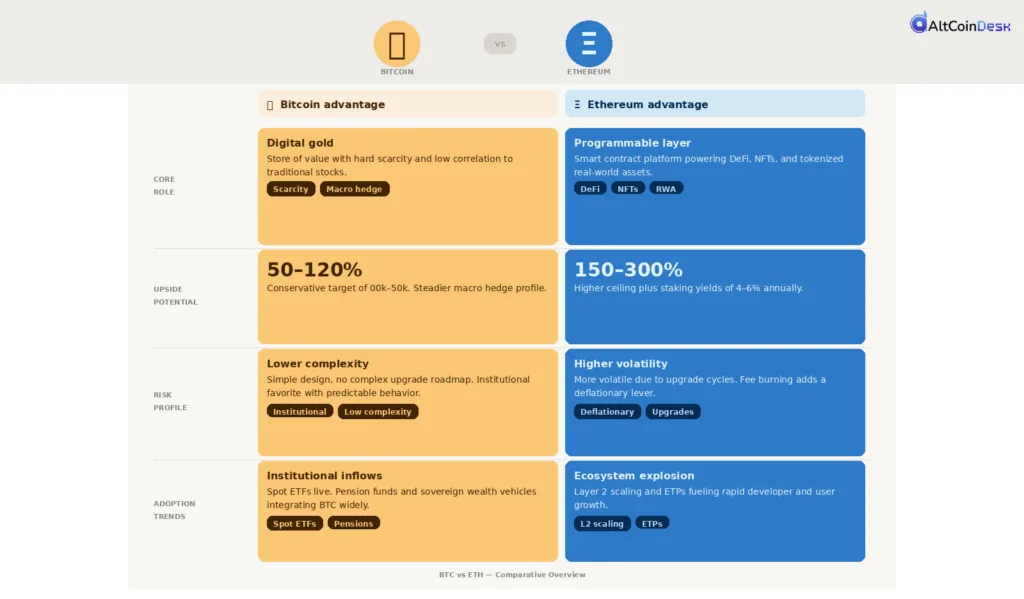
Bitcoin is simple. That is its genius and its pitch to traditional finance simultaneously. It has a fixed supply, a predictable halving schedule, and no complex upgrade roadmap to worry about. The 2024 halving cut Bitcoin’s block reward to 3.125 BTC, enforcing a scarcity that has historically preceded significant price rallies. Spot Bitcoin ETFs now hold over $60 billion in assets under management, with pension funds and sovereign wealth funds quietly allocating to it. Ethereum vs. Bitcoin price prediction debates often miss this: Bitcoin’s institutional adoption story is far more linear and easier for a traditional fund manager to explain to a board.
6. The Layer 2 awkward truth
Layer 2 networks like Arbitrum and Optimism now handle over 95% of Ethereum transactions, with a combined total value locked exceeding $63 billion and throughput reaching 12,000 transactions per second. This sounds like a win. And in terms of user activity, it is.
But here is the awkward part: when transactions happen on Layer 2 instead of Ethereum’s main chain, fewer fees are burned on the main chain. That means less deflationary pressure on ETH, which was one of the asset’s core investment narratives post-Merge. This is precisely what Glamsterdam is designed to address by bringing serious Layer 1 scaling back into the conversation.
7. ETF scores worth watching
Bitcoin ETFs like FBTC hold roughly $17.7 billion in assets under management with a 0.25% expense ratio and a one-year return of approximately negative 13.7%. Ethereum ETFs like ETHA hold around $10.3 billion with the same fee structure but a comparatively better one-year return of approximately negative 9.7%.
More interestingly, Bitcoin ETFs saw roughly $325 million in outflows in April, while Ethereum ETFs attracted around $187 million in weekly inflows. For the first time in 2026, Ethereum ETFs are outperforming their Bitcoin counterparts on a flow basis. BlackRock has even filed for ETHB, a staked Ethereum ETF that would distribute staking yields directly to shareholders. That is a significant signal.
8. The green argument is settled
Bitcoin consumes approximately 150 terawatt-hours of electricity annually, comparable to the energy consumption of a medium-sized country. Ethereum, since its transition to Proof of Stake in 2022, uses roughly 0.02 terawatt-hours per year. That is a 99.95% reduction in energy consumption.
For ESG-conscious institutional investors, this distinction is becoming impossible to ignore. Bitcoin advocates correctly note that Proof of Work provides unparalleled decentralized security. But Proof of Stake advocates will point out that Ethereum now offers 4% to 6% annual staking yields on top of its energy efficiency, which is a compelling combination.

9. Vitalik’s 2026 mission
Vitalik Buterin has publicly committed to making 2026 the year Ethereum reclaims ground on self-sovereignty and trustlessness, directly addressing centralization concerns that crept in over recent years.
His 2026 plans include ZK-EVM development, quantum-resistant cryptography, and a biannual upgrade cadence with Glamsterdam, followed by the Hegota upgrade later this year. This is not the scattered roadmap of previous years. Ethereum is operating with something increasingly rare in crypto: a coherent, published, engineering-first delivery model.
10. Own both, sleep better
The honest answer to the Ethereum vs. Bitcoin price prediction is that nobody knows with certainty who wins in 2026. Bitcoin forecasts range from $100,000 to $200,000 based on post-halving momentum and institutional flows.
Ethereum predictions span from a conservative $2,000 floor to an optimistic $7,500 or higher if the Glamsterdam upgrade delivers and DeFi activity rebounds. What analysts broadly agree on is that holding both reduces the kind of single-asset volatility that makes investors sell at exactly the wrong moment. Bitcoin offers stability and institutional credibility. Ethereum offers growth potential and yield. Together, they cover the bases.
Key takeaway from the Ethereum vs. Bitcoin debate
The Bitcoin or Ethereum investment debate has no clean winner, and anyone pretending otherwise is selling something. Bitcoin is the dependable asset that has survived regulatory threats, quantum computing panic, and 400 obituaries written by journalists who should probably apologize.
Ethereum is the builder’s asset, constantly upgrading, occasionally chaotic, but pointing toward a genuinely transformative future for decentralized finance. In 2026, with the Glamsterdam upgrade incoming, staked ETF applications in motion, and institutional money flowing into both, this is perhaps the most interesting year to hold either asset or both. Just maybe do not check the price at 2 a.m.