

So, Ethereum decided it did not want to be the congested highway it once was. You know the one. The kind where you pay $80 in gas fees to send $20 worth of tokens and sit in traffic for 20 minutes wondering where your life went wrong. Welcome to 2026, where the blockchain has grown up, gotten therapy, and hired a team of engineers with a real plan.
Ethereum’s latest direction makes one thing clear: its base layer handles security, while layer 2 networks do the actual work. Think of it like a corporate org chart, except nobody is getting fired and transactions cost cents, not stress.
This piece breaks down everything in Ethereum’s scaling universe, from the best Ethereum L2 networks keeping the lights on to the zombie chains haunting the blockchain graveyard.
So, what is a layer 2?
Before anyone panics, here is the short version. A Layer 2 is a network built on top of Ethereum that handles transactions off-chain and then reports back to Ethereum, like a very diligent intern who does all the work and lets the boss take the credit. The crucial difference between an L2 and a sidechain is that L2s inherit Ethereum’s security rather than relying on their own validators.
In 2026, most Ethereum activity happens on L2s because they are faster and dramatically cheaper. The base layer now plays the role of supreme security overlord and settlement hub, while L2s handle the transaction-processing action.
What the Foundation declared
The March 2026 announcement reshuffled the whole L1 versus L2 conversation. Previously, the unspoken job description for L2s was simply “scale Ethereum.” That job description has now been rewritten entirely.
Today, the primary objective of L2s is to provide differentiated features, services, customizations, go-to-market strategies, and zones of control. Translation: just being cheap is no longer enough. You need a personality.
Meanwhile, Ethereum L1 is described as the primary hub for settlement, shared state, liquidity, and DeFi, with the Foundation noting that no other chain matches its adoption, decentralization, and resilience today.
The Foundation also introduced a “walkaway” test for L2 security. L2s must reach at least Stage 1 security standards, meaning users should be able to exit safely to L1 even if operators act maliciously. Basically, if your L2 operator goes rogue, you should still be able to grab your funds and leave with your dignity intact.
Top layer-2 solutions: Five scaling updates to know
1. Blobs are nowhere near full, which is actually good news
When EIP-4844 introduced blob transactions through proto-danksharding, the whole point was to make it cheaper for rollups to post data back to Ethereum. It worked. Blobs are currently only around 30% full, giving the Ethereum Foundation room to expand capacity as L2 ecosystem demand grows. That headroom means L2s can keep growing without immediately hitting a wall, which is a refreshing change from Ethereum’s previous habit of hitting walls constantly.
2. The gas limit is finally going up
Ethereum’s 2026 roadmap includes a default gas limit increase to around 60 million from the current 45 million, with a transaction gas limit cap of 16.7 million gas per transaction. Optimists predict that after enshrined proposer-builder separation arrives, the gas limit could double or higher. That is a lot of room for more activity without sacrificing security.
3. Enshrined proposer-builder separation is coming
EIP-7732, also called ePBS, moves the mechanism that separates who proposes blocks from who builds them directly into Ethereum’s protocol. Right now that separation depends on external software and relays, which introduces trust risks nobody loves discussing at conferences. Enshrined proposer-builder separation allows validators to process more data and safely outsource block assembly without trusting external software. The indirect benefit for scaling is cleaner block production and a stronger foundation for higher throughput.
4. Cross-chain UX is being fixed, finally
The Ethereum Foundation aims to unify L2s, making them feel like a single, cohesive chain through three phases: Initialization, Acceleration, and Finalization. The Open Intents Framework lets users declare what they want, and solvers figure out the best path across chains. No more manually routing funds while quietly questioning your choices. The goal is to make Ethereum feel like a single chain again, anchored by the maturity of intent architecture.
5. ZK technology matured faster than anyone expected
Zero-knowledge rollups, which prove the validity of transactions cryptographically before finalizing them, were supposed to take longer to become practical. They did not. ZK technology has matured faster than initially anticipated, opening new scaling paths through contributions from many teams across the ecosystem. Optimistic rollup fans are now being forced to acknowledge that ZK is no longer just a research project.
Who survives the L2 shakeout?
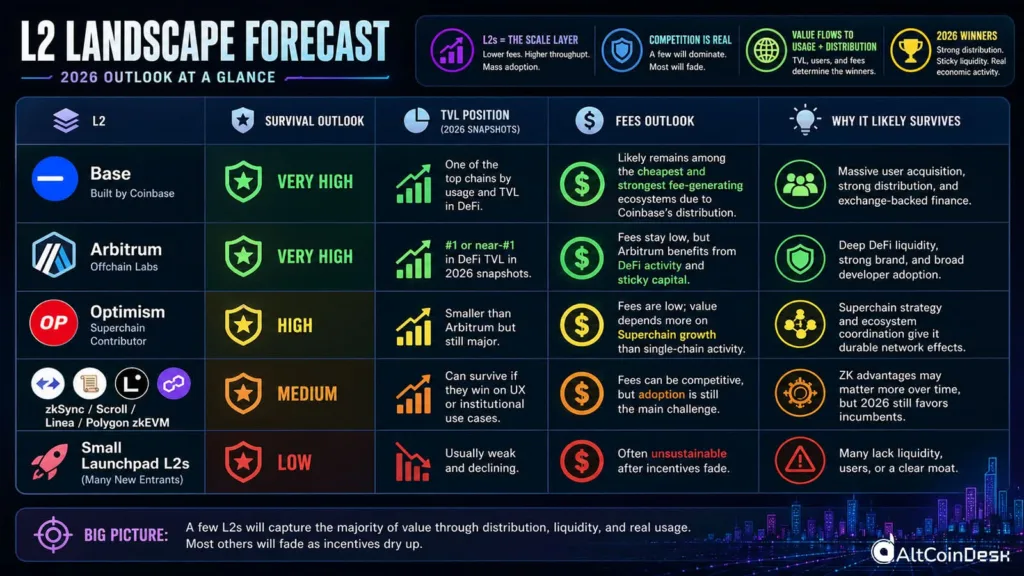
Here is the part nobody in a project Discord server wants to read. The L2 market is in a full consolidation wave, and most participants are not winning. Research and market data point to three clear frontrunners among the leading Ethereum rollup networks.
Base has Coinbase distribution, which is essentially a cheat code. When you are backed by one of the world’s largest crypto exchanges, user acquisition becomes significantly less of a crisis. Base leads in daily active users and is building the consumer app ecosystem that Ethereum always promised but never quite delivered on its own.
Arbitrum holds the DeFi crown. Its liquidity depth and TVL position make it the chain of choice for serious traders and protocols that need capital to actually show up. That stickiness is hard to replicate.
Optimism is playing a different game with the Superchain vision. Rather than competing as a single chain, it coordinates a network of aligned chains sharing security, standards, and infrastructure. That ecosystem strategy gives it durability that single-chain competitors struggle to match.
ZK rollups including zkSync, Scroll, Linea, Starknet, and Polygon zkEVM are closing the gap and carry the stronger long-term proof model. Their 2026 challenge is less about technology and more about competing for mindshare against incumbents who already have the users, the liquidity, and the developer relationships.
Why zombie chains fade away
This is where it gets sobering. Much of the smaller L2 ecosystem built its user numbers on incentives: points, airdrops, liquidity mining, and generous grants. When those programs end, the users leave. Not some of them. Most of them.
The failure loop looks like this: fewer users means lower fee revenue, lower revenue means the treasury weakens, a weaker treasury means fewer grants and ecosystem programs, which makes the chain less attractive, which means fewer new projects want to build there. At some point the chain is technically operational but economically invisible. That is the zombie state, and 2026 is full of them.
Without a moat in distribution, liquidity, developer mindshare, or a genuine product advantage, cheaper fees alone cannot save a chain that nobody has a reason to use. It is now a standard for L2 solutions to provide more than just scaling; they need to give unique services while adhering to high security standards.
What the future looks like
The picture taking shape is not one where L2 replaces Ethereum. It is one where Ethereum becomes the trusted backbone and top layer-2 solutions become the primary interface most users interact with, often without realizing which chain they are actually on. That invisibility is the whole goal.
The signals worth watching: blob capacity growth, L1 gas limit progression, ZK proof adoption in production, and whether leading rollups can turn activity into durable economic value rather than incentive noise. Priorities for 2026 include faster transactions, smarter wallets, improved cross-chain interoperability, and quantum-resistant security.
If Ethereum executes on its roadmap, the end state is a network that feels fast and cheap while remaining as secure and decentralized as anything in crypto. The best Ethereum layer-2 networks will not be destinations users think about. They will just be the place where things work, quietly, reliably, and without a $80 gas bill attached.
Considering where Ethereum started, that would be a remarkable ending.