

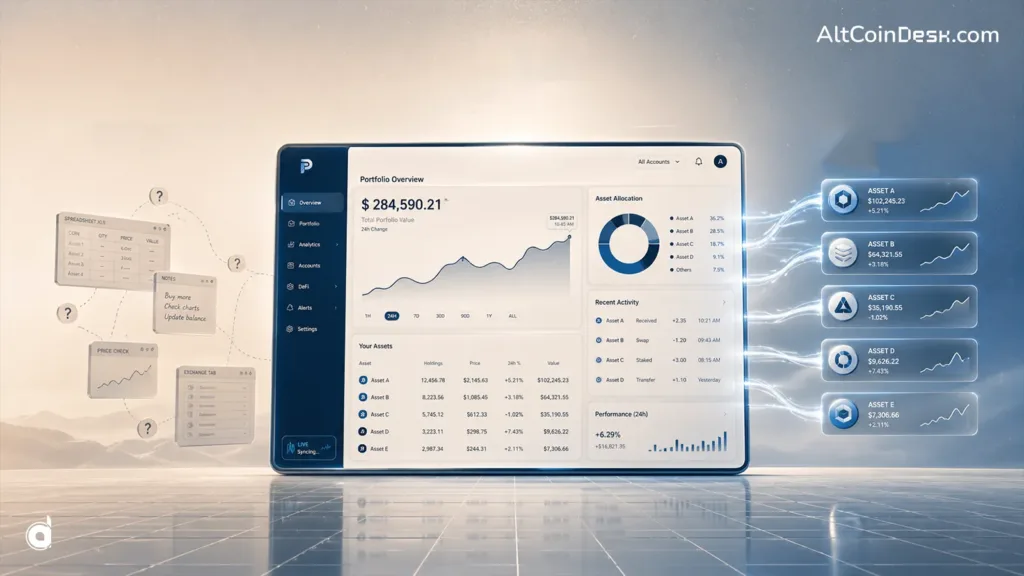

Holding crypto used to be simple. Buy some Bitcoin on one exchange, watch the price, done. That world is gone. Today someone might have coins on Coinbase, an Ethereum wallet on MetaMask, a few altcoins staked through a DeFi protocol, and an NFT sitting on Solana. Keeping a clear head across all of that without help has become a job nobody signed up for.
That’s where a portfolio tracker steps in. One dashboard, every coin, every wallet, every exchange, all pulled into a single view. What follows is a beginner-friendly walkthrough of how these tools work, what to look for, and which ones actually deliver in 2026.
What crypto tracker apps actually do
Think of a portfolio tracker like a personal finance dashboard built for digital coins. Crypto tracker apps connect to exchanges using a secure key, or they pull info from a public wallet address, and then they show the total value of someone’s holdings in real time.
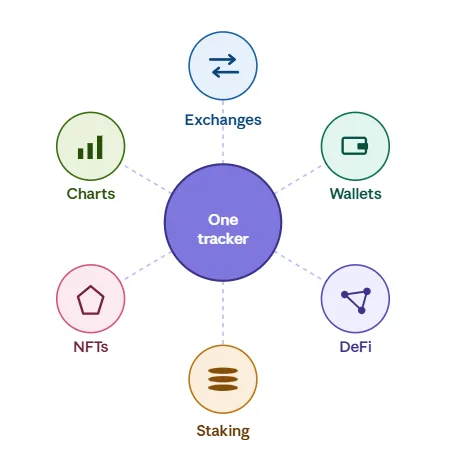
The good ones go beyond a simple balance. They display profit and loss, asset allocation, transaction history, and how each coin has performed over time. Many also handle NFTs and DeFi positions like staking and liquidity pools.
So if someone owns Bitcoin, a couple of altcoins, and some staked Ethereum, a tracker turns all of that into one clean number with charts. No more flipping between five tabs.
Why crypto tracker apps matter more in 2026
A few shifts have made trackers feel less like a nice-to-have.
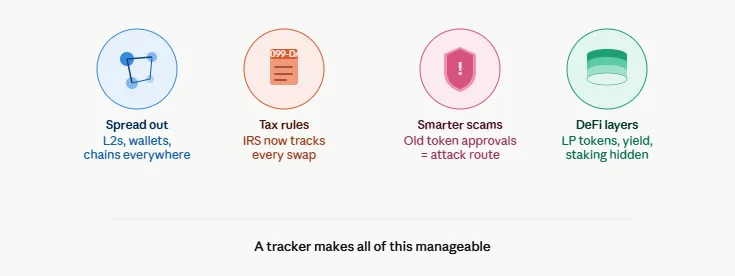
- Portfolios are spread out. Layer-2 networks like Arbitrum and Base added new places coins can live, and many users juggle several wallets at once.
- Tax rules tightened. Every swap, sale, or staking reward can be a taxable event. As of 2026, US centralized exchanges must issue Form 1099-DA, reporting crypto sales straight to the IRS. Cost basis on those forms is often missing or wrong, so clean personal records save real money come filing season.
- Scams got smarter. Forgotten token approvals on old DeFi sites are a common attack route, and some trackers help flag them.
- DeFi got complicated. Yield farming, lending positions, and LP tokens don’t show up neatly in a regular wallet view, so a tracker makes them visible.
Trying to manage a modern crypto stack without one feels a bit like running a small business without a bookkeeper. It works for a while, then it doesn’t.
What to look for in good crypto tracker apps
Not every option is built the same. Before picking one, it helps to check a few boxes.
- Coverage: Check whether it actually supports the exchanges, wallets, and chains you use. A Bitcoin-and-Ethereum-only app is useless if half your bag sits on Solana or Cardano.
- Auto-sync: The good ones hook in through API keys or wallet addresses and just keep themselves current. Manual entry sounds fine until you’ve done it for a month.
- Profit and loss tracking: Decent trackers work out cost basis and tell you what you actually netted after fees, instead of throwing a gross number at you.
- Tax reporting: Big plus if it spits out reports that drop cleanly into something like TurboTax.
- Security model: Read-only, no exceptions. Any tracker asking for a private key or seed phrase is either broken or a scam.
- NFT and DeFi support: If you hold either, rule out anything that pretends they don’t exist.
The top crypto tracker apps worth knowing about
Different users have different needs, so it helps to split the field into groups.
For everyday investors who want one clean dashboard:
- CoinStats often gets called the best overall. It supports a wide range of blockchains, lots of wallets and exchanges, and a deep list of DeFi protocols.
- Delta fits anyone who also holds stocks, ETFs, or bonds and wants everything in one app.
- CoinMarketCap offers a free tracker that’s friendly for absolute beginners, though it leans on manual entry.
For people who care about taxes:
- CoinLedger is the smoothest option for users who file with TurboTax. The integration is built right in.
- CoinTracker started as a tax tool and grew into a full portfolio app. Solid pick for anyone who wants compliance baked in from day one.
- Koinly has a generous free tier. Someone only pays when they actually need to download a tax report.
For DeFi power users:
- Zerion feels like a wallet and tracker rolled into one. Clean, friendly, and great for someone exploring decentralized finance.
- Zapper leans into discovery and lets a user bundle several wallets into one combined view.
- DeBank is a favorite on Ethereum-style chains and doubles as a security tool by flagging risky token approvals.
For multi-asset folks:
- Kubera tracks crypto alongside bank accounts, real estate, and even cars or art. Strong fit for someone wanting a wider net worth picture.
Safety basics nobody should skip
This part matters more than the app choice itself.
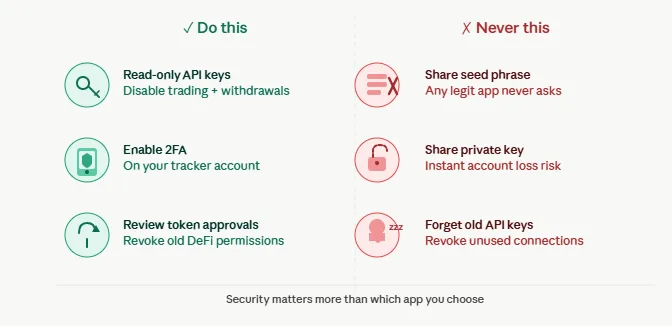
- Always use read-only API keys. When generating a key on an exchange, trading and withdrawals should be disabled so the tracker can only look, not move funds.
- Never share a seed phrase or private key with any tracker. A legit app only needs a public address.
- Turn on two-factor authentication on the tracker account itself.
- Review token approvals every few weeks. Old DeFi permissions are a top exploit route, and tools like DeBank can help revoke them quickly.
Free or paid: What works best
Free tiers in 2026 are surprisingly capable. A casual investor with a couple of wallets and a single exchange usually doesn’t need to spend a dime. CoinStats, CoinMarketCap, Delta, and Zerion all offer strong free experiences.
Paid plans start to make sense in two situations. The first is heavy trading, where transaction counts climb past what free tiers allow. The second is tax season, when downloading a full report often sits behind a paywall. For active traders, paying once a year for clean tax exports is usually money well spent.
Mistakes to avoid
A handful of habits trip up beginners every year.
- Connecting accounts and forgetting them. Old API keys are a security risk, so unused ones should be revoked.
- Trusting auto-generated tax numbers blindly. They’re a starting point, not the final word.
- Treating wallet-to-wallet transfers as sales. Good crypto tracker apps let users label these so the math stays accurate.
- Skipping coins from smaller chains. Not every tracker covers every blockchain, so gaps can hide real value.
The last note
Crypto in 2026 has more moving parts than ever, and trying to keep up with a notebook or a spreadsheet doesn’t hold up anymore. A good tracker pulls everything into one place, saves hours during tax season, and quietly catches problems before they grow.
Picking the right one comes down to honest self-checking. Someone with one exchange and a single wallet will love CoinStats or Delta. A heavy DeFi user belongs on Zerion or Zapper. Anyone dreading tax filings should start with CoinLedger or Koinly.
The best tracker is the one that fits how a person actually holds and uses their crypto.