



Sending money across borders should feel as simple as sending a text message. Yet for decades, moving funds between countries has meant slow transfers, surprise fees, and waiting several days for things to clear. That gap between expectation and reality is what’s pushed a new option into the spotlight.
Stablecoins, the digital tokens designed to hold a steady value against major currencies, have started taking on traditional banks in the global payments race. The question worth asking is simple. When it comes to moving money internationally, who actually has the edge?
Breaking down the two ways money moves across borders
A stablecoin is a digital token that mirrors the value of a regular currency, usually the dollar. For every token in circulation, the issuer holds an equal amount in cash or short-term Treasury bills. That backing keeps its price steady, unlike Bitcoin or Ether, which swing in price all the time.
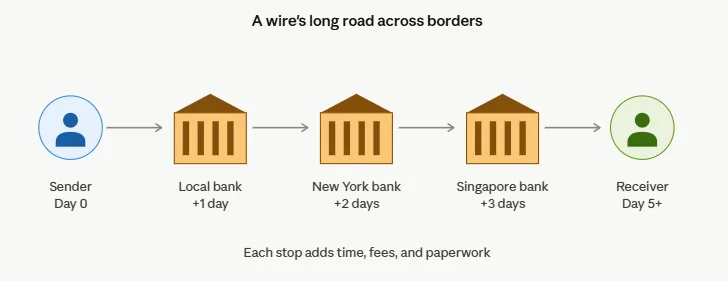
Banks move international payments through a messaging system called SWIFT. The actual money doesn’t travel through SWIFT directly. Instead, it passes through a chain of partner banks, each one handing the funds along like a relay race. Every step adds time, paperwork, and a small fee.
So the stablecoins vs banks debate is really about two different ways of solving the same problem. One leans on an old web of bank partnerships and messaging. The other runs on public blockchains and digital tokens.
Why traditional bank transfers feel stuck in the past
Anyone who’s ever wired money abroad knows the drill. You hit send, the bank takes a few business days, and a chunk of the amount disappears into fees that aren’t easy to understand.
Some of the biggest issues with bank-led cross-border payments include:
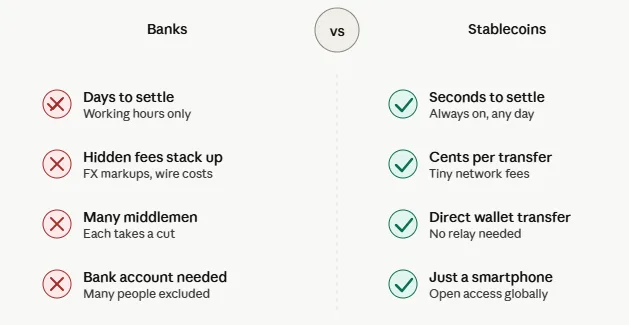
- Settlement that often takes several business days
- Flat wire fees plus markups on currency exchange
- Limited operating hours, with weekends and holidays off the table
- Multiple middlemen, each taking a small cut
- Pre-funded accounts in foreign banks that lock up working capital
Take a small business owner paying a supplier in Vietnam. The wire might leave on a Friday, sit in transit through banks in New York and Singapore, and only land the following Wednesday. Meanwhile, the supplier’s holding off on shipping until the funds clear. By the time everything reconciles, both sides have lost most of a working week.
How stablecoins skip the bank relay race entirely
Stablecoins skip the relay race entirely. A sender holds tokens in a digital wallet, types in the recipient’s wallet address, and the transfer settles on a public blockchain within seconds or minutes. There’s no chain of correspondent banks. There’s no waiting for Monday morning.
What makes them appealing for everyday cross-border use:
- Settlement that lands quickly, any day of the week
- Network fees that are usually small, sometimes just a few cents
- Full transparency, since every transaction is visible on the blockchain
- Programmable rules that release funds only when conditions are met
- Access for anyone with a smartphone and internet connection
That last point matters in places where banking infrastructure barely exists. A worker abroad sending money home can reach a relative who has a wallet but no bank account, something the old system has long struggled with.
Stablecoins vs banks under new rules
The bigger shift recently has been regulatory clarity. Lawmakers passed the GENIUS Act, the first federal framework specifically built for payment stablecoins. Under the law, issuers have to back every token one-for-one with safe assets like cash or short-term Treasuries, publish regular disclosures about their reserves, and meet strict criteria before they can issue stablecoins at all.
Through early 2026, a handful of federal agencies – the OCC, FDIC, NCUA, the Federal Reserve, and Treasury – have each been putting out their own proposed rules. The OCC has been driving the pace, and the others have largely been shaping their drafts to match what comes out of it.
In April 2026, Treasury’s FinCEN and OFAC jointly issued a proposed rule extending Bank Secrecy Act and sanctions compliance requirements to permitted payment stablecoin issuers, with comments due in early June.
That same month, U.S. banking groups asked Treasury and the FDIC to extend their comment periods until at least 60 days after the OCC finalizes its framework, arguing the other agencies’ rules are directly contingent on the OCC’s final version.
Once final rules are in place, the framework is set to take effect by early 2027. That clarity is part of why so many traditional players are jumping in now rather than waiting on the sidelines.
The global stablecoin market hit roughly $305 billion in January 2026, but 99% of that is still dollar-denominated, with euro-pegged tokens accounting for only around $650 million, a gap European banks are now racing to close.
Big banks are joining the stablecoin movement, fast
Banks aren’t just watching from the sidelines. Many of the biggest names are quietly building or partnering on stablecoin projects of their own.
JPMorgan launched its USD deposit token JPMD on the public Base blockchain in late 2025 after years of internal trials with JPM Coin, and is now expanding it for round-the-clock institutional transfers. Citi runs Citi Token Services, which already moves tokenized funds between major financial hubs. Bank of America’s leadership has openly said the firm is preparing its own stablecoin strategy.
Wells Fargo put down a marker in March 2026 by trademarking WFUSD, a sign its own stablecoin isn’t far off. SoFi Bank didn’t stop at filings. SoFiUSD is already out there, fully backed by reserves and running on rails from BitGo.
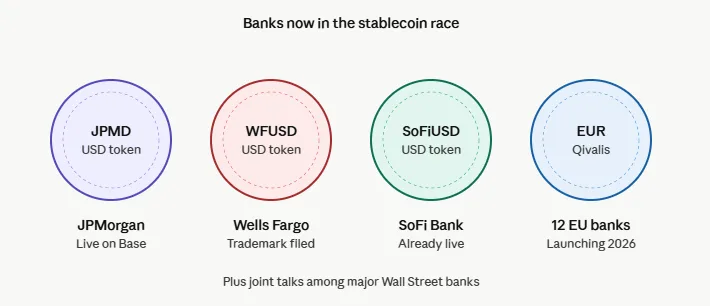
A consortium of twelve major European banks, operating under a new Amsterdam-based venture called Qivalis, is teaming up to launch a euro-backed stablecoin in the second half of 2026. The group includes ING, UniCredit, BNP Paribas, CaixaBank, BBVA, Danske Bank, DekaBank, DZ BANK, KBC, Raiffeisen Bank International, SEB, and Banca Sella, with Fireblocks named as its core infrastructure partner.
Separately, a group of global banks including JPMorgan, Bank of America, Citi, and Wells Fargo have discussed launching a joint stablecoin in the U.S., though those talks have yet to produce a public product.
Even payment giants like Fiserv, Visa, and Payoneer have added stablecoin rails to their networks. The line between traditional finance and digital tokens keeps getting thinner.
The verdict on stablecoins vs banks for global payments
The honest answer is that nobody fully wins outright. The likely future has both systems sharing the load.
Stablecoins clearly have the upper hand in some areas:
- Small to mid-size business payments where speed matters
- Remittances to regions with high traditional fees
- Freelancer and gig worker payouts across borders
- Real-time treasury moves for global businesses
Banks still hold strong ground where it counts most:
- Large corporate and institutional transfers
- Highly regulated transactions with strict legal frameworks
- Customers who want deposit insurance and the safety net that comes with it
- Markets where crypto rules are still murky
For a freelancer in Manila getting paid by a client overseas, stablecoins are a clear win. For a multinational closing a major acquisition, banks are still the default. Most companies will end up using both, depending on the situation.
Why stablecoins still aren’t a perfect fix
Stablecoins aren’t a perfect solution. Anyone weighing stablecoins vs banks for their own payments should keep a few tradeoffs in mind. Issuers can freeze wallet addresses if law enforcement asks. Send tokens to the wrong address, and they’re often gone for good. Stablecoin reserves also don’t carry the same deposit insurance that regular bank accounts do.
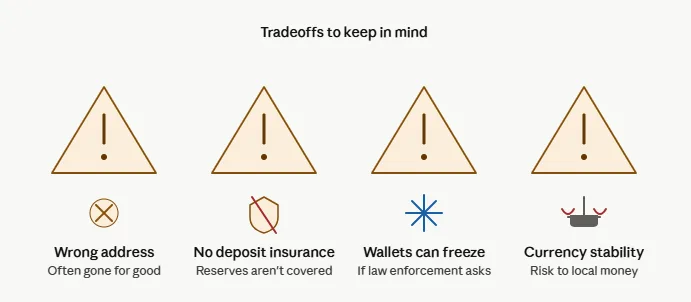
There’s also a bigger concern. If too many people in unstable economies switch to dollar-backed stablecoins, local central banks lose grip on their own money supply. That’s something regulators worldwide are watching closely. The trade-off between innovation and financial stability remains one of the trickiest debates in finance today.
The stablecoins vs banks debate doesn’t have a clean winner. The future looks like a system where both rails coexist, with stablecoins handling fast and low-cost flows while banks anchor large and tightly regulated transactions.
What’s changed recently is that the rules are finally catching up with the technology. Businesses now have real options for how they send money abroad, and those options are only going to get richer as the next wave of products launches over the coming year. For anyone moving money across borders, that’s reason enough to start paying attention.