


So there you are, a perfectly respectable global enterprise, dutifully parking mountains of cash in bank accounts across a dozen countries, watching your treasury team age in real time, all so that you can send money to a vendor in Manila or pay a contractor in Lagos without a three-day delay and a fistful of wire transfer fees. Congratulations. You have been running a very expensive, very slow, very 1987 operation. Then Coinbase USDC payouts walked into the room and laughed.
On April 21, 2026, Nium, the Singapore-born payments infrastructure company that has been quietly building one of the most ambitious global payout networks on earth, officially announced it had teamed up with Coinbase to embed USDC stablecoin rails directly into its platform.
The integration is already live. No waiting list. No beta testers. No vague promises about Q3. It is happening right now across more than 190 countries, under more than 40 regulatory licenses, and it is the clearest sign yet that stablecoins have graduated from speculative curiosity to serious financial plumbing.
So what actually changed?
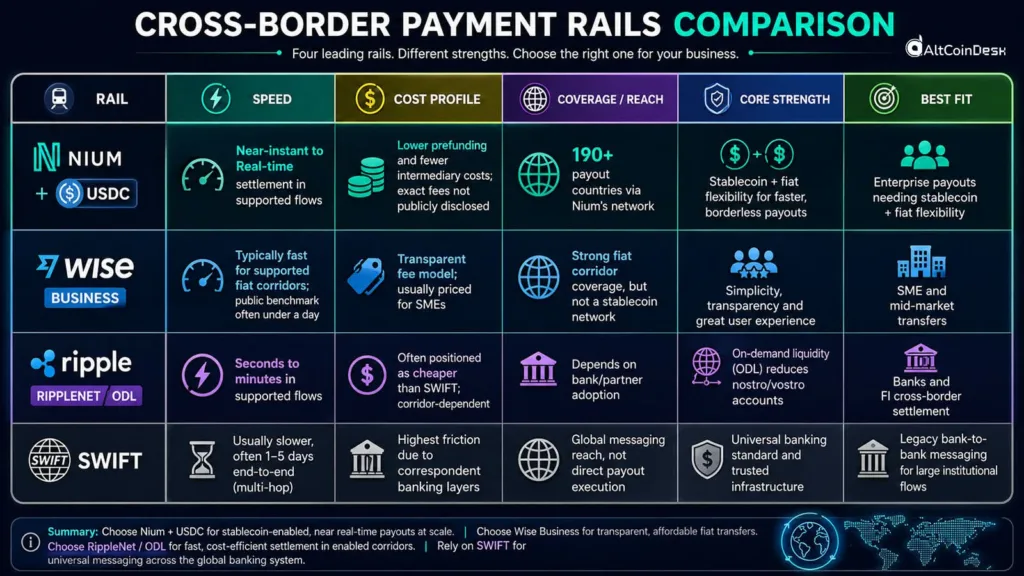
Let us talk about the thing nobody in traditional finance likes to admit. The correspondent banking model, the one powering most cross-border payments today, is essentially a relay race where the baton is a large pile of your money, being passed between institutions that each want a small cut, taking anywhere from one to five business days to cross the finish line. And before the race even starts, you have to prefund accounts in each destination country, meaning your cash sits idle, doing nothing useful, while your finance team pretends this is fine.
Nium’s integration with Coinbase changes the starting pistol entirely. Instead of stuffing money into foreign bank accounts weeks in advance, businesses can now fund their cross-border payouts in USDC, Coinbase’s jointly created stablecoin, and settle at the exact moment the payout happens. Just-in-time liquidity, they call it. Which sounds like a logistics term from a Toyota factory but is actually a very elegant way of saying your capital no longer needs a permanent vacation in other people’s banking systems.

Coinbase handles the stablecoin side of the deal, providing custody, liquidity, wallet infrastructure, and payment APIs, all running quietly behind the scenes. Nium handles the global reach, the local currency conversions, the regulatory complexity, and the 190-country network that most companies would take a decade and a small fortune to build on their own. Neither company had to build what the other already had. That is called a sensible partnership, and there are not nearly enough of those in fintech.
Wait, is this actually crypto?
Here is where it gets philosophically interesting, and slightly funny. The whole premise of this rollout is that it does not feel like crypto. That is deliberate. Nium is very clear that it wants stablecoins treated as core payment infrastructure, not as a separate crypto product that requires your compliance team to have an existential crisis before approving it. The USDC settlement rail is meant to sit alongside traditional fiat rails the way USB-C sat alongside your old charger port. Familiar workflow, better outcome.
For a bank or fintech using Nium’s platform, the Coinbase USDC payout mechanism operates invisibly through APIs. The settlement happens same-day. There are on-chain records for transparent, auditable reconciliation delivered via real-time webhooks. The underlying networks include Base and Solana, and the infrastructure supports automated stablecoin minting and burning and multi-chain compatibility. Your treasury team does not need to understand any of that. They just need to know the money got there faster and cost less to park.
Coinbase is, by any measure, an appropriate partner for institutional work like this. The exchange holds nearly $20 billion in USDC on its platform and was one of the original co-creators of the stablecoin alongside Circle. USDC itself, as of April 21, 2026, carries a market cap of $78.51 billion, making it the second-largest stablecoin in existence, and gets monthly audits from Deloitte. That is not a fly-by-night operation. That is infrastructure.
What about the card?
Right, because sending money internationally via stablecoins was not enough. Nium also announced that businesses holding USDC balances can now launch their own USDC-backed card programs, putting those stablecoin funds to work for everyday spending at any merchant that accepts Visa or Mastercard. Which is basically everywhere that takes plastic.
This builds on Nium’s recently launched stablecoin card issuance platform. As a principal card issuer on Visa, Mastercard, Discover, and UATP, Nium issues more than 38 million card tokens annually, so it is not as if they are new to this.
The card angle means USDC is no longer just a settlement instrument sitting in a ledger somewhere. It can fund a debit-style card, convert to fiat at the point of sale, and be spent on coffee in Singapore or rent in Berlin without the cardholder ever needing to think about blockchains. The stablecoin, in other words, has become aggressively normal.
Why is this a bigger deal than it sounds?
Cross-border payments have long been dominated by what economists politely call trapped liquidity. Your money is trapped in a prefunded account in Vietnam. Your money is trapped in a nostro account in Nigeria. Your money is trapped in a correspondent bank in Germany waiting for clearing. Multiply that by every corridor your business operates in, and you have a significant chunk of your working capital doing absolutely nothing while your operations team watches the clock.
The Coinbase USDC payout model attacks that problem directly. By funding payouts in stablecoins and converting to local currency only at the moment of settlement, businesses free up the idle capital sitting in those foreign accounts. That improves treasury efficiency. It reduces FX friction. It compresses settlement from days to near-instant in many corridors. And it does all of this within a regulated, licensed, compliant framework because Nium’s 40-plus global licenses do not disappear just because you added a stablecoin to the mix.
It is worth noting that USDC grew by $2 billion in supply during the first quarter of 2026 alone, while its main rival Tether shed $3 billion in the same period. That divergence is not an accident. It reflects growing enterprise preference for a stablecoin with transparent compliance, regular audits, and institutional-grade infrastructure. The Nium-Coinbase deal both reflects that trend and accelerates it.
So is adoption through the roof yet?
Honestly? Not quite, and that is fine. The integration launched about a week ago. There are no publicly disclosed transaction volumes, no dramatic case studies yet, no CFO testimonials with a number attached to them. What there is, is enablement. The platform is live. The clients can use it today. The infrastructure is real.
The slower part, as anyone who has ever tried to change a large company’s treasury workflow knows, is the human layer. Finance teams move cautiously. Compliance teams need internal sign-offs. Engineering teams need to update integrations. Stablecoins still carry a faint whiff of novelty risk for institutions that have been doing things the same way since before the internet existed. The 190-country capability is a network achievement. Actually filling that network with volume is a sales and adoption challenge that will take months, not days.
But the architecture is sound. Nium has been building toward this since its early crypto experiments with Zero Hash in 2022, through the Visa stablecoin settlement pilot in late 2025, and now into this live, full-scale Coinbase integration in April 2026. This is not a pivot. It is a progression.

The bigger picture you should not miss
What is happening here is a quiet but consequential reframe of what stablecoins are for. They are not for speculation. They are not for avoiding regulation. They are not for replacing fiat currencies in some libertarian utopia that keeps getting postponed.
They are for moving money faster, cheaper, and with less capital sitting around doing nothing in foreign bank accounts.
Nium’s CEO Prajit Nanu put it plainly in the official announcement: the future of money movement is multi-rail, where fiat and onchain infrastructure work together rather than in competition. That framing matters because it is the version of stablecoins that regulators can accept, that banks can adopt, and that enterprises can run past their boards without triggering a risk committee meltdown.
Coinbase’s head of infrastructure products Alec Lovett added that the goal is extending stablecoin utility into real-world payment flows, connecting digital asset liquidity with global fiat infrastructure. That is not revolutionary language. It is operational language. And operational language is what gets approved.
The key takeaway
If you are running treasury operations for a global business, managing vendor payments across dozens of countries, or building a fintech that needs serious cross-border infrastructure, the Coinbase USDC payout capability now sitting inside Nium’s platform deserves your attention. Not because it is exciting in a cryptocurrency sort of way, but because it is efficient in a very boring, very useful, very adult sort of way.
The prefunding era is not dead yet. Inertia is a powerful force and legacy systems have more lives than a cat. But every week that Coinbase USDC payouts are live and functional across 190 countries, settling same-day, with auditable on-chain records, and running on top of 40-plus regulatory licenses, is another week that the old system has a little more explaining to do. And honestly, after 25 years of watching finance move at the speed of fax machines wrapped in compliance paperwork, it is about time.