

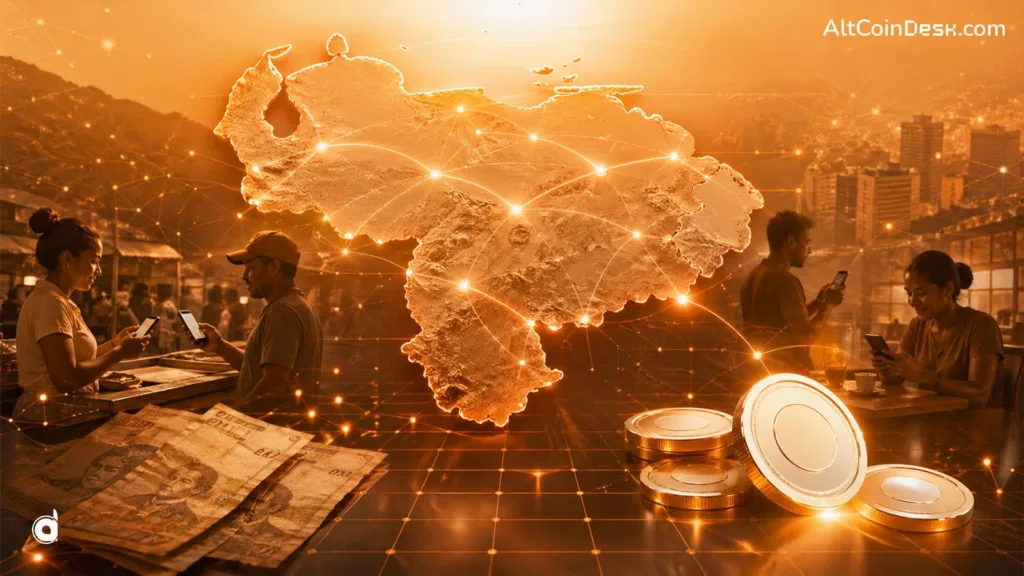

There is something almost poetic about a country whose currency has lost nearly all its value, becoming one of the world’s most enthusiastic adopters of digital dollars. Venezuela did not choose to lead a quiet revolution in how ordinary people use money. It was pushed into one.
And now, with the bolívar effectively a historical curiosity and a former president in a Brooklyn detention cell awaiting trial, stablecoins in Venezuela are not a trend. They are the economy.
So how did Venezuela get here?
Let us rewind, briefly, to a simpler time when the bolívar was just struggling rather than in full cardiac arrest.
Venezuela spent nearly a decade bleeding through hyperinflation that at its peak exceeded 270% annually, sanctions that cut off the banking system from the outside world, and a government that tried to fix everything by launching a state-backed crypto called the Petro, an oil-backed token that the public trusted about as much as a secondhand parachute. The Petro flopped spectacularly. Meanwhile, USDT quietly became the currency everyone actually used.
By the time TRM Labs published its Q1 2026 Global Crypto Adoption Index, Venezuela had climbed to 17th globally in retail crypto volume, registering $17.9 billion for the quarter alone, up from 22nd the previous year. Globally, crypto volumes fell 23% in Q1 2026. Venezuela went the other direction. This is what economists call a necessity-driven market and what regular people call survival.

The Binance dollar meets the real dollar
Here is where it gets both fascinating and a little absurd. The official Central Bank exchange rate for the bolívar sits at roughly 48 VES to one US dollar. On Binance’s peer-to-peer platform, the same dollar fetches around 630 VES. That is a gap of approximately 13 times the official rate. In any other context, this would be called a black market. In Venezuela, it is called Monday.
Over 90% of the 2,565 peer-to-peer VES listings on Binance involve USDT pairs. One bank, BancoVeneCredit, alone accounts for 725 active advertisements on the platform. More than 38% of all crypto site visits from Venezuelan users go directly to P2P platforms. The so-called Binance dollar has become the de facto benchmark for street-level exchange rates, and it tracks USDT because USDT is what people actually hold.
The reason for this is not complicated. Stablecoins are increasingly used not only as a store of value but also as a medium of exchange for routine transactions. Venezuelans pay rent in USDT. They pay for haircuts in USDT. Groceries, car repairs, and school fees. By late 2025, cryptocurrency accounted for roughly 10% of Venezuelan grocery payments, and that number has only grown since. The informal dollarization that economists had been tracking for years simply jumped onto a blockchain and kept going.
The spy thriller nobody expected
Then, on January 3, 2026, things happened, and things got genuinely cinematic.
US forces launched what was officially called Operation Absolute Resolve, neutralizing Venezuelan air defenses before raiding Maduro’s fortified compound at Fort Tiuna in Caracas in the early hours of the morning.
Maduro and his wife, Cilia Flores, were captured and flown to the United States. By January 5, they were in a Manhattan federal court, pleading not guilty to narco-terrorism and cocaine trafficking charges. They remain in Brooklyn’s Metropolitan Detention Center as of April 2026, with no trial date yet set and motions still ongoing.
The crypto angle on this arrest is extraordinary. Venezuela’s state oil company, PDVSA, had relied on Tether to settle crude transactions while the stablecoin provided relief from hyperinflation.
PDVSA required buyers to hold crypto wallets and pay in USDT, with Chinese refineries processing payments through intermediaries on the TRON blockchain. Investigators had been tracking these flows for years, and Tether had already frozen 41 Venezuela-related wallets by 2024. Around $182 million in USDT reserves were frozen just days after Maduro’s arrest.
And then came the rumor that turned heads across every trading floor on earth. Intelligence reports suggested that the Maduro regime had quietly built a shadow Bitcoin reserve of somewhere between 600,000 and 660,000 BTC, valued at roughly $60 to $67 billion, accumulated through gold swaps, oil payments converted from USDT into Bitcoin, and seized domestic mining equipment.
If even directionally accurate, this would make Venezuela one of the largest Bitcoin holders on the planet, comparable in scale to BlackRock and MicroStrategy. Bitcoin briefly spiked to $93,000 on the headlines. The keys to those alleged coins remain, at the moment, anyone’s guess.
Delcy steps in; USDT steps up
Back in Caracas, the show went on. Vice President Delcy Rodríguez was sworn in as acting president on January 5 by her brother Jorge Rodríguez, head of the National Assembly, with the military pledging recognition. The US does not formally recognize the Rodríguez government but engages with it pragmatically. A broad amnesty bill covering events from 1999 onward was approved in February. Senator Rubio outlined a three-phase plan involving stabilization, investor access to oil, and eventual elections. No elections are scheduled as of April 2026.
For Venezuelans trying to buy groceries or send money to relatives abroad, the transition’s political choreography matters considerably less than whether USDT is still accessible. It is. Stablecoin access in 2026 is even easier than before, with stablecoins now used as a regular payment tool by merchants across the country. Retail transfers, being smaller in size, tend to stay below the thresholds that trigger sanctions scrutiny. People use VPNs when needed. They keep using Binance P2P. The machinery of survival is remarkably adaptive.
Someone has a plan, naturally
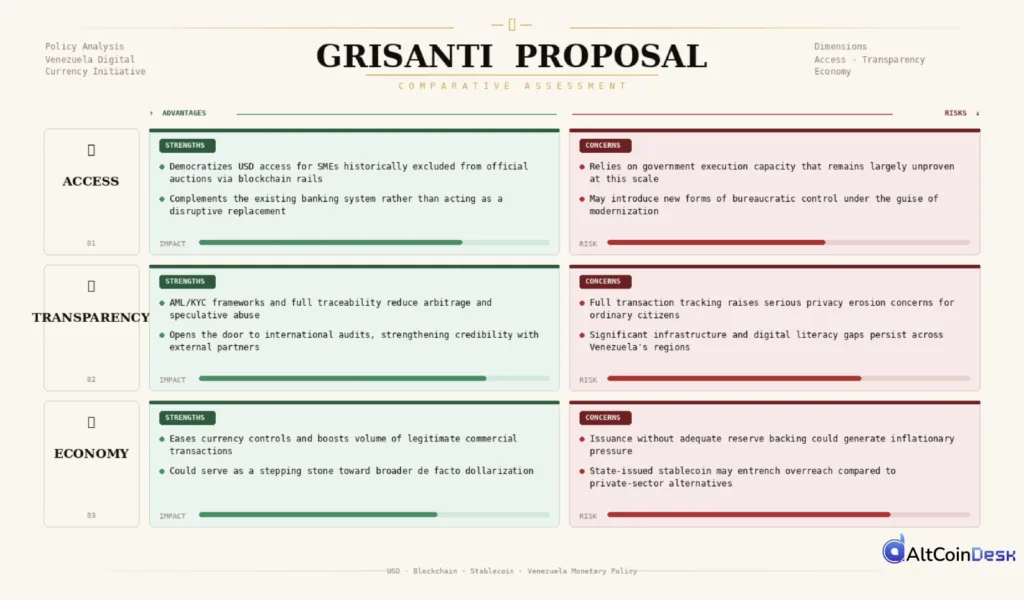
Into this environment, economist Alejandro Grisanti of Ecoanalitica stepped forward in April 2026 with a proposal for a government-backed USD stablecoin. The pitch is, on its face, sensible: create a blockchain-based digital dollar with full AML and KYC integration, international audits, and one-to-one reserve backing, designed to give small and medium enterprises access to dollars they currently cannot reach through official auction systems.
It would complement the existing banking infrastructure rather than replace it and would aim to reduce the arbitrage and speculation that currently thrive in the gap between official and parallel rates.
Critics note that Petro’s failure matters here because it lacked trust, liquidity, and connection to major global exchanges. Without transparency and real-time audits, a stablecoin claiming dollar stability would need a credible one-to-one reserve backing in liquid assets, which is operationally hard under active sanctions.
Firms including R&D and Conexus are already piloting stablecoin settlement systems, suggesting the private sector is not waiting for government approval to experiment. Whether a state-issued token could earn the trust that USDT commands organically is, charitably, an open question.

What TRM actually said
TRM Labs, in its Q1 2026 Global Crypto Adoption Index and its 2026 Crypto Crime Report, did not mince words. Absent a material shift in Venezuela’s macroeconomic conditions or the emergence of cohesive regulatory oversight, the role of digital assets, particularly stablecoins, is poised to expand.
Regulatory uncertainty surrounding SUNACRIP, Venezuela’s crypto regulator, combined with ongoing distrust in domestic banks, continues pushing citizens toward blockchain-based alternatives. The report notes that USDT’s centrality extends across retail payments, remittances, and even oil-adjacent transactions and that adoption is driven by necessity rather than speculation, which is exactly what makes it durable.
Post-Maduro, US policy discussions have floated the idea of stablecoins playing a role in Venezuela’s economic reconstruction, including speculation about potential shadow reserves of Bitcoin and USDT being used as leverage in rebuilding efforts. Whether that translates into coherent policy or remains a talking point depends on how the transition unfolds.
The uncomfortable punchline
Here is the thing about stablecoins in Venezuela that tends to get buried in the geopolitics and the market data: what is happening there is not really a crypto story. It is a story about what people do when the institutions that are supposed to protect their money fail comprehensively and repeatedly. USDT did not win Venezuela’s trust through marketing campaigns or regulatory approval. It won it by being available, by holding its value, and by working when everything else did not.
Stablecoins are better dollars, but the reason people get them is out of necessity and out of self-preservation. Wherever there are limitations around dollars flowing freely, stablecoins will find a way through. Venezuela did not invent this lesson. It just demonstrated it at a national scale, in real time, with $17.9 billion in quarterly volume and a Binance P2P rate that stubbornly refuses to pretend the official exchange rate exists.
The bolívar collapsed. The Petro was laughed out of the room. The president is in Brooklyn. And USDT is still trading at 630 VES, one peer-to-peer transaction at a time. If that is not a proof of concept, it is hard to imagine what would be.