

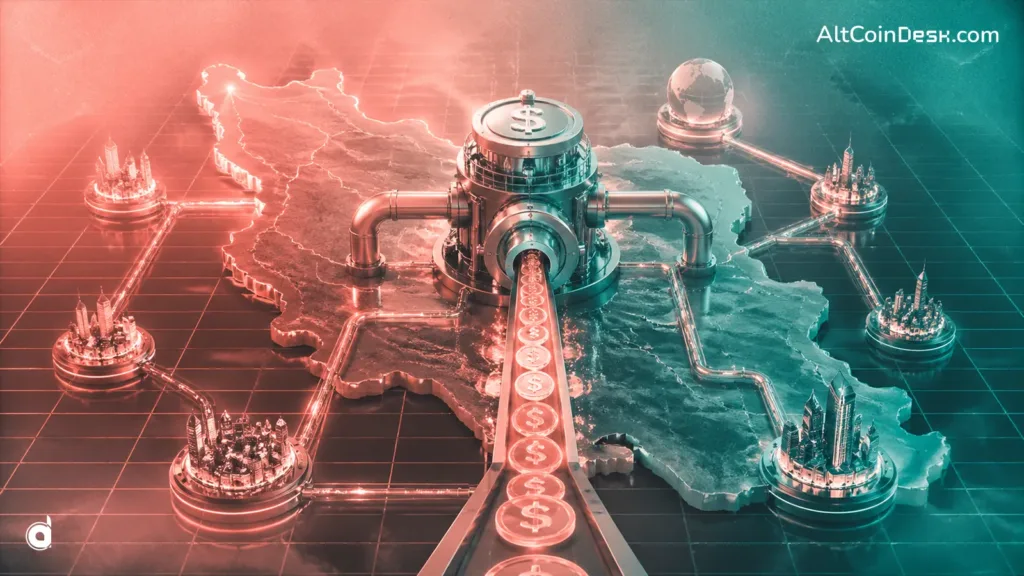

Iran has essentially been running a shadow bank on the blockchain, and the world just noticed. On April 23, 2026, Tether froze $344.2 million in USDT sitting in two wallets on the Tron network.
Treasury Secretary Scott Bessent announced the action on X, confirming that the Office of Foreign Assets Control sanctioned multiple crypto wallets tied to Iran and that the U.S. would follow every dollar Tehran tries to move outside the country.
The operation has a name that sounds like it belongs in a summer blockbuster: Economic Fury. And if you thought decentralized finance was some kind of untouchable digital Wild West, Iran just learned the hard way that the sheriff can still walk in and bolt the safe shut.
So what exactly got frozen?
Two Tron addresses, TNiq9…… QZH81, holding roughly $213 million, and TTiDLW…W2pjSr9, holding roughly $131 million, were both frozen on April 23, 2026, with both addresses subsequently added to the Specially Designated Nationals list. That is not pocket change. That is the kind of number that makes central bankers in Tehran sit upright at their desks and quietly reach for a glass of water.
A U.S. official told reporters that government analysts, working alongside blockchain analytics experts, observed clear material links to the Iranian regime, including confirmed transactions with Iranian exchanges and a series of payments routed through intermediary addresses connected to Central Bank of Iran wallets. In plain English, they followed the money, and it left a very obvious trail.

Why stablecoins and not Bitcoin?
This is the part that most news cycles gloss over, and it is honestly the most interesting piece of the whole story. Iran did not just stumble into stablecoins by accident. The regime made a deliberate strategic shift away from bitcoin, and the reasoning is actually quite logical if you are a sanctioned state trying to keep the lights on.
Bitcoin wobbles. One bad tweet from a tech billionaire and your oil revenue is suddenly worth 30% less than it was at breakfast. USDT, on the other hand, stays pegged to the dollar. Because stablecoins are pegged to the U.S. dollar, they offer relative price stability while maintaining the speed and accessibility of cryptocurrency, which is exactly what a regime under sanctions needs to stabilize its struggling rial and keep cross-border trade flowing.
So the Iran stablecoin pipeline was not just a workaround. It was a functioning liquidity system, complete with its own infrastructure, its own brokers, and its own on-ramps and off-ramps designed to keep the Iranian economy breathing while the rest of the world tried to cut off its air supply.
The plumbing behind the scheme
Here is where it gets genuinely impressive, in a deeply illegal sort of way. This was not a couple of guys sending wallets to each other at midnight. The setup described by researchers at Chainalysis and Elliptic reads more like a multi-story financial skyscraper than a back-alley crypto swap.
Elliptic’s research found that the Central Bank of Iran had quietly accumulated at least $507 million in USDT, apparently to support the rial and keep state-linked trade ticking over. The funds first flowed through Nobitex, Iran’s largest domestic crypto exchange, before moving outward through cross-chain bridges and into decentralized finance protocols.
Those protocols then connected to centralized venues where the money could be converted into goods, other currencies, or simply held as dollar-pegged working capital.
Chainalysis reported that Iran’s crypto economy reached an estimated $7.8 billion by 2025, with the Islamic Revolutionary Guard Corps controlling a massive portion of those digital assets. By the final quarter of 2025, IRGC-linked addresses reportedly represented around half of Iran’s total crypto activity. For a military organization that is technically designated as a terrorist group by the United States, that is an extraordinarily brazen financial footprint.
USDT freeze sanctions hit at exactly the right weak point
Here is the satirical twist the regime probably did not see coming. Iran built its financial escape hatch on a stablecoin issued by a company called Tether. Tether is centralized. That means one entity controls the blacklist function. And the moment U.S. authorities shared their evidence, Tether flipped the switch.
Justin Sun, the founder of Tron, had recently described Tron as the most decentralized blockchain in the world. However, because USDT includes issuer-level controls, Tether can blacklist addresses even when the underlying blockchain continues operating normally. The blockchain kept humming. The money just stopped moving. It is a bit like discovering your master key works everywhere except the one door you actually need to open.
Paolo Ardoino, Tether’s CEO, made clear that USDT is not a safe haven for illicit activity, a statement that probably reads as cold comfort in Tehran right now.
Chainalysis crypto tracking: Powerful but not perfect
To be fair, the picture is not entirely rosy for the enforcement side either. Chainalysis crypto tracking has real structural limits, and Iran’s financial network is well aware of them.
The biggest challenge is what analysts call attribution lag. By the time a wallet address gets officially labeled as IRGC-linked and added to a sanctions list, the funds have often already hopped across three chains, passed through an OTC desk, and landed in a Hawala network somewhere between Istanbul and Dubai that does not appear on any blockchain at all. Independent on-chain researchers often spot anomalous large transfers on Tron within minutes using automated alert systems, while larger firms focus on verified, aggregated reporting that takes more time to compile.
The offshore intermediary layer is where enforcement gets genuinely complicated. Experts note that the way to truly constrain Iran at this point is to go after the third-country actors enabling them, with jurisdictions like China representing a more consequential chokepoint than individual wallets. Freezing $344 million is meaningful. Freezing the entire network of facilitators is a different and considerably harder problem.
A toll booth on the world’s most important shipping lane
One detail in this story deserves its own paragraph because it is almost too audacious to believe. On April 23, the Iranian government publicly announced that the Central Bank of Iran had successfully collected its first toll revenue from commercial ships transiting the Strait of Hormuz, one of the world’s most critical maritime chokepoints.
The same day Tether froze $344 million in Iranian stablecoin funds, Tehran announced it was literally charging ships a fee to pass through international waters. That timing is either a remarkable coincidence or the geopolitical equivalent of flipping a table on your way out of the room.
What Economic Fury actually means
Operation Economic Fury is not a one-time freeze. The Treasury’s campaign is designed to systematically degrade Tehran’s ability to generate, move, and repatriate funds, targeting not just wallets but the full network of financial facilitators tied to the regime. That includes procurement networks behind Iran’s missile and drone programs, entities in Turkey, the UAE, and elsewhere who have been quietly lubricating the machine.
The secondary sanctions threat is the part that should keep foreign banks and exchanges awake at night. Any financial institution that continues processing Iran-linked crypto flows now faces the risk of being cut off from the U.S. financial system entirely. That threat, more than any individual wallet freeze, is the real enforcement lever.
The uncomfortable lesson for crypto idealists
The Iran stablecoin pipeline tells a story that the crypto community has been reluctant to sit with. Decentralization is real, but it has a ceiling. The moment your chosen stablecoin is issued by a centralized company that cooperates with governments, your financial sovereignty is conditional. Iran found that out the expensive way.
Blockchain transparency, which was sold as a feature for privacy advocates, turned out to be a remarkable forensic tool for the very governments those advocates were trying to avoid. Every transfer left a permanent, public record. The regime layered brokers, bridges, and intermediaries on top of that record, and for a while, the strategy worked. But the ledger never forgot.
The updated designations combined with the $344 million USDT freeze send a clear message: stablecoins are not a viable long-term workaround for state-sponsored sanctions evasion. The transparency of public blockchains, combined with public and private sector cooperation between authorities and asset issuers, makes large-scale evasion highly vulnerable to targeted disruption.
Tehran may adapt, as it has done for four decades of sanctions. But the Iran stablecoin pipeline now has a very expensive hole in it, and the whole world is watching to see where the next leak appears.