

Blockchain has moved beyond the early hype cycles and speculative narratives. The technology is now the driving force behind real-world applications and shapes how organizations build trust in the digital space.
It also serves as the base for modern-day contemporary systems through decentralized identity systems, automated smart contracts, and scalable infrastructure. This article dissects the five best blockchain development trends in 2026.
Blockchain technology, current market size, and growth forecast
A blockchain is a digital registry that is secure, decentralized, and records data in a irreverisble manner. As the need for sophisticated blockchain solutions is increasing, people and organizations are seeking reliable systems to ensure the safety of information, genuine identities, and transactions.
With the rising degree of digital interaction, the use of blockchain reduces fraud and misinformation. Blockchains are also decentralized, meaning there is no use of intermediaries, which prevents time and cost wastage. This renders blockchain a pillar technology for new digital ecosystems.
As of 2026, blockchain technology is not only used in cryptocurrencies but also in finance, health care, logistics, and identity systems, which involve the processing of data in a secure and verifiable way.
A recent report by Future Market Insights shows that the blockchain technology market is at $13.82 billion in 2026. The market is forecast to reach $543.8 billion in 2036, a 44.3% CAGR during the forecast period.
5 leading blockchain trends in 2026
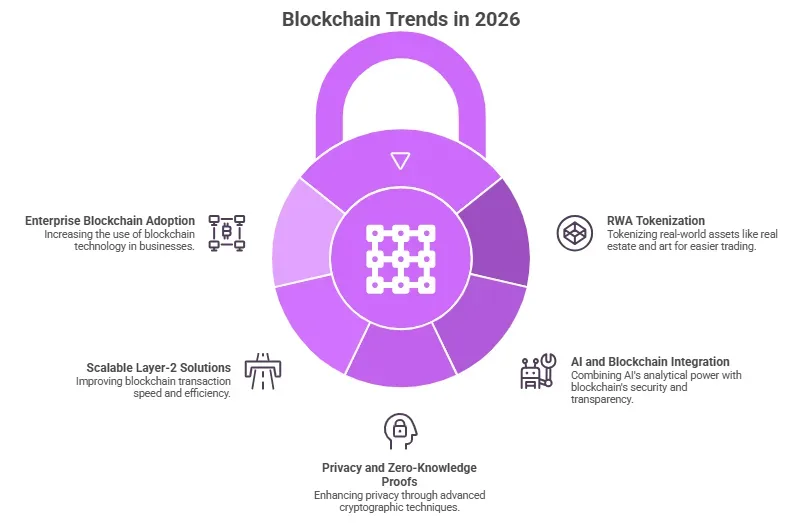
Some of the best blockchain development trends in 2026 include the following:
1. Real-world asset (RWA) tokenization
Tokenization of real-world assets has shifted from a niche experiment to become a part of the financial infrastructure in 2026. It enables the transformation of the physical and financial resources into digital tokens, which could be exchanged, splintered, and checked on-chain.
Such changes increase the liquidity of historically illiquid assets such as real estate and fine art. Tokenization also allows fractional ownership of high-value assets without requiring investors to commit large sums of capital upfront. It also ensures that the businesses enjoy the advantage of shorter settlement periods and less administrative load.
RWA tokenization enhances transparency, ownership, and registers of transactions that are stored in an immutable way. Nonetheless, regulatory harmonization is a factor to monitor because jurisdictions shift towards rationalizing legal frameworks regarding tokenized digital assets.
2. AI and blockchain integration
Artificial Intelligence (AI) and blockchain technology integration have become one of the most important trends in the development of Web3 in 2026. Blockchains offer high-quality data layers, and AI algorithms analyze this data to generate insights and make autonomous choices.
Such integration results in more efficient and intelligent systems. Additionally, AI can identify financial anomalies, while blockchain can be used to record immutable transactional data.
AI’s predictive analytics capabilities can also be used in supply chains to automatically pay for goods and services via automated smart contracts. AI and blockchain integration also lowers the risk and enhances the reliability of the systems due to the immutability of the records stored on the blockchain.
Despite the significant potential of this trend, it brings about new challenges. Increased autonomy of AI-based decision-making can be erroneous and irreversible, and thus requires checking and monitoring.
3. Privacy and zero-knowledge proofs
Innovations connected to privacy are also viewed as a characteristic trend in blockchain development in 2026. Such technologies include zero-knowledge (ZK) proofs, which are capable of allowing users to certify data without having access to the underlying data.
This technology will be able to verify the identity in a secure way, the transactions can be carried out privately, and compliance can be achieved without exposing any sensitive information. Privacy and ZK proofs act as vital components in the industry by prioritizing data protection for industries like finance and healthcare.
Zero-knowledge systems also have the ability to answer regulatory needs because they can be discriminative in disclosure. Through this innovation, organizations are able to reflect compliance without sending the entire dataset.
4. Scalable layer-2 solutions
Scalability has been a key challenge for most blockchain ecosystems. However, scalable layer-2 solutions are designed to curb this issue. As a result, layer-2 blockchain solutions have become necessary in managing a higher level of transactions without the need to compromise on security.
These systems handle the transactions outside the main chain, eliminating congestion and expenses. Some of the key developments in this sector include rollups, sidechains, and state channels, which enhance the performance of networks.
Scalable layer 2 solutions also lead to a seamless user experience. They also power fast execution and real-time applications in payments, gaming, and decentralized finance (DeFi).
Enhancement across scalable L2 solutions is directed towards making user interaction easier. The aim is to remove friction in transfers of assets between layers, and blockchain applications will feel the same experience as regular digital platforms.
5. Enterprise blockchain adoption
Most organizations are now adopting blockchain technology after realizing its value in daily operations. Stakeholders and organizations now use blockchain to create shared and tamper-proof records.
This strategy helps to remove the discrepancy in data and decrease the use of intermediaries. For instance, logistics firms and clients can monitor goods in real time due to the available data. Financial institutions can also make transactions easier and less expensive.
Blockchain-as-a-service (BaaS) is also reducing the entry barriers, allowing even smaller businesses to access the technology without the need to spend a lot of money on infrastructure.
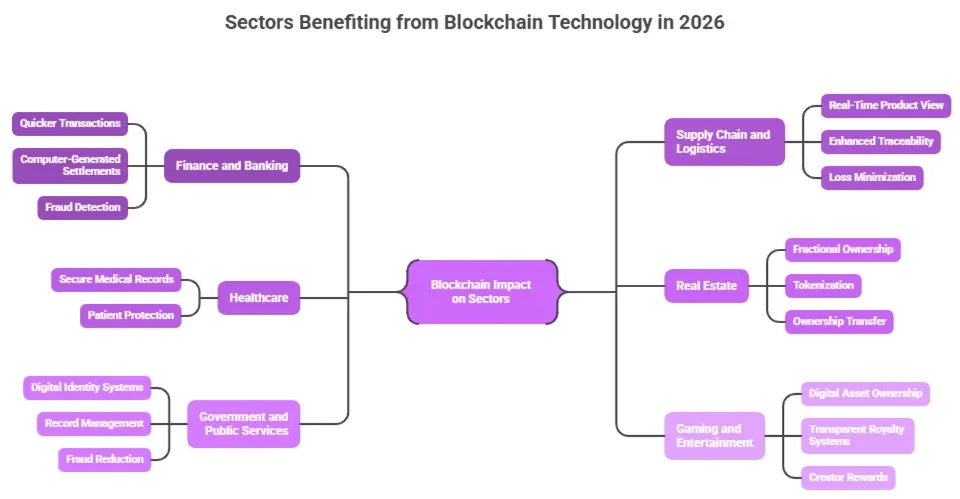
Sectors that will be most impacted by blockchain development trends in 2026
New advancements and trends across blockchain have the potential to impact the following industries:
- Finance and banking: Blockchain facilitates quicker international transactions, computer-generated settlements, and better detection of fraud by having transparent records of transactions.
- Supply chain or logistics: Businesses are able to see the flow of products in real-time, which not only improves the traceability of the product but also reduces losses related to inefficiencies or fraud.
- Healthcare: Blockchain has the potential to protect medical records, which contain sensitive information about patients.
- Real estate: Tokenizing ownership enables the transfer of ownership to other individuals.
- Governmental and social services: The record management and the digital identity systems will assist in reducing fraud and improving the efficiency of the process of government service provision.
- Gaming and entertainment: The blockchain allows users to possess digital assets and allows creators to earn income with open-source royalty systems.
The future of blockchain development
The following blockchain technology trends will revolutionize the functionality, connection, and scaling of blockchain systems in the future:
- Smart financial systems: Smart contracts will potentially go even further in making finance more automated, to speed up transactions and remove middlemen.
- Decentralized identity expansion: Individuals will have greater access to services as self-sovereign identity solutions increase, allowing people to have control over personal data.
- Invisible infrastructure: Blockchain will be used as a back office, driving mechanisms without user interaction and awareness.
- Further AI and blockchain integration: This will lead to increased integration to produce systems that bring trusted data with smart automation to enhance decision-making.
- Cross-chain interoperability: Different blockchain networks will be interoperated in a smoother manner, and hence it will be more convenient to transfer data and assets between the ecosystems.
Final thoughts
Blockchain technology is now used across various sectors besides cryptocurrencies. The technology is widely used in industries that need transparency, automation, and reliability.
Because of this demand, multiple blockchain development trends such as real-world assets tokenization, AI and blockchain integration, privacy and zero-knowledge proofs, scalable layer-2 solutions, and enterprise blockchain adoption have been developed. The future of blockchain technology in 2026 and beyond will be influenced by subsequent growth across web3 development trends.