



Every time someone hits “Sign in with Google,” a corporation quietly logs who they are, what they clicked, and where they went. Online identity has always been owned by someone else. Decentralized identity projects are changing that by handing control back to the user.
The idea is straightforward: instead of a company holding data on their server, the user holds it in a digital wallet and shares only what’s needed. With Web3 growing fast, these projects have moved from niche experiments to real infrastructure that developers and platforms are already building on.
What are decentralized identity projects?
A Decentralized Identifier, or DID, is the technical building block behind a new model of online identity. It lets you prove who you are without relying on Google, a bank, or any central authority. Credentials live in a wallet the user controls.
When a platform needs to verify something, the user shows just that one credential, like a library card that only says “member” with nothing else printed on it.
Every DID system is built on two things:
- Verifiable credentials: Tamper-proof digital versions of real-world documents like an ID, a degree, or a license
- Identity wallets: Apps that store those credentials and let the user decide what to share and with whom
A key technology running underneath most DID projects Web3 relies on is called a zero-knowledge proof. It’s a cryptographic method that lets someone prove a fact, like being over 18, without ever revealing the underlying data. No birthday shown. No name shared. Just proof.
Why DID projects for Web3 matter right now
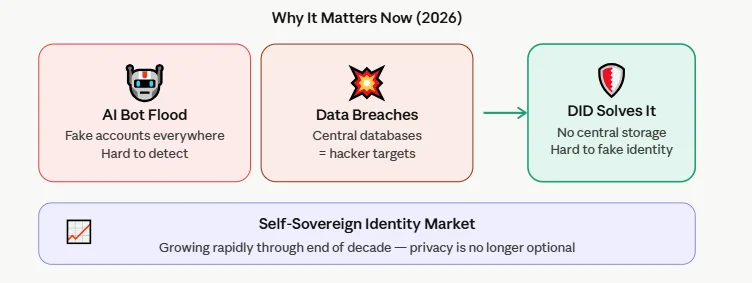
In 2026, two things are making digital identity more urgent than ever. First, AI-generated bots are flooding the internet at a scale that’s genuinely hard to manage. Second, data breaches keep happening because personal information sits in too many central databases at once.
Decentralized identity projects directly address both problems. They make it very hard to fake a verified identity, and they remove the centralized data storage that hackers consistently target. The self-sovereign identity market has grown significantly in recent years and is projected to keep expanding rapidly through the rest of the decade.
Top decentralized identity projects to know in 2026
These five projects were selected based on developer adoption, live deployments, and architectural breadth, and each one approaches the problem from a different angle.
1. World ID
World ID, built by the project formerly known as Worldcoin (WLD) and co-founded by OpenAI CEO Sam Altman, is focused on one specific thing: proving that a real human being is behind an online account. It uses a physical device called the Orb, which scans a user’s iris to create a unique cryptographic proof of personhood. The Orb converts the iris image into a numerical code, then discards the raw image. What stays is that anonymous iris code, stored in the user’s wallet. It’s not a photo, but a derived identifier.
This matters a lot right now. As AI agents start booking reservations, making purchases, and acting across the web, knowing whether a real person is responsible becomes critical. In early 2026, World launched AgentKit in beta, a toolkit allowing AI agents to carry cryptographic proof that a verified human is behind their activity. It integrates with Coinbase and Cloudflare’s x402 protocol for payments, making it one of the more forward-thinking moves in the DID space.
Biometric data collection has drawn pushback from privacy advocates and regulators, with the loudest criticism coming from Europe. Skepticism about the Orb’s proprietary hardware and centralized infrastructure runs deeper than one region though, and it’s a debate World hasn’t fully resolved.
2. Ethereum Name Service (ENS)
Mistyping a wallet address is easy, and sending funds to the wrong one is usually permanent. ENS replaces those long character strings with readable names like “alice.eth,” the same way a domain name stands in for a server address, except it lives entirely on the blockchain.
A “.eth” name can link to a wallet, a website, a profile photo, social handles, and on-chain reputation, all in one place that the user fully owns. Registrations now number in the hundreds of thousands, and major platforms across DeFi, NFT marketplaces, and Web3 social apps recognize ENS as a default identity standard.
One honest limitation worth noting is that it’s primarily Ethereum-focused and doesn’t natively bridge every other blockchain yet. However, things are changing. In February 2026, ENS Labs scrapped its planned Layer 2 solution and committed to deploying ENSv2 on Ethereum mainnet, where gas costs have already dropped 99% over the past year. Cross-chain support is on the roadmap.
3. Privado ID (formerly Polygon ID)
Privado ID lets users prove specific things about themselves without handing over that information directly. Need to show a DeFi platform that you’re a legally verified adult? Privado ID can confirm that without ever sharing a name, address, or date of birth.
It runs on zkSNARK technology, a specific type of zero-knowledge proof. Recent updates added dynamic credentials so users can refresh outdated information easily, along with an on-chain revocation service that lets platforms check in real time whether a credential is still valid or has been revoked.
For developers building compliance features into decentralized apps, it’s become one of the most practical tools available.
4. Civic Pass
Civic is the most compliance-focused name on this list. It bridges the gap between Web3’s open structure and the legal requirements real businesses have to meet. Its main product, Civic Pass, is a non-transferable soulbound token tied to the verified user. Unlike regular crypto tokens, it can’t be sold or transferred because it represents the person, not an asset.
When someone holds a Civic Pass, platforms know they’ve cleared a genuine verification check. It works across a large number of countries and is already in use by major Web3 projects on Solana, Ethereum, Polygon, Arbitrum, and others. NFT projects use it to stop bots during launches. DeFi platforms use it to confirm users meet legal requirements. It’s a practical, working infrastructure, not a concept.
5. Galxe Identity Protocol
Galxe takes a completely different approach from the others. Rather than verifying a static document, it builds an identity from what someone has actually done on-chain. Governance votes, community participation, DeFi activity, and gaming achievements all become part of a dynamic credential profile.
It combines on-chain and off-chain data using zero-knowledge proofs to keep everything private. The result is an identity built on real behavior rather than a piece of paper. DAOs, Web3 gaming platforms, and marketing teams use Galxe to reward genuine participants and filter out fake or low-quality accounts. It’s reputation functioning as identity.
How the best DID projects fit together
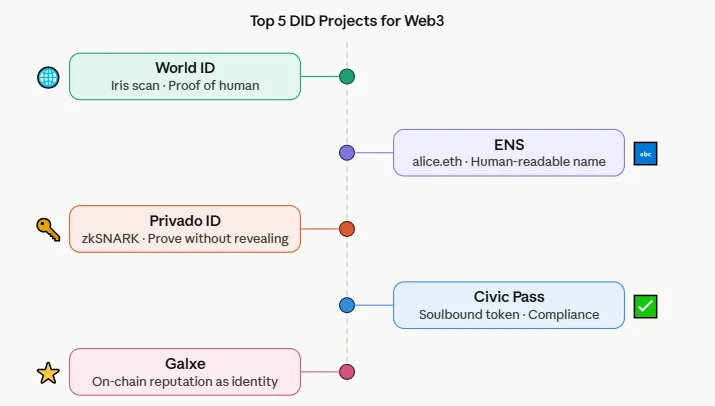
These best DID projects don’t really compete with each other. They each solve a different piece of the same larger problem:
- World ID: Are you a real human?
- ENS: What’s your name and identity in Web3?
- Privado ID: Can you prove your credentials without exposing them?
- Civic Pass: Are you verified and legally compliant?
- Galxe: What does your on-chain history say about you?
Together, these Web3 identity projects form a complete stack. A user could carry an ENS name, a Civic Pass for compliance, private credentials from Privado ID, a behavioral profile from Galxe, and a World ID confirming they’re human. That’s what a full decentralized identity looks like in practice.
Web3 identity projects are building the next layer of trust
The theory phase is over. These projects are live, they’re being built on, and they’re handling real problems that centralized systems spent years ignoring or making worse.
Replacing “log in with Google” won’t be a single moment. It’ll be a gradual shift as more platforms quietly swap out the old infrastructure for something users actually own. That process has already started.