

At a time when crypto is still searching for its most meaningful real-world applications, Solstice Finance is betting on one idea: yield shouldn’t be a privilege reserved for institutions; it should be accessible to everyone.
Solstice Finance stands at the forefront of decentralized finance (DeFi), challenging the traditional financial system by offering retail users universal access to institutional-grade yield strategies with zero management or swap fees.
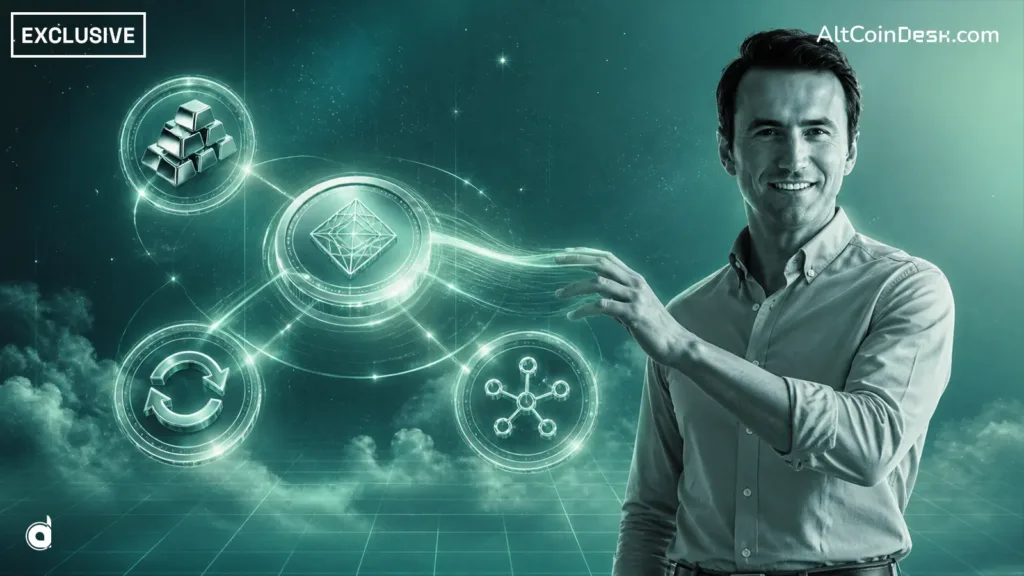
In an interview, Solstice Finance Co-founder Ben Nadareski joins AltCoinDesk to describe the company’s journey and vision, emphasizing a shift from building back offices for traditional finance (TradFi) to championing DeFi’s value proposition of universal participation.
A journey to Wall Street from physics
Nadareski joined the crypto space in 2013. But he wasn’t always so focused on building the institutional narrative of crypto.
“I started my career in physics, then moved to Wall Street, and eventually applied that experience to what I saw as the future of finance, building a new financial system on digital asset infrastructure.”
Ben Nadareski
He worked in several companies, including R3, Consensus, Six Digital Exchange, Galaxy Digital, and other leading institutional crypto efforts globally. Meanwhile, in the background, he was working on hundreds of DeFi projects across multiple different L1’s.
“This was a focus point that I said, okay, if we really want cryptos to succeed, then we need to get the institutions trading that,” he added.
Before finance, he worked in physics labs as a nuclear physicist, spending time on particle accelerators. “It was a fascinating world,” he exclaimed.
What stayed with him was the analytical approach, breaking things down to the smallest level to understand how they work. They would analyze everything from biological samples to radioactive materials in detail. That same mindset is what he carried in his journey with Solstice. Their vision is breaking down financial systems and yield generation to rebuild them more efficiently.
The protocol is designed to allow individuals, regardless of capital size, from millions down to $5, to participate in leading strategies that were once exclusive to institutions.
Tokenized yield vs traditional finance
Traditional finance has been known to rely largely on intermediaries such as banks, hedge funds, and asset managers while controlling access to high-quality yield strategies. They also experienced barriers to entry, such as the capital requirements, accreditation, and limited access.
Nadareski explains how Solstice Finance is different here. Their approach is simply that anyone, whether they have millions or just a few dollars, should be able to access institutional-grade strategies.
The company used a delta-neutral strategy to enable users to access yield without taking market risk. As the strategy generates returns, the token reflects that value which benefits users by giving them control and choice over how they generate yield.
“It’s all about making sure the user has a wide option of taking their yield back in whatever risk format that they believe is appropriate for them,” Nadareski added.
Regulations that shape the space
The Clarity Act and the Genius Act are really important because they’ve set up rules that change how people use crypto and how crypto companies operate. It determines whether users can access these systems globally.
In the US, regulators have done well in defining stablecoins and moving toward classifying digital assets as commodities. However, the challenges revolve around the yield-bearing stablecoins. To put it simply, banks aren’t resisting them because they’re risky, but because they work. They would disrupt the traditional savings model.
Banks profit by using customer capital while offering very low returns. Yield-bearing stablecoins challenge that very model. One question seemed to need an opinion over the others. Is it fair to say banks are prejudging this system because it threatens their model?
To which Nadareski opined that,” in some ways, yes—but we also have to remember that most of the world still relies on traditional banking.” That system needs stability.
The real disruption comes from challenging basic assumptions—like why a savings account offers 0.01% while banks generate much higher returns using that same capital.
DeFi offers more transparency, verifiability, and accessibility. The question is: why wouldn’t we move toward that?
Institutional adoption and what is slowing them down
AltCoinDesk curiously asked about What’s the minimum change institutions need to move on-chain?
He broke it down to three things
- Custody transparency – where assets are held and whether they’re verifiable
- Yield transparency – how returns are generated
- Security – strong, institutional-grade risk controls
In traditional finance, you often send money to an account and get limited updates. However, in DeFi, everything can be verified on-chain in real time. But security and due diligence are critical as the space still requires expertise.
Partnerships & stablecoin strategy with Paxos and USDG
Nadareski said that they integrated USDG as collateral for their stablecoin, USX. What’s unique about Paxos is that they redistribute a large portion of yield, around 97% back to users. This makes them different from models like USDT or USDC, where yield stays with the issuer.
“We see this as the next evolution: not just holding stablecoins, but putting them to work,” he added.
DeFi composability & Kamino
The company introduced Kamino into its ecosystem with one agenda- increasing utility. Because tokenization isn’t just about ownership but about its utility. Once assets are on-chain, users can do more with them, including lending, borrowing, and optimizing yield.
Kamino enables that composability. It turns assets into building blocks for further financial activity. That is something traditional finance doesn’t offer.
The next question was on how they would educate users, bringing them into DeFi.
“We focus on transparency, clear explanations of strategies, risks, and how the system works,” he said. However, user adoption also depends on institutional trust. Once institutions enter and scale, retail users follow.
Education is critical, people need to understand where their yield comes from and how their capital is used.
AI’s role in the future of crypto
AI and blockchain have been working towards creating autonomous financial systems where AI provides the decision-making layer, and blockchain provides the transparent execution and data layer.
Solstice Finance is also proactively building its system with AI being integral in many aspects of its services. “We’re moving toward agentic allocators, AI systems that allocate capital automatically,” the co-founder said.
These agents will analyze yield strategies and deploy funds efficiently. For that to work, platforms like Solstice need to be transparent, readable, and accessible to AI systems.
However, the risk of Agentic AI acting independently has been on the rise. Nadareski said that the company is not at sentient AI, yet. However, most issues concerning AI come from poor design, not autonomy, according to him.
“AI systems follow the rules they’re given. If something goes wrong, it’s usually because of flawed instructions—not independent decision-making.” he said.
Crypto for anyone and everyone
Lastly, the interview concluded on a note about a potential future where crypto didn’t exist. We asked him if crypto disappeared, what would he do?
“I’d go back to physics. Understanding the universe is one of the most fascinating things you can do,” he said.
Moving forward, the path to widespread adoption, particularly by institutions, requires critical elements of trust: custody transparency, yield transparency, and institutional-grade security controls. However, Nadareski believes that he carries his previous career in his journey through crypto, too.
“So, I’m not going to say crypto is ever going to die. It’s just going to get stronger,” he reassured his audience.
But he says there’s a guy who built a ham radio and, through wavelengths of translated binary, transacted Bitcoin from one ham radio to another without internet. So, it will always be possible.