
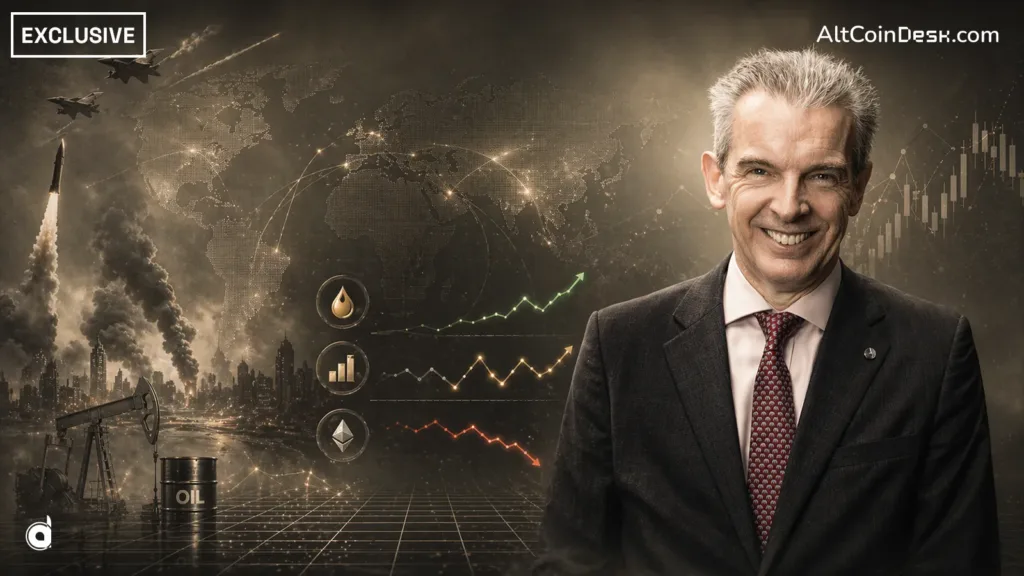

Global markets are once again navigating a period of intense geopolitical uncertainty, impacting the Middle East and sending ripples across asset classes. As we see the influence of this global stress in everything from oil to equities and crypto, investors are still assessing the outlook. For veteran market analyst Michael Hewson, however, such volatility is nothing new.
With over three decades of experience, Hewson’s approach to trading has been shaped not by calm markets but by chaos and volatility.
Crisis-driven markets demand flexibility, not herd thinking, says Hewson
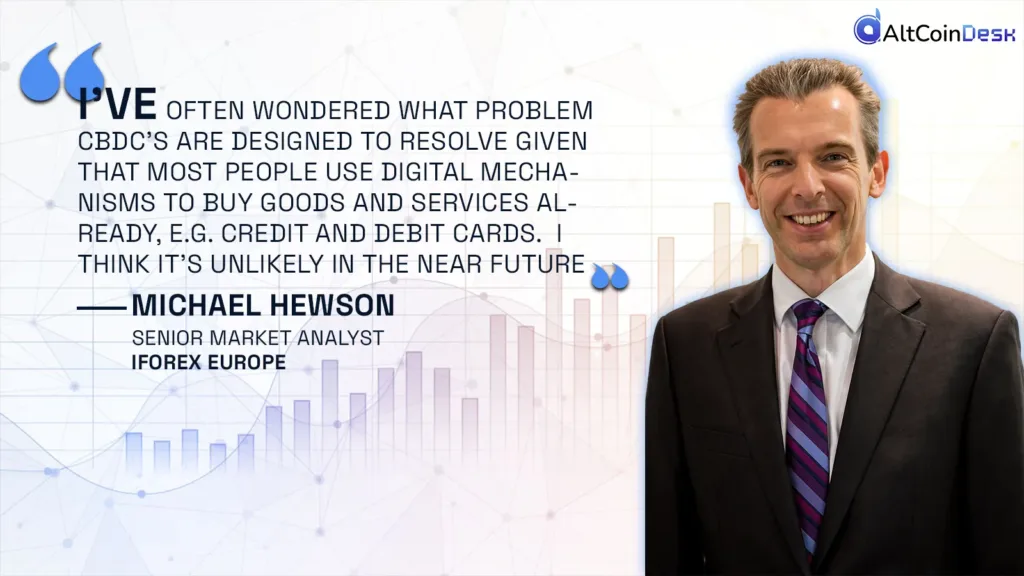
Joining the desk of discussion at AltCoinDesk, Hewson speaks with over 16 years of experience as Chief Market Analyst at CMC Markets, and his deep expertise is rooted in both technical and fundamental analysis.
Hewson points to major historical disruptions as an important step in shaping his trading philosophy. According to him, the first thing in trading that one must stay prepared to face is the ability to be flexible in their approach to unfolding events. Stepping away from the herd mentality, as he says it.
A crisis with lasting consequences
Despite the many crises that the Middle East region has seen and faced, the current effects seem to have a more lasting impact, rippling out for years to come.
Unlike the earlier crises that the world has witnessed, such as the Iran-Iraq War or Iraq’s invasion of Kuwait, which saw relatively contained economic fallout, Hewson believes the current situation may reshape global systems more fundamentally.
“This crisis has already done long-lasting damage to the global economy,” he explained, indicating risks to food production, energy flows, and even AI-related supply chains following attacks on Qatari infrastructure at Ras Laffan.
“It will also reshape supply chains as countries and corporations shift their axis away from the Persian Gulf in an attempt to make their supply chains more resilient,” he added.
Crypto can be a hedge or a high-risk asset, what defines the role?
Crypto has shown increasing strength to withstand the stress and volatility of the market during a crisis. However, trying to predict the role of cryptocurrencies amid the stress is hard enough at the best of times.
At varying times in the years gone, there are instances where it was viewed as a substitute for gold, or an inflation hedge as well as a risk asset in its own right.
Hewson pointed out, “based on its behaviour over the past 12 months, I would say crypto is more of a risk asset in its own right than any of the other two. A year ago, Bitcoin was trading just above $80k and since then has been as high as $125k and as low as $60k.”
In turbulent markets, liquidity drives investors
When identifying which aspect of crypto seems more resilient to further escalation, it is interesting to note two segments, as neither one is more resilient than the other during geopolitical escalation.
However, investors tend to gravitate towards highly liquid assets like Bitcoin and Ethereum for their ability to absorb market stress while smaller or less liquid tokens, including privacy-focused coins, are typically more exposed to volatility and liquidity risks during uncertainties in the ecosystem.
Impact of Iran’s conflict on crypto mining
Iran is known for its high volume of illegal crypto mining activities, contributing to the digital financial ecosystem worth over $7.8 billion, according to reports. The recent happenings have made mining pricier, even pushing smaller miners to closure.
Hewson said, “the damage to Iranian infrastructure has impacted the operations of local operators. More globally, the crypto network has been more resilient even as mining costs have increased.”
While some countries may explore crypto as a workaround for cross-border payments, widespread adoption remains a distant prospect.
The US dollar continues to dominate global trade due to its stability, liquidity, and ease of settlement, seen as proven advantages that neither the euro, the yuan, nor cryptocurrencies have fully matched.
Although digital assets can offer an alternative in situations where access to the dollar is restricted, their volatility remains a major barrier to practical use in trade.
The price volatility seen over the previous years underscores the counterparty risk associated with assets like Bitcoin; their rapidly fluctuating value makes them an unreliable basis for payments.
However, according to Hewson, “the main downside as far as crypto is concerned is its volatility, and the last 12 months have proved that.”
“Why would you pay for something in bitcoin only for it to halve in value in the space of a few months?” he added.
The Iranian government has been reportedly considering charging the ships with cryptocurrency for the safe passage through the Strait of Hormuz. The decision led to the market showing much excitement, jumping slightly according to reports by the Financial Times.
AltCoinDesk asked him if the use of crypto for trade in Iran, specifically for the passage of the Strait of Hormuz, has been a sign of growing mainstream adoption or the repercussions of the downfall of the Iranian rial.
“I would suggest that it is the latter, with Rial becoming ever more devalued, however there has also been talk of Iran demanding payments in Yuan as well,” he said.
Hewson clarified that the efforts to make crypto mainstream have been ongoing since the start of 2020 when institutional investors started to get involved, and regulatory authorities like the SEC started to approve the use of Bitcoin and Ether ETFs in 2024.
Hence, Iran demanding BTC is merely an attempt to break free from the shackles of the US dollar, in his opinion. Serving his role at iFOREX, Hewson has been contributing to the market analysis for clients globally.
Michael’s journey, a timeline to trade
Describing his journey in the financial market, he mentions how trade has changed in the past 30 years.
In his own words, he exclaims, “there wasn’t really a retail trading environment in the 1990s, when I first traded iForex and what there was would have had huge spreads for all of the major currencies.”
Even in the 2000s, forex trading wasn’t as mainstream as it is now. According to him, nowadays the retail traders seem spoiled for choice in terms of the brokers they can use, as well as spreads that are extremely tight.
However, 2026 sees the forex market heavily influenced by geopolitical tensions, especially with USD reportedly gaining on safe-haven demand amid rising U.S.-Iran conflict.
In Hewson’s view, markets entering 2026 are increasingly defined by geopolitical risk rather than pure economic cycles, suggesting that crypto remains highly speculative and should be treated as such.